 Mount Vernon
 Why Anacortes Homes Are Harder on Windows Than Most
Anacortes sits out on Fidalgo Island, surrounded by saltwater on nearly every side, and that location shapes what a window has to survive. It's not just Skagit County rain — it's rain pushed sideways by wind coming off open water, salt-laden air that finds every piece of unprotected metal, and a long stretch of the year when moisture just sits against the house instead of drying off. A window that would be fine in a drier inland town can start failing early out here if it wasn't built and installed with those conditions in mind.
Salt air and hardware corrosion
Salt in the air settles on window frames, screen hardware, hinges, and fasteners. Over time it accelerates corrosion on anything that isn't rated for it — pitted aluminum tracks, rusted screws, cloudy or pitted glass coatings near the coast are all things we see on older installations. It doesn't happen overnight, but it happens faster here than in most of the state.
Wind-driven rain
Rain that falls straight down is easy to shed. Rain that's being driven sideways by wind off the strait finds its way into gaps that would otherwise never see water — under trim, behind flashing, along the top corners of a window frame. This is where most leaks actually start, and it's why the installation details matter more here than the window brand does.
A long moss and moisture season
Skagit County's mild, wet stretch of the year runs long. Anything that traps moisture against wood trim or sits in constant shade grows moss and algae, and that organic growth holds water against the building even longer. Around windows specifically, this shows up as soft trim, staining below the sill, and tracks that never fully dry out between rains.
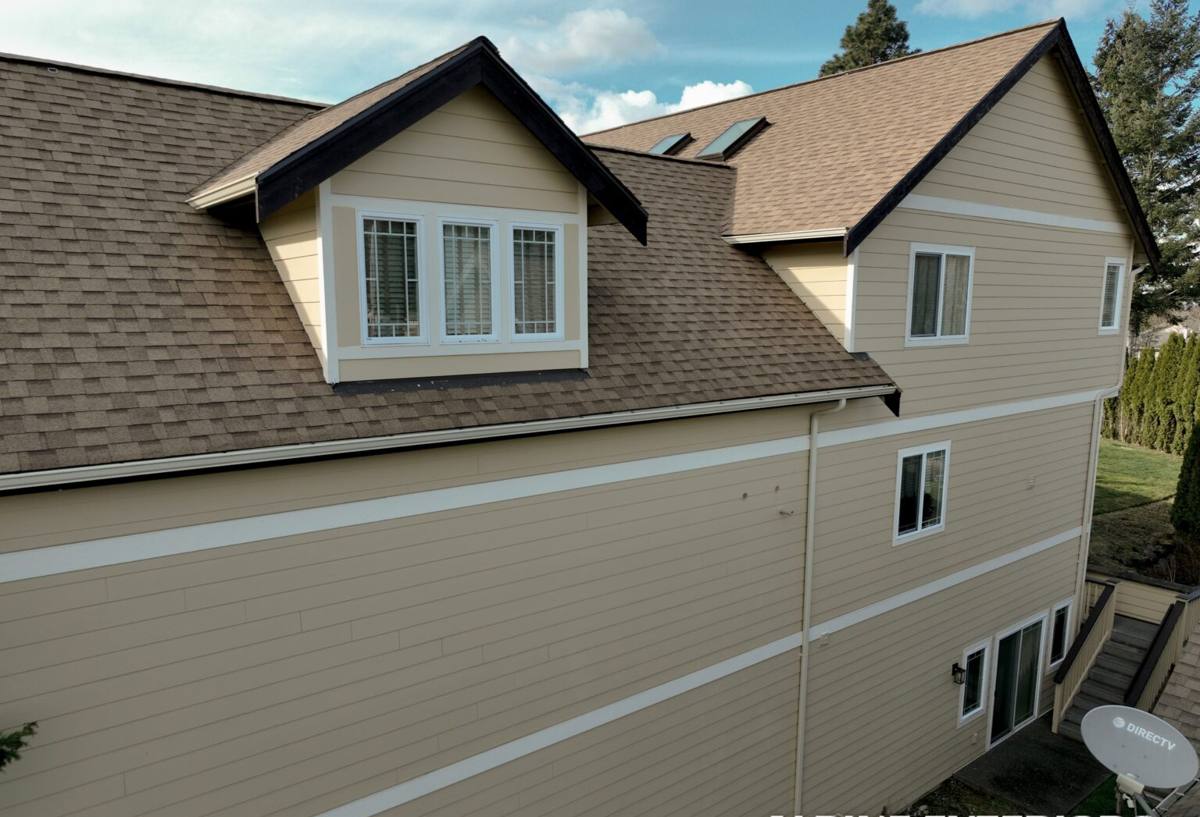
Signs Your Current Windows Are Losing the Fight
- Fogging or a milky haze between the panes — the seal has failed and the insulating gas is gone
- Soft or discolored trim and sills, especially on walls that face the weather
- Visible staining or a musty smell in the wall below a window after heavy rain
- Windows that are noticeably harder to open, close, or lock than they used to be
- Noticeable drafts or a cold wall around the frame even with the window shut
- Corrosion or white powdery buildup on aluminum tracks and hardware
Any one of these on its own might just mean a window needs attention. Several at once, especially on the weather-facing side of the house, usually means water has been getting behind the frame for a while.
What a Correct Installation Actually Involves
The window itself matters less than most homeowners assume. What actually determines whether a window leaks in five years is how it's flashed, sealed, and tied into the wall around it. This is the part that's easy to rush and hard to inspect once the trim is back on — which is exactly why it's worth understanding before you hire anyone.
Flashing and drainage, not just caulk
A correct install builds a drainage path so any water that does get past the exterior finish has somewhere to go besides into your wall. That means integrating the window with the weather-resistive barrier in the right shingle-lap order, using a proper head flashing or drip cap above the window, and never relying on a bead of caulk to do a flashing detail's job. Caulk fails. Flashing that's lapped correctly still works after the caulk is gone.
Sill pans and back dams
At the bottom of the opening, a sloped sill pan with a back dam keeps any water that reaches the sill from running back into the house and instead directs it back outside. This is one of the most commonly skipped details on lower-cost installs, and it's one of the most important ones in a climate that gets driving rain as often as this one does.
Insulation and air sealing around the frame
The gap between the window frame and the rough opening needs to be filled with a proper low-expansion foam or backer rod and sealant — not stuffed with fiberglass batting, which does nothing to stop air movement and can actually hold moisture against the frame. Done right, this step is also what keeps the window from feeling drafty in a windstorm.
Choosing a Window Material for a Coastal Skagit County Home
There's no single "best" window material — there's a best fit for your house, your budget, and how much maintenance you want to take on. For homes exposed to salt air and constant moisture, the trade-offs below matter more than they would further inland.
| Material | How it handles salt air & moisture | Maintenance | Typical trade-off |
|---|---|---|---|
| Vinyl | Good — won't rust or corrode, some color fade over time in direct sun | Low | Most affordable; frame can't be repainted a new color |
| Fiberglass | Very good — dimensionally stable, resists moisture and corrosion well | Low | Higher upfront cost than vinyl |
| Aluminum | Poor without marine-grade coatings — prone to pitting and corrosion near the coast | Moderate to high | Strong and slim sightlines, but a maintenance liability in this climate |
| Wood-clad | Depends entirely on cladding quality and installation; wood core is vulnerable if water gets behind it | Highest | Best interior appearance, but the least forgiving of a flawed install here |
We don't install bare aluminum or unclad wood on weather-exposed elevations in this area as a matter of our own standard — not because those materials are inherently bad, but because they demand a level of ongoing upkeep and installation precision that doesn't hold up well against salt air and driving rain without real commitment from the homeowner.
New Construction vs. Retrofit Replacement
There are two basic ways to replace a window, and the right choice depends on the condition of what's already there.
A retrofit, or "pocket," replacement drops a new window frame into the existing opening and trim, which is faster and less invasive — a reasonable option when the surrounding frame and sheathing are still sound. A full-frame, new-construction-style replacement removes the old unit down to the rough opening, which costs more and takes longer but is the only way to actually inspect and fix what's behind the window — critical when there's been any sign of past water intrusion. On a coastal, older home, we'd rather tell you honestly that a retrofit isn't the right call than install one over hidden rot and have it fail again in a few years.
Our Process, Start to Finish
- On-site assessment of each window opening, including a check for existing moisture damage before we quote anything
- Written estimate covering material, labor, and any framing or trim repair the openings actually need
- Ordering the windows to the exact opening sizes, not stock sizes that get shimmed to fit
- Removing the old unit and inspecting the rough opening and sheathing before anything new goes in
- Repairing any rot or damaged framing found at that stage — this gets flagged and discussed with you, never assumed
- Installing flashing, sill pan, and the new window per the sequence above, then air-sealing and insulating the gap
- Trim work, exterior sealant, and a final operational check on every window installed
- Cleanup and a walkthrough so you can see and test the finished work before we consider the job done
What Actually Drives the Cost
Every quote is different, but the factors below are what typically move the price up or down more than the window brand does.
| Factor | Why it matters |
|---|---|
| Retrofit vs. full-frame replacement | Full-frame costs more but is sometimes the only responsible option |
| Hidden rot or water damage found during removal | Repair work is priced separately once it's actually visible |
| Window material and glass package | Fiberglass and upgraded low-E glass cost more than base vinyl |
| Number and size of openings | Larger openings and specialty shapes take more time and material |
| Access and site conditions | Second-story or hard-to-reach windows take longer to stage and finish safely |
We'd rather walk your specific windows and give you real numbers than quote a broad range that doesn't mean much for your house.
Why a Crew That Already Works in Anacortes Matters
A lot of window problems on this island trace back to installers who treat it like any other job site. Flashing sequences that work fine in a drier inland town aren't enough here, and a crew that hasn't dealt with wind-driven rain off the water may not think to add the extra protection a west- or north-facing wall actually needs. Working out of Mount Vernon, we're in Anacortes regularly enough to know which parts of the county take the worst weather, and close enough that if something needs a warranty callback, it's not a special trip. That local familiarity shows up in the details — how we flash a west-facing wall, how much we insist on a full-frame replacement instead of a quick pocket fix, and being upfront when a window issue is really a bigger moisture problem behind the siding.
Protecting Your New Windows Season to Season
- Rinse salt residue off frames and hardware a few times a year, especially after storms
- Keep window tracks and weep holes clear of dirt, moss, and debris so water can actually drain
- Check exterior caulk lines annually and have any cracked or missing sealant redone before winter
- Trim back vegetation that keeps a window or its trim in constant shade and dampness
- Operate every window a few times a year, even ones you rarely open, so hardware doesn't seize up
- Watch for soft trim or fresh staining after the wettest months and address it early
New windows installed correctly should need very little from you beyond this. If you're doing more than basic upkeep and still seeing problems, that's usually a sign the install — not the window — is the issue.
If you're dealing with drafty, fogged, or leaking windows in Anacortes, or you're planning ahead before the next wet season, we're happy to take a look and give you a straightforward, no-pressure estimate — just fill out the form below.