 Mount Vernon
 Two Very Different Materials, Often Sold as Interchangeable
Homeowners in Mount Vernon shopping for new siding usually end up comparing two categories: fiber cement and engineered wood. Both are marketed as upgrades over vinyl, both come primed or factory-finished, and both look good on a sales sheet. But they are not the same product wearing different labels. One is a cement-based composite. The other is a wood product — real wood fiber, pressed and resin-treated, but wood all the same. That single difference in composition drives almost everything else: how each holds up to Skagit County's wet winters, how each ages, what each costs to maintain, and what kind of warranty a manufacturer is willing to stand behind.
We install only James Hardie fiber cement siding. We don't install engineered wood products like LP SmartSide, and we think homeowners deserve a straight answer about why — not a marketing pitch, just the trade-offs that led us to standardize on one material.
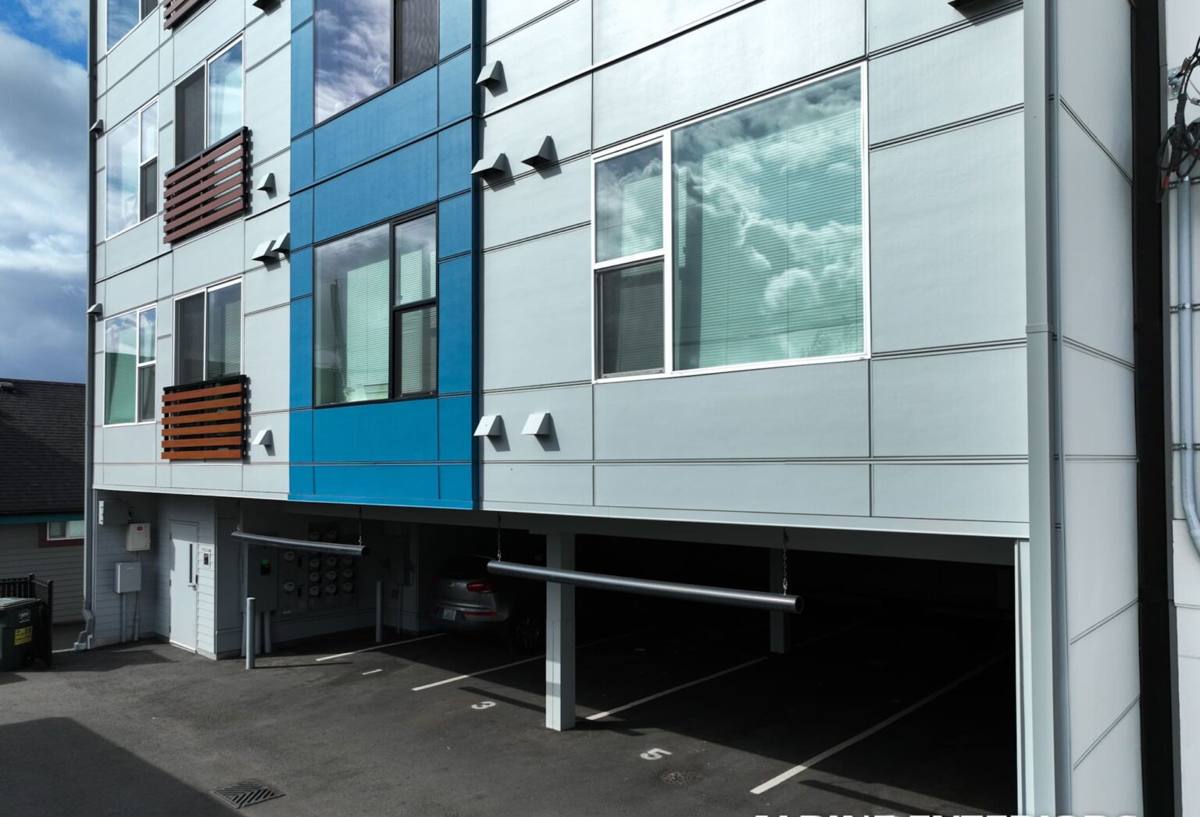
What Each Product Actually Is
Fiber Cement
Fiber cement siding is made from Portland cement, sand, and cellulose fiber, cured under pressure into dense, stable boards. There's no wood grain to rot, no OSB core to swell, and nothing in the board itself that feeds fungus or insects. It's heavy, rigid, and dimensionally stable across temperature and moisture swings.
Engineered Wood
Engineered wood siding starts as strand board — wood fibers bonded with resin under heat and pressure, similar in principle to the OSB used for roof and wall sheathing, but manufactured to a tighter spec and treated with zinc borate for insect and fungal resistance. It's lighter than fiber cement, easier to cut, and holds paint well when new. It is still, at its core, a wood product with an engineered shell protecting a wood interior.
Why Moisture Behavior Is the Real Dividing Line
Mount Vernon sits close enough to Puget Sound and Skagit Bay that salt air is a routine part of the exterior environment, not an occasional coastal storm event. Combine that with the driving rain that comes off the Sound most winters and a moss season that can stretch from October into May, and you have a climate that tests every seam, cut edge, and joint in a siding system harder than most of the country ever will.
Fiber cement doesn't absorb water into its structure the way wood does. A board that gets rained on, splashed by a sprinkler, or shaded under moss for months doesn't swell, and it doesn't feed rot at the cut edges. Engineered wood siding is manufactured to resist moisture far better than untreated lumber, and modern resin binders and edge seals have closed a lot of the gaps that gave early wood-composite products a bad name in the 1990s. But the vulnerability hasn't been eliminated — it's been managed. Every cut edge, nail penetration, and butt joint is a place where the factory seal is broken and raw engineered wood is exposed. In a dry climate, that's a minor detail. In Skagit County, where siding can stay damp for days at a stretch during the rainy months and moss holds moisture directly against the wall, those exposed edges are exactly where problems start.
What Moss Season Adds to the Equation
Moss doesn't just grow on roofs here — it colonizes north-facing walls, fence lines, and shaded siding runs too. Moss holds moisture against whatever it's growing on for weeks at a time. On fiber cement, that's a cosmetic issue you can wash off. On any wood-based product, sustained damp contact at an unsealed edge is the kind of chronic exposure that shortens the life of the material, even when the surface finish is holding up fine.
Fire Performance
Fiber cement is non-combustible — it won't ignite, and it doesn't contribute fuel to a fire moving across a wall or through eaves. Engineered wood siding, even with fire-retardant treatment, is still a wood product and carries a combustibility rating that fiber cement doesn't. This matters less in downtown Mount Vernon than it does for homes near wildland-urban interface areas around Skagit County, but it's a real, unglamorous difference between the two materials that we think homeowners should know rather than discover later through an insurance conversation.
Factory Finish and How It Ages
James Hardie's ColorPlus finish is baked on at the factory in multiple coats, under controlled conditions, before the board ever reaches a job site. It's engineered specifically to resist fading, chipping, and cracking, and it carries its own finish warranty separate from the substrate warranty. Engineered wood products are also typically factory-primed or factory-finished now, which is a big improvement over field-painted wood siding of decades past. The difference shows up over time: fiber cement's cement-based substrate doesn't expand and contract with moisture the way a wood substrate can, so the finish sits on a more stable surface and tends to hold its coating longer with less chalking and cracking at seams.
Installation Sensitivity
Both products are more installation-sensitive than vinyl, but in different ways.
- Fiber cement requires correct fastener spacing, proper clearance from grade and hard surfaces, and factory-finish touch-up at cuts — miss these and you invalidate warranty coverage, but the material itself doesn't punish small gaps the way wood does.
- Engineered wood requires every cut edge, joint, and penetration to be sealed with the manufacturer-specified sealant, every time, with no exceptions — because those are the exact points where moisture gets past the engineered shell into the wood core.
- Both require the installer to follow manufacturer flashing and clearance details specific to a wet coastal climate, not generic national guidelines.
- Both come with published installation manuals that most warranty denials trace back to — installed wrong, either product can fail early; installed right, both are built to last decades.
The practical difference is margin for error. Fiber cement gives you more of it. In a market where crews turn over, subcontractors get swapped mid-project, and not every installer treats the manual as gospel, that margin matters.
Warranty and Long-Term Cost
| Factor | James Hardie Fiber Cement | Engineered Wood |
|---|---|---|
| Substrate warranty (typical) | 30-year limited, transferable | Commonly 5-year to lifetime limited, terms vary by manufacturer and often prorate after early years |
| Finish warranty | Separate ColorPlus finish warranty, factory-applied | Varies; some lines include a finish warranty, others rely on field-applied paint maintenance |
| Repainting cycle | Rarely needed if ColorPlus finish is intact; longer intervals when it is | Field-painted or touch-up areas typically need repainting sooner, especially at high-moisture exposures |
| Combustibility | Non-combustible | Combustible, fire-retardant treated |
| Weight / handling | Heavier, requires more crew and equipment on-site | Lighter, faster to handle and cut |
| Upfront material cost | Generally higher | Generally lower to moderate |
The upfront cost gap is real and we won't pretend otherwise — engineered wood is usually the less expensive material to buy and install. The question we ask homeowners to weigh is what that gap buys back over 20-30 years in a climate like ours: fewer maintenance calls, no edge-sealing upkeep, a warranty that doesn't depend on a homeowner keeping up with caulk touch-ups, and a non-combustible wall assembly.
Why We Standardized on Hardie
We used to install a broader mix of siding products. We narrowed to James Hardie fiber cement exclusively because it gave our crews one system to master, our customers one warranty structure to understand, and our callbacks a consistent, low rate driven by moisture-related issues in this climate specifically — not because Hardie is the only decent product on the market. James Hardie's HZ5 product line is engineered for climates with exactly the freeze-thaw, humidity, and moisture exposure Skagit County sees. Between the non-combustible substrate, the factory ColorPlus finish, and a 30-year transferable warranty, it's the product we're comfortable standing behind on a home that has to face down Puget Sound weather for the next three decades, not just the next three years.
Questions to Ask Any Contractor, Regardless of Product
- Is the substrate warranty transferable if you sell the home?
- Does the finish carry its own warranty, or does it rely on you repainting on a schedule?
- What sealant or edge treatment does the manufacturer require at every cut, and will it be documented on your job?
- How does the manufacturer's install manual handle clearance from grade, decks, and roof lines — details that matter more in a wet coastal climate?
- Is the crew factory-trained or certified on the specific product they're installing, or is this the first time they've worked with it?
- What's the manufacturer's stated combustibility rating, and does that matter for your insurance or location?
If you're weighing fiber cement against engineered wood for a home in Mount Vernon or anywhere else in Skagit County, we're glad to walk through what we see on both products locally and give you a straight read on what your specific home and exposure call for. Reach out for a free, no-pressure estimate — there's a form below.