 Mount Vernon
 A One-Product Decision, Made on Purpose
Most siding contractors carry a catalog: vinyl for the budget-minded, LP SmartSide for a wood look at a lower price, fiber cement for the customers who ask for it by name. We don't. Every siding job we take on in Mount Vernon and the rest of Skagit County goes on the house as James Hardie fiber cement, full stop. No vinyl, no engineered wood, no primed spruce, no cedar.
That's not a marketing angle. It's a standard we set after years of doing tear-offs and repair calls on every kind of siding sold in this region, and watching which products held up to the specific punishment a house takes here — salt-laden air off the Sound and the Skagit River delta, driving rain that comes in sideways for months at a stretch, and a moss and algae season that runs longer than most of the country ever deals with. Narrowing to one product line let us get genuinely good at installing it correctly, instead of being average at five different systems.
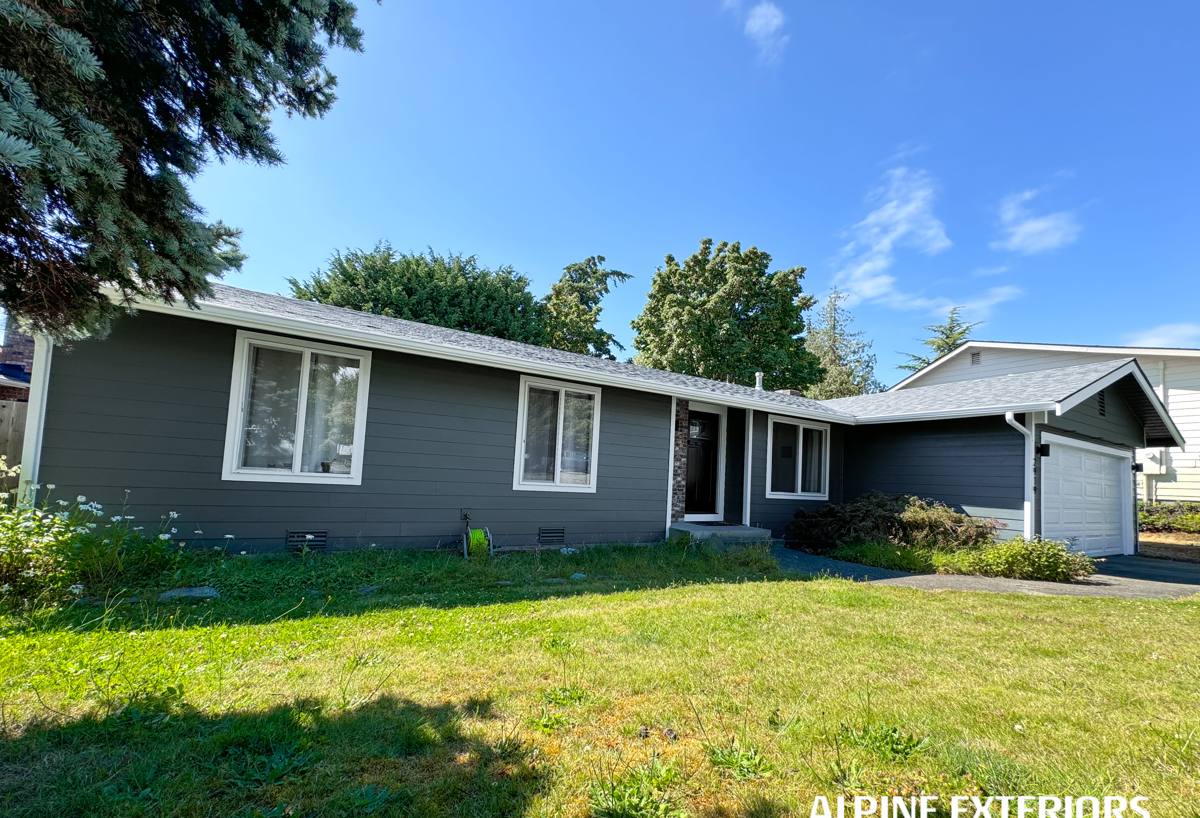
What James Hardie Fiber Cement Actually Is
Fiber cement siding is a blend of Portland cement, sand, and cellulose fiber, cured and formed into planks, panels, and trim. It is not plastic, and it is not wood — it doesn't have the thermal expansion problems of vinyl or the organic material that gives wood-based products something to feed on when they get wet and stay wet.
The two properties that matter most for a house in this climate are dimensional stability and non-combustibility. Fiber cement doesn't swell, cup, or warp with moisture cycling the way engineered wood can, and it carries a noncombustible rating that matters more every year as wildfire smoke seasons creep further into the Pacific Northwest, even for a wet-side county like ours.
Why This Matters More Here Than in Drier Climates
A siding product's weak points show up fastest wherever the local climate stresses them hardest. In Skagit County that means constant moisture exposure, not occasional storms. A product that performs fine in Spokane's dry summers and cold winters can behave very differently after a decade of Mount Vernon's wet season, and that's the gap we stopped being willing to install around.
Salt Air, Driving Rain, and Moss: What Local Weather Does to Siding
Mount Vernon sits close enough to Puget Sound and the Skagit River delta that salt-laden air is a real factor on fasteners, trim, and any exposed metal flashing. Add driving rain that hits siding at an angle instead of falling straight down, and you get sustained wetting on wall surfaces that drier regions simply don't experience. Then there's moss — Skagit County's moss and algae season runs long, and any siding material with texture or porosity gives it somewhere to establish and hold moisture against the wall.
None of this destroys siding overnight. It's a slow, cumulative process: fastener corrosion, seam failure, moisture wicking into edges and end cuts, and finish breakdown from UV and damp cycling. The products that survive it long-term are the ones engineered specifically for this kind of exposure, not general-purpose siding rated for an average of every climate in the country.
The HardieZone HZ5 Engineering
James Hardie doesn't sell one universal product — it engineers its formulations by climate zone under what it calls the HardieZone system, and the Pacific Northwest falls under HZ5, the wet-climate formulation. HZ5 products are engineered against moisture damage and are backed by an extended warranty specifically because the company rates this region as one where fiber cement gets tested the hardest.
This is one of the practical reasons we standardized on Hardie over other fiber cement or engineered wood competitors: buying a product that was formulated for a dry-climate zone and installing it in Skagit County means fighting the product's own engineering, not working with it.
Product Lines We Install
- HardiePlank lap siding — the most common product on Mount Vernon homes, available in several plank widths and surface textures (smooth, cedarmill, beaded)
- HardiePanel vertical siding — used for modern facades, gable accents, and board-and-batten looks
- HardieTrim boards — corner boards, window and door trim, and fascia that match the siding's durability instead of mixing in a wood trim that ages differently
- HardieShingle — for homes where a shingle or shake profile is the right architectural fit, without the maintenance burden of real cedar shakes
ColorPlus Factory Finish vs. Field Painting
Every fiber cement product can be painted on site after installation, and some homeowners assume that's simply how it's done. We push customers toward Hardie's ColorPlus finish instead, and it's worth explaining why.
ColorPlus is a multi-coat finish baked onto the plank at the factory under controlled conditions, with a bond that field-applied paint can't fully replicate. It resists fading, chipping, and the color mismatch that shows up when touch-up paint from a different batch or a different year doesn't quite match the original. In a region with as much sustained damp weather as Skagit County, a factory-cured finish also sheds water and resists mildew growth better than site-applied paint that hasn't had the same cure time or environment.
Field-painted siding isn't wrong — it's a legitimate option, and some architectural situations call for it, particularly custom colors or trim details. But for the bulk of a home's field siding, ColorPlus is the better long-term investment, and it's what we recommend by default.
Warranty Structure That Actually Transfers
James Hardie backs its siding with a non-prorated limited warranty — 30 years on most HZ5 lap and panel products — and ColorPlus finishes carry their own separate finish warranty covering fading and peeling. The detail that matters most to homeowners planning to sell within a decade or two: Hardie's warranty is transferable to a subsequent owner, which is a real selling point when the house changes hands.
Warranty terms only protect a homeowner when installation follows the manufacturer's specifications exactly — clearances, fastener patterns, caulking practices, and flashing details all matter, because incorrect installation is the most common reason a warranty claim gets denied industry-wide, regardless of brand. That's a large part of why we treat installation training as seriously as we treat the material choice itself.
What Correct Installation Actually Involves
Fiber cement siding is more installation-sensitive than vinyl. It has to be cut, fastened, and flashed correctly, or the product's real-world performance won't match its engineering. A rushed or undertrained crew can put Hardie siding on a house and still end up with moisture problems within a few years — not because the product failed, but because the installation didn't follow spec.
- Correct nailing pattern and fastener type — no over-driven or under-driven nails, and corrosion-resistant fasteners appropriate for coastal-influenced air
- Proper minimum clearance from grade, roofing, decks, and other horizontal surfaces to keep planks out of standing moisture
- Weather-resistant barrier and flashing installed behind and around every penetration, window, and door before siding goes on
- Correctly sized gaps at butt joints and trim, sealed with a flexible, paintable sealant rated for exterior use
- Field-cut edges sealed or primed before installation, not left exposed to soak up moisture
- Panel and plank overlap that meets manufacturer minimums, not just "close enough"
How Hardie Compares to the Alternatives We Don't Install
| Material | Where It's Strong | Why We Don't Install It Here |
|---|---|---|
| Vinyl siding | Low upfront cost, low maintenance in dry climates | Seams and panel expansion behave poorly under sustained wet-dry cycling; limited impact and heat tolerance |
| LP SmartSide | Wood-grain appearance, easier field cutting | Engineered wood core is more moisture-sensitive at cut edges and seams over a long wet season |
| Cedar / primed spruce | Natural appearance, traditional look | Ongoing refinishing burden and higher susceptibility to moss, rot, and insect damage in constant damp conditions |
| James Hardie fiber cement | Non-combustible, HZ5-engineered, factory finish, transferable warranty | Higher installation sensitivity, requires trained crews and correct fastening/flashing |
Cost Factors Homeowners Should Understand
Fiber cement generally costs more upfront than vinyl and is comparable to or somewhat higher than engineered wood siding, depending on the product line and trim package chosen. A few factors drive the final number on any given house more than the base material price:
| Factor | Why It Moves the Price |
|---|---|
| Tear-off vs. new construction | Removing and disposing of old siding adds labor and disposal cost |
| House complexity | More corners, gables, and trim details mean more cutting, waste, and labor hours |
| Product line and texture | ColorPlus finishes and specialty profiles (shingle, board-and-batten) cost more than standard smooth lap |
| Underlying sheathing and moisture barrier condition | Rot or damaged sheathing discovered during tear-off needs repair before new siding goes on |
We give straightforward, itemized estimates rather than a single flat number, so homeowners can see what's driving the cost and where there's flexibility.
Questions Worth Asking Before You Hire Anyone
- Is the crew installing to the manufacturer's written specifications, or to "how we've always done it"?
- Will the installer register the warranty with the manufacturer, and is that documented in writing?
- What fastener type and pattern will be used, and is it appropriate for coastal-influenced air?
- How will clearances at grade, roofline, and deck ledgers be handled on your specific house?
- Is the quote itemized enough to show tear-off, repair, and material costs separately?
If you're weighing a siding replacement or repair in Mount Vernon or elsewhere in Skagit County, we're glad to walk your house, point out what we're actually seeing, and put together a free, no-pressure estimate — no obligation either way.