 Mount Vernon
 Burlington sits in the flat, fertile stretch of the Skagit Valley just north of Mount Vernon, close enough to Padilla Bay and the Puget Sound shoreline that salt-laden air is a regular part of the weather here, not an occasional visitor. Add in the long, gray stretch of driving rain that defines a Skagit County winter and the moss season that follows it into spring, and you've got an exterior environment that is genuinely tough on a house. Siding in Burlington doesn't fail because homeowners neglect it. It fails because it was never built for this climate in the first place.
We're a local exterior contractor working throughout Mount Vernon and the surrounding Skagit County communities, including Burlington, and we install one siding product: James Hardie fiber cement. That's not a marketing angle — it's a standard we hold because of what we've seen happen to other materials on homes in this exact weather pattern. Below is an honest look at what Burlington's climate does to a house, what we do about it, and why we've made the choices we've made.
What Burlington's Climate Actually Does to a House
Three things define the exterior environment here, and they compound each other.
Salt Air and Moisture Off the Water
Burlington isn't beachfront, but it's close enough to Padilla Bay and the broader Salish Sea that airborne salt and moisture reach homes here on a regular basis, especially with prevailing winds off the water. Salt-laden moisture accelerates corrosion on fasteners, trim, and any exposed metal, and it speeds up the breakdown of coatings and finishes that aren't engineered to handle it. Over years, siding that looked fine in a showroom starts chalking, fading, or lifting at the seams.
Driving Rain, Not Just Rain
Skagit Valley weather isn't gentle drizzle sitting politely on a wall. Winter storms push rain sideways, and wind-driven moisture finds every gap, seam, and fastener point a siding system has. A product that's only rated to shed water straight down will let water work its way behind the cladding on a windy Burlington afternoon — and once moisture gets behind siding, the real damage (rot, mold, sheathing decay) happens where you can't see it.
A Long Moss and Algae Season
The combination of persistent moisture, mild temperatures, and shaded lots common in the valley gives moss, algae, and mildew a long growing season on north-facing walls, under eaves, and anywhere airflow is limited. Some siding materials resist this better than others. Untreated wood-based products and some composite panels are particularly susceptible to green and black staining that's difficult to fully remove without damaging the surface underneath.
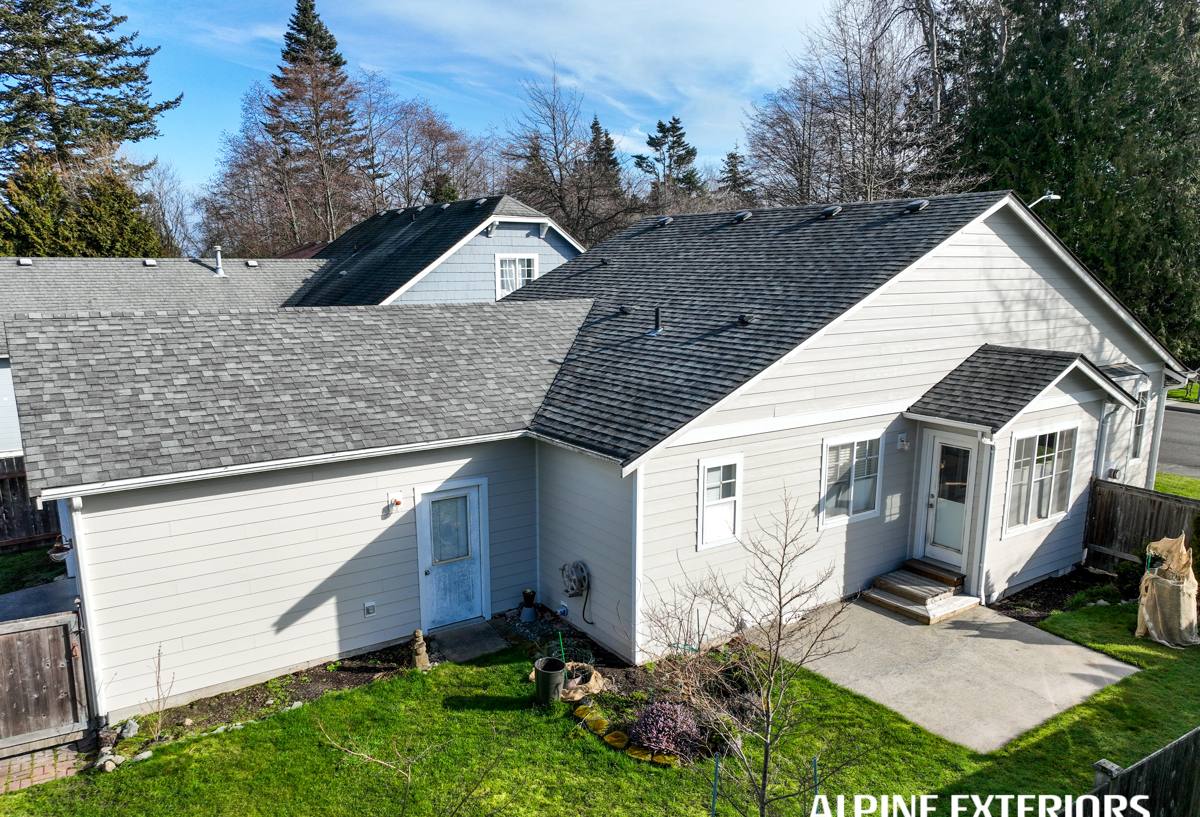
Why We Only Install James Hardie Fiber Cement
We get asked regularly why we don't offer vinyl, LP SmartSide, or the other engineered wood and composite products that show up in other contractors' bids. The honest answer is that we looked at how each of those materials performs over a 20-30 year window in a climate like this one, and we didn't like what we saw enough to put our name behind installing them.
- Vinyl siding is inexpensive and easy to install, and it has a place in some markets. But it's a petroleum-based product that expands, contracts, and can warp or crack in temperature swings, and it offers essentially no fire resistance. In a wind-driven rain event, vinyl's overlapping panel design is also more prone to water infiltration at the seams than a properly caulked and flashed fiber cement system.
- LP SmartSide and other engineered wood products use wood strand technology with a resin binder, which makes them lighter and easier to handle than fiber cement. The trade-off is that they're still wood at their core — if the factory coating is ever compromised (a nail pop, an unsealed cut edge, a hairline crack from impact), moisture can get into the substrate and cause swelling or rot from the inside out. In a climate with this much sustained moisture exposure, that's a real risk over the life of the product, and it's one we're not willing to take on for our clients.
- Cedar and primed wood siding can look beautiful, but they demand a maintenance commitment — regular re-staining or repainting, vigilant caulk inspection, and active moss management — that most homeowners underestimate until they're a decade in.
James Hardie fiber cement is cement, sand, and cellulose fiber — it doesn't rot, it isn't a food source for moss or mildew the way wood is, and it's non-combustible. Hardie's ColorPlus factory finish is baked on and backed by a separate finish warranty, so you're not relying on field-applied paint to hold up against salt air and driving rain. It's heavier and more labor-intensive to install correctly, which is part of why it costs more up front — but it's engineered specifically for the wet, moisture-heavy climates of the Pacific Northwest, and that shows in how it holds up here.
Hardie's Climate-Engineered Product Lines
James Hardie makes different formulations for different climate zones, and Western Washington falls into their HZ5 category, engineered specifically to resist moisture damage in wet, humid regions like ours. We spec HZ5 products for Burlington installs as standard practice, not as an upsell. Within that line, most homeowners choose between:
- HardiePlank lap siding — the traditional horizontal look, available in several exposure widths and textures (smooth or cedar-grain).
- HardiePanel vertical siding — often used for a board-and-batten look or paired with lap siding as an accent.
- HardieShingle — for homes wanting a shingled or shake aesthetic without the maintenance burden of real cedar shakes.
- HardieTrim — matching trim boards that give window and corner details a clean, finished look and share the same moisture resistance as the field siding.
What Correct Installation Actually Involves
Fiber cement siding is only as good as the installation behind it. Most of the siding failures we get called out to inspect — regardless of brand — trace back to installation shortcuts, not the material itself. For a Burlington home, given the wind-driven rain exposure, we pay particular attention to:
- Weather-resistant barrier and flashing — a properly lapped house wrap and correctly integrated flashing at every window, door, and penetration, so any water that does get past the siding has a path to drain out, not in.
- Fastener pattern and depth — Hardie specifies exact nailing patterns and depths; overdriven or underdriven fasteners are one of the most common causes of early siding problems.
- Proper clearances — siding held off the ground, decks, and roof lines by the manufacturer's minimum clearances so it isn't sitting in standing water or trapped moisture.
- Caulking and sealant at seams — the right sealant, applied correctly, at every joint and butt seam, since this is where wind-driven rain finds its way in on any siding system.
Beyond Siding: The Full Exterior Envelope
Siding doesn't work in isolation. On a lot of Burlington homes, the siding call turns into a broader conversation because the roof, windows, and trim are all part of the same moisture-management system, and they age together.
We handle roofing, window replacement, and deck construction alongside siding, which matters in a climate like this because a leaking roof or a failed window seal can undermine even a brand-new siding installation — water finds the weak point, regardless of what's next to it. When we're on site for a siding estimate, we'll flag anything we see on the roof or around window flashing that's worth addressing at the same time, rather than waiting for it to become its own emergency.
Cost Factors to Understand
Every Burlington home is different, so we won't quote a number without seeing the house, but these are the variables that actually move a siding estimate:
| Factor | Why It Matters |
|---|---|
| Home size and wall complexity | More corners, gables, and dormers mean more cutting, flashing, and labor time. |
| Existing siding removal | Tear-off and disposal of old siding adds cost versus building on new sheathing. |
| Sheathing and moisture damage found | Rot discovered once old siding comes off has to be repaired before new siding goes on — this is the most common source of a mid-project change order. |
| Product line and texture | HardiePanel, HardiePlank, and HardieShingle carry different material and labor costs; smooth vs. cedar-grain texture is a smaller factor. |
| Trim and accent work | Matching HardieTrim at corners, window surrounds, and fascia adds material and detail labor. |
| Access and site conditions | Multi-story sections, tight side yards, or landscaping that limits scaffolding access affect labor time. |
Choosing a Local Contractor in the Skagit Valley
Because Burlington and Mount Vernon sit in a climate that punishes bad installation faster than a drier region would, who you hire matters as much as what material you choose. A few things worth checking before you sign anything:
- Confirm the contractor is licensed and insured in Washington, and ask for the license number so you can verify it yourself.
- Ask specifically whether the crew doing the physical installation is direct employees or subcontracted out, and how much Hardie-specific installation experience they have.
- Get the manufacturer's flashing and clearance specifications in writing as part of the scope, not just "we'll handle it right."
- Ask how tear-off and any discovered rot or sheathing damage would be handled and priced, before it becomes a surprise mid-project.
- Get more than one estimate, and be wary of a bid that's dramatically lower than the others — it's usually a sign of a shortcut somewhere in the scope.
- Ask about warranty coverage on both the product and the labor, and get it in writing.
What to Expect After Installation
One of the real advantages of fiber cement in a climate like Skagit County's is how little it asks of you afterward. It doesn't need re-staining or re-sealing on a schedule the way wood does. That said, a little routine care goes a long way:
- Rinse the siding down once or twice a year, especially north-facing and shaded walls, to keep moss and algae from getting a foothold.
- Keep gutters clear so overflow isn't running directly down a wall section during heavy rain.
- Trim back landscaping that's keeping any wall section shaded and damp longer than the rest of the house.
- Have caulking at trim joints and penetrations checked every few years, since sealant is the one component that does age faster than the siding itself.
If your Burlington home's siding is showing its age — fading, soft spots, moss that won't quit, or seams that are starting to gap — we're happy to come take a look. We'll give you a straightforward, no-pressure estimate and an honest read on what your home actually needs, whether that's siding alone or a broader look at the roof and windows too.