 Mount Vernon
 Two Very Different Materials, One Big Decision
If you're re-siding a home in Mount Vernon, you've almost certainly narrowed your choices down to vinyl and fiber cement. Both are widely available, both come in dozens of colors and profiles, and both have contractors in Skagit County who will happily install either one. That's exactly why this comparison needs to be honest rather than a sales pitch. We only install James Hardie fiber cement siding, and we think homeowners deserve to know why before they spend a five-figure sum on their home's exterior.
This isn't about declaring vinyl "bad." It's a legitimate, inexpensive product that has sided millions of American homes reasonably well. The question isn't whether vinyl works — it's whether it's the right long-term investment for a house that sits under Skagit Valley's rain clouds for eight months of the year, a few miles from tidal water where salt-laden air is a daily fact of life.
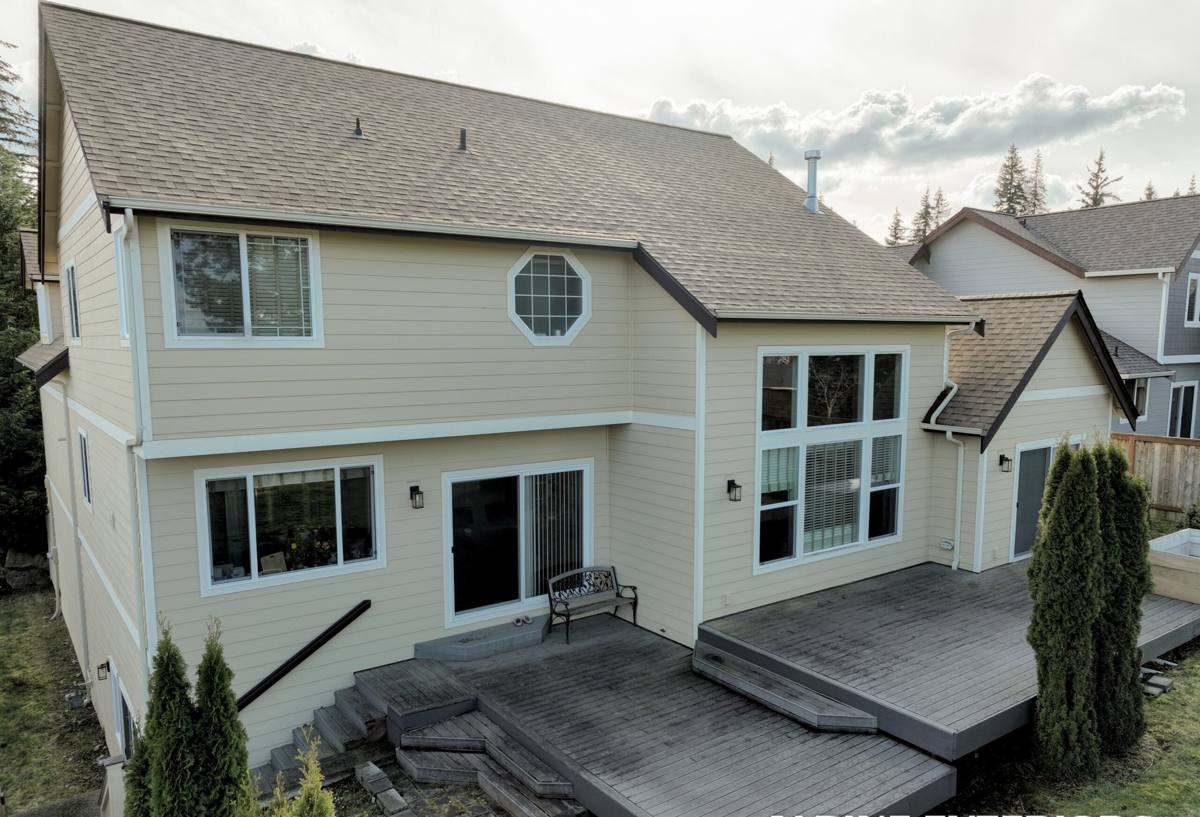
What Vinyl Siding Actually Is
Vinyl siding is extruded PVC (polyvinyl chloride) plastic, formed into panels that interlock and hang on the wall rather than being fastened rigidly to it. That "hanging" installation method is intentional — vinyl expands and contracts significantly with temperature swings, so it's designed to move. This is also its Achilles' heel: because it's not fastened tight, it can rattle in wind, and gaps at the fastener slots and panel joints are part of the design, not a flaw.
Where vinyl does well
- Low upfront material and labor cost compared to fiber cement
- Never needs painting — the color is molded through the panel
- Lightweight, which speeds up installation on straightforward wall sections
- Reasonably resistant to insects, since there's no wood or cellulose content
Where vinyl struggles
Vinyl is a petroleum-based plastic, and plastic has real physical limits. It becomes brittle in cold weather and can crack on impact — a thrown rock, a ladder bump, a wind-driven branch. It softens and can warp in direct, sustained heat, which shows up as visible waviness on south- and west-facing walls. Because the color is baked into the material rather than applied as a finish, sun exposure fades it unevenly over the years, and there's no practical way to touch it up — faded vinyl means replacing panels or living with the mismatch. And because panels aren't sealed at the seams, wind-driven rain can work its way behind vinyl siding over time, which matters a great deal in a place like ours.
What Fiber Cement Actually Is
Fiber cement is a composite of Portland cement, sand, and cellulose fiber, cured under pressure into a dense, rigid board. James Hardie, the manufacturer we install exclusively, engineers regional formulations — HZ5 for the wetter, colder climates like the Pacific Northwest — specifically to resist moisture-related damage. Unlike vinyl, fiber cement is nailed rigidly to the wall, similar to how wood lap siding has always been installed, and it doesn't expand and contract nearly as much with temperature.
Where fiber cement does well
- Dimensionally stable — it doesn't warp, buckle, or sag with heat
- Non-combustible, which matters for fire-rated assemblies and insurance considerations
- Resists impact damage far better than plastic siding
- ColorPlus factory finish is baked on with multiple coats and backed by a separate finish warranty, so color holds up more evenly over time than field-painted or through-body-colored products
- Doesn't attract woodpeckers or carpenter ants the way wood-based products can
Where fiber cement is more demanding
Fiber cement costs more upfront in both material and labor — it's heavier, requires carbide-tipped blades or shears to cut, and needs correct flashing, caulking, and fastening detail to perform as designed. It's less forgiving of a rushed or careless installer than vinyl is; get the water management wrong and you can create problems rather than solve them. This is the single biggest reason fiber cement's reputation varies so much from one installation to the next — the product's performance is only as good as the crew putting it on.
Side-by-Side Comparison
| Factor | Vinyl Siding | Fiber Cement (James Hardie) |
|---|---|---|
| Typical lifespan | 20-30 years, shorter in harsh sun/wind exposure | 30-50+ years when installed to spec |
| Impact resistance | Cracks and shatters, especially when cold | Resists dents and impacts; can chip if struck hard |
| Fire rating | Combustible plastic; can melt near heat sources | Non-combustible |
| Moisture behavior | Panels not sealed; water can travel behind them | Engineered for wet climates (HZ5); relies on correct flashing/sealing |
| Color/finish | Molded-in color; fades unevenly, cannot be spot-repaired easily | Factory ColorPlus finish, separately warrantied, can be repainted later |
| Upfront cost | Lower | Higher |
| Installation sensitivity | Fairly forgiving | Requires trained, careful installation |
| Resale perception | Seen as a budget/rental-grade material by many buyers | Generally viewed as a premium, durable upgrade |
Why the Skagit County Climate Tips the Scale
Mount Vernon sits in a river valley a short drive from Padilla Bay and the Salish Sea, and that geography shapes what your siding has to survive. Salt air carried in off the water accelerates the breakdown of fasteners, caulk joints, and any material that isn't dimensionally stable — vinyl's constant micro-movement at the joints gives salt-laden moisture more opportunities to work its way in over the decades. Driving rain off Puget Sound weather systems doesn't just fall straight down; it gets pushed sideways into walls, which is precisely the condition vinyl's non-sealed seams are least equipped for.
Then there's moss. Skagit Valley's long, mild, damp season is close to ideal moss and algae growing conditions, and north-facing and shaded walls here show it. Fiber cement's factory finish resists organic growth better than the surface texture of some vinyl products, and because it can be repainted down the road, a homeowner isn't stuck if growth or staining does take hold. None of this means vinyl "fails" in our climate — plenty of vinyl-sided homes in Mount Vernon hold up fine for years. It means the margin for error is smaller here than in a drier region, and that margin matters when you're deciding what to put on a home you plan to keep.
The Real Cost Comparison Isn't the Install Price
Comparing vinyl and fiber cement purely on quoted installation price misses the more useful number: cost per year of service life. A lower upfront bid on vinyl can look attractive until you account for a shorter realistic lifespan, the likelihood of replacing storm-damaged or faded panels partway through, and the fact that a full re-side is disruptive and expensive no matter which material you choose. Fiber cement's higher installed cost is spread over a longer service life, and its repaintable finish means a tired-looking wall doesn't have to mean a full tear-off — a real cost advantage that shows up ten or twenty years down the road rather than on day one.
None of that erases the fact that fiber cement costs more to install today, and for some budgets that difference is the deciding factor. We think homeowners should make that call with the full picture in front of them, not just a same-day bid comparison.
What Correct Installation Looks Like — For Either Product
Whichever material a homeowner chooses, the installation details matter as much as the material itself. For fiber cement specifically, the checklist below is what separates a siding job that performs for decades from one that causes problems in five years.
- Weather-resistive barrier installed and lapped correctly behind the siding, not just stapled up
- Rigid flashing at every window, door, and roofline intersection — not caulk used as a substitute for flashing
- Proper fastener type, spacing, and depth per the manufacturer's installation manual
- Correct clearance between the bottom of the siding and grade, decks, and roof lines to keep splash-back and standing water away from the material
- Factory-cut and factory-primed edges used wherever possible, with any field cuts sealed per spec
- Expansion gaps left where the manual calls for them, even though fiber cement moves far less than vinyl
Why We Standardized on James Hardie
We made a decision, as a company, to install only James Hardie fiber cement — not LP SmartSide, not vinyl, not cedar, not the lower-cost fiber cement alternatives on the market. That's a narrower offering than most siding contractors provide, and we think it's the right trade-off. Installing one product line lets our crews build deep, consistent expertise in exactly how it behaves, what it needs at every flashing detail, and how to install it so it earns its warranty rather than voids it. It also lets us stand behind the material itself: non-combustible, engineered for wet Pacific Northwest conditions, backed by a transferable warranty, and able to be refreshed with paint instead of torn off when it eventually shows its age. For a home that has to shrug off salt air, driving rain, and a long moss season year after year, we think that's the more honest recommendation — even though it isn't the cheapest one.
Making the Right Call for Your Home
Budget, how long you plan to stay in the home, and how much maintenance you want to take on all factor into this decision honestly — there's no universal right answer for every homeowner. What we can tell you is what we'd put on our own homes in this climate, and why. If you'd like to talk through your specific house, wall exposures, and budget, we're happy to walk the property with you and put together a free, no-pressure estimate — no obligation, just straight answers.