 Mount Vernon
 What Downtown Mount Vernon's Homes Are Up Against
Downtown Mount Vernon sits along the Skagit River in the heart of Skagit County, and the housing stock reflects the town's long history — a mix of older bungalows, craftsman-era homes, and postwar construction close to the core, with newer infill and remodels mixed in. A lot of these homes have already gone through at least one round of exterior siding, and many still carry whatever the original builder used, which in older Skagit Valley construction often means wood lap siding, old asbestos-cement panels, or a layer of vinyl installed decades later over problems nobody dealt with properly.
That older housing stock, combined with mature tree canopy in many of the residential blocks near downtown, creates a specific set of exterior problems. Shade from big trees keeps siding damp longer after it rains. Older homes weren't always built with the wall assemblies or ventilation gaps that modern building science calls for. And decades of Pacific Northwest weather take a cumulative toll that isn't always visible from the curb until you get up close.
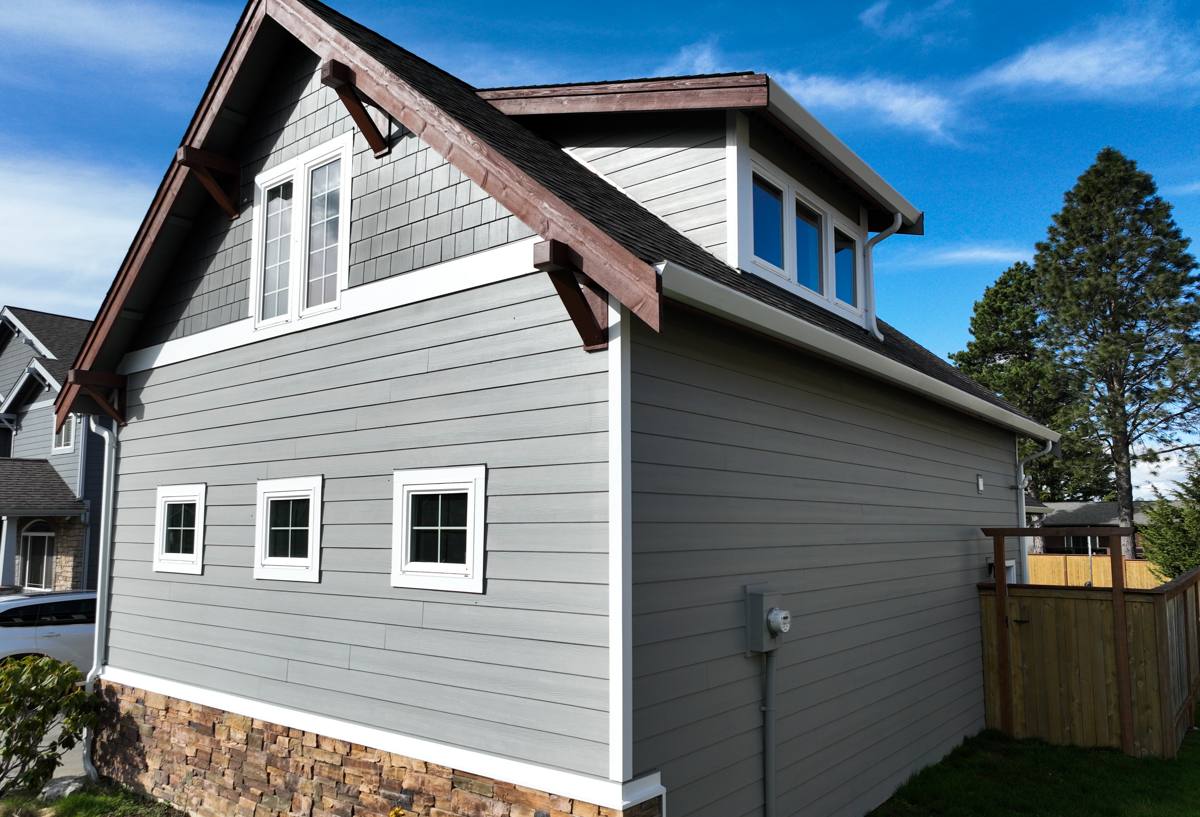
The Regional Climate Factor: Salt Air, Rain, and Moss
Mount Vernon isn't a beach town, but it's close enough to Skagit Bay and Puget Sound that homes here still deal with a mild salt-air influence, especially on days with onshore wind. Combine that with the long, wet stretch of fall through spring typical of western Washington, and you get siding that stays damp for extended periods, especially on north- and west-facing walls that don't get much sun to dry out between storms.
Moss is the most visible symptom. In shaded, damp spots — under eaves, along fence lines, behind shrubs pressed up against the house — moss and algae can establish themselves on siding, trim, and roofing within a year or two if surfaces stay damp long enough. On wood siding, that moisture doesn't stop at the surface. It works into seams, fastener holes, and any spot where paint has thinned, and from there it starts rotting the substrate from the inside out — often long before the exterior looks obviously bad.
Driving rain adds a second layer of stress. Wind-driven rain during fall and winter storms pushes water sideways into laps, corners, and butt joints in a way that vertical rain doesn't. Siding and trim details that work fine in a drier climate can fail here simply because they were never designed to shed water moving horizontally.
Why We Only Install James Hardie Fiber Cement
We get asked why we don't offer vinyl, LP SmartSide, cedar, primed spruce, or other fiber cement brands like Cemplank or Allura. It's not that these products don't have a place in the industry — it's that after years of installing and repairing siding in this exact climate, we standardized on one product because it holds up the most consistently here.
Vinyl siding is inexpensive and low-maintenance in the sense that it doesn't need painting, but it's a thin plastic product that expands and contracts with temperature swings, can crack in cold snaps, and doesn't offer much of a barrier against wind-driven rain finding its way behind the panels. Wood products — cedar, primed spruce, LP SmartSide's engineered wood — perform well when maintained on a tight schedule, but in a climate with this much sustained moisture, that maintenance schedule is unforgiving. Miss a repaint or let caulking fail for a season or two, and wood-based products start absorbing water at the edges and fastener points, which is exactly the failure mode we see repeatedly on older Mount Vernon homes.
Other fiber cement brands are a closer comparison to what we install, and they're reasonable products. We standardized on James Hardie specifically because of the combination of their ColorPlus factory-applied finish (which resists fading and doesn't require field painting the way primed siding does), their HZ5 product engineering for Pacific Northwest moisture and temperature conditions, and a warranty structure that's transferable if the home sells. Fiber cement itself doesn't rot, doesn't feed moss the way bare wood can, and is non-combustible — a real consideration as wildfire smoke and dry-season fire risk have become more of a factor even in western Washington.
What This Means for Your Estimate
When we walk a Downtown Mount Vernon property, we're not just quoting material and labor — we're looking at how the specific site (tree cover, sun exposure, proximity to the river, existing wall condition) will interact with whatever product goes back up. That's part of why every estimate is a real site visit, not a generic square-footage number.
How James Hardie Performs in This Specific Climate
Fiber cement is a mix of cement, sand, and cellulose fibers, pressed and cured into boards and panels. Because it's not wood and not plastic, it doesn't rot when it gets wet and doesn't become brittle in the cold the way vinyl can. James Hardie's HZ5 line is engineered specifically for regions like ours that see a lot of freeze-thaw cycling and sustained moisture, which matters more here than it would in a drier climate.
The factory-applied ColorPlus finish is also relevant to the moss conversation. A painted or primed surface that's aging and chalking gives algae and moss more to grip onto; a consistent factory finish sheds water and resists that buildup better over time, though no siding product is immune to moss in deep shade — regular gentle cleaning is still part of ownership on heavily shaded lots.
Correct installation matters as much as the product itself. Fiber cement has to be installed with the right clearances from grade and roofing, proper fastener spacing, and correctly flashed and caulked joints — especially around window and door openings, where wind-driven rain finds any gap. A well-made product installed to a loose standard can still fail early; that's a labor and detailing issue, not a material one.
The Whole Exterior Envelope: Roofing, Windows, and Decks
Siding doesn't work in isolation. On a lot of the older homes near downtown, we're often looking at the roof, windows, and any decks or porches at the same time as the siding, because they all interact with the same moisture problems.
- Roofing: A roof that's shedding granules, sagging at valleys, or has failing flashing sends water down onto the top course of siding, which accelerates exactly the kind of damage described above.
- Windows: Old or poorly flashed window openings are one of the most common points where wind-driven rain gets behind siding, regardless of what the siding itself is made of.
- Decks: Ledger boards and deck attachment points are notorious for trapping moisture against the house if they weren't flashed correctly when built, which can rot wall framing behind otherwise sound siding.
Because we handle all four trades, we can flag these interactions during an estimate instead of just quoting the siding and leaving a moisture source untouched next to the new material.
What the Installation Process Looks Like
Every project starts with a site visit, not a phone quote. For a Downtown Mount Vernon home, that means checking the condition of the existing wall assembly, looking for signs of past water intrusion, checking clearances at grade and roofline, and assessing how much of the existing siding needs to come off versus what can be addressed as part of prep.
From there, the general sequence is: removal of failing siding and trim, repair of any rotted sheathing or framing found underneath, correct installation of a weather-resistant barrier and flashing details, then installation of the Hardie boards or panels to manufacturer spec — proper fastener placement, gapping, and caulking at joints. On older homes we often find surprises once the old siding comes off, which is part of why a thorough initial inspection matters more than a fast estimate.
Cost Factors to Understand
Every home is different, and we don't publish fixed per-square-foot pricing because the real cost drivers vary a lot from house to house. The table below is meant to help you understand what actually moves a bid up or down, not to serve as a quote.
| Factor | Why It Matters |
|---|---|
| Condition of existing wall sheathing | Hidden rot found after tear-off adds repair scope that can't be fully known until the old siding is removed |
| Home age and trim complexity | Older homes near downtown often have more detailed trim, corner boards, and window casings than newer construction |
| Number of stories and access | Second-story and steep-lot work requires more scaffolding or lift time |
| Product choice (lap vs. panel, smooth vs. woodgrain) | James Hardie offers multiple profiles and textures at different price points |
| Tree cover and site prep | Heavy landscaping or tree limbs near the house can add prep and protection time |
A Homeowner's Checklist Before Replacing Siding
- Look for soft spots, bubbling paint, or visible gaps at seams and corners — press gently, don't just look
- Check north- and west-facing walls and any shaded sections for moss or persistent green staining
- Note whether gutters and downspouts are directing water away from the foundation and walls
- Check that deck ledger boards and any wall-mounted fixtures are sealed where they meet the siding
- Ask any contractor for their actual installation process, not just a material brand name — installation quality is where most siding failures start
- Get more than one estimate, and be wary of a quote given without an in-person site visit
Why a Local Crew Matters
A crew that works Skagit County regularly knows how Mount Vernon's climate behaves differently than, say, drier parts of eastern Washington or even other parts of the Puget Sound region with less river influence. We know what wind-driven rain does to a poorly flashed window on a downtown-area home, what a shaded north wall looks like after five years without maintenance, and what it takes to get a fiber cement installation to actually perform the way the manufacturer's engineering intends in this specific climate. That local knowledge shapes how we detail flashing, where we pay extra attention during tear-off, and what we flag during an estimate that a crew unfamiliar with the area might miss.
If your Downtown Mount Vernon home has siding that's showing its age — moss buildup, soft spots, peeling paint, or just a general sense that it's due — we're happy to come take a look. Estimates are free and there's no pressure to commit on the spot; it's a straightforward walk-through so you know exactly what condition your exterior is in and what your real options are.