 Mount Vernon
 Siding in Kulshan Ridge: Built for the Skagit Valley Climate
Kulshan Ridge is one of the residential pockets of Mount Vernon, and like the rest of Skagit County, it sits in a stretch of the Pacific Northwest where exterior materials work hard for their keep. The name itself borrows from "Kulshan," the Indigenous name for Mount Baker, whose snowmelt feeds the Skagit River running through the valley below. That geography matters more than most homeowners realize: proximity to the Skagit River delta and the Salish Sea means homes here deal with a steady mix of moist air, wind-driven rain, and a marine influence that keeps things damp for much of the year.
We've installed and repaired exteriors across Mount Vernon and the surrounding Skagit Valley long enough to know that siding failures here rarely happen overnight. They build slowly — a little moisture intrusion at a poorly flashed seam, a little moss taking hold in a shaded north wall, a little swelling at a butt joint — until a homeowner is looking at soft spots, peeling paint, or rot they didn't see coming. Kulshan Ridge homes aren't immune to any of that.
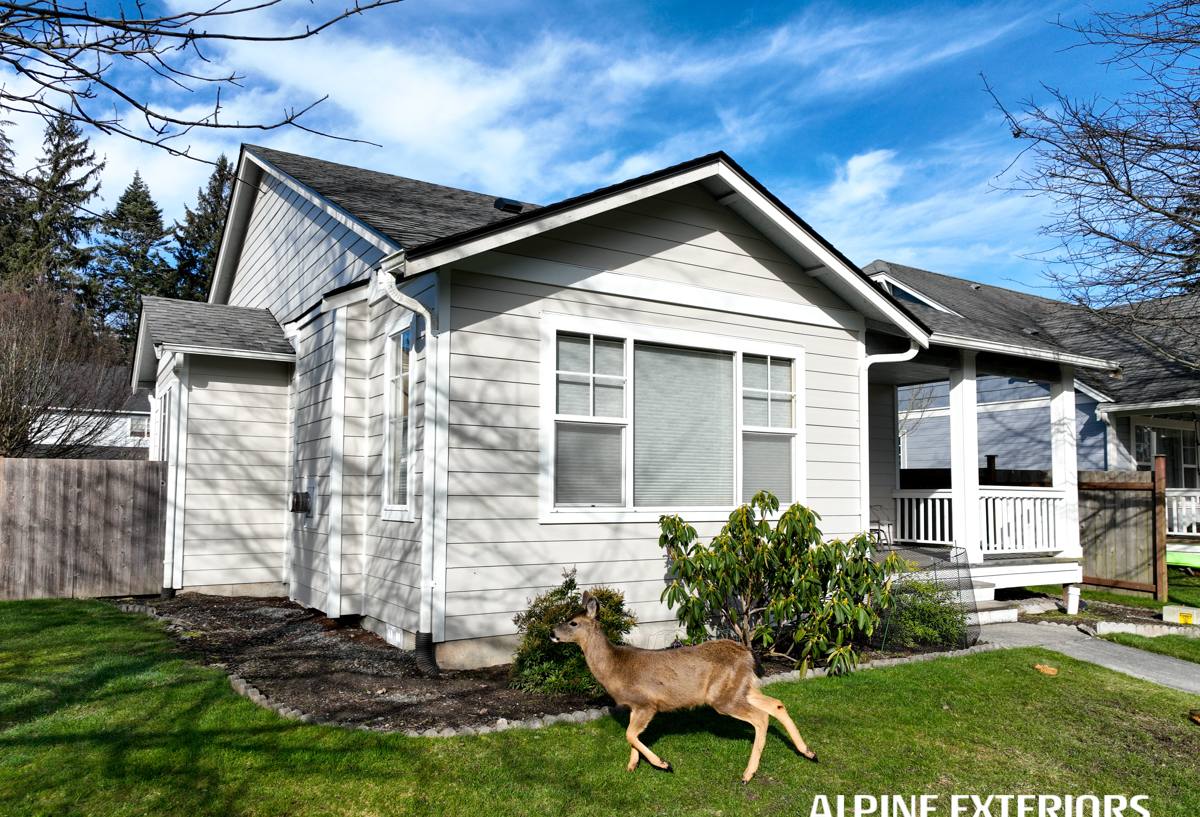
What the Regional Climate Actually Does to Siding
Salt Air and Moisture
Mount Vernon isn't right on the coast, but it's close enough to Skagit Bay and the broader Puget Sound basin that homes here still see a mild marine air influence, especially compared to drier areas east of the Cascades. Combined with the valley's naturally high humidity, that means siding materials are almost never fully dry. Wood-based products absorb that ambient moisture over time even without direct rain contact, and that slow saturation is what eventually leads to swelling, warping, and paint failure.
Driving Rain
Skagit Valley weather isn't just wet — it's frequently windy at the same time rain is falling, which pushes water sideways into seams, laps, and fastener penetrations that a calmer rain would never reach. Siding systems that rely on paint film or caulk alone to keep water out tend to show their weaknesses here first: hairline cracks at butt joints, nail heads that back out slightly and let water track behind the panel, and corner trim that never quite stays sealed.
The Long Moss Season
Western Washington's moss season effectively runs most of the year on north- and shade-facing walls, under eaves, and anywhere airflow is limited by mature landscaping — and Kulshan Ridge, like much of Mount Vernon, has plenty of trees and established yards that create exactly those conditions. Moss and algae hold moisture directly against the siding surface, which accelerates whatever degradation is already happening underneath. On wood, engineered wood, and lower-grade composite products, that constant damp contact is one of the more common paths to premature failure.
Why Material Choice Is the Real Decision
Most siding problems we get called out for in Skagit County trace back to a material or installation choice made years earlier, not bad luck. The table below reflects how the common siding options actually perform under the conditions described above — sustained moisture, driving rain, and heavy moss exposure — not just how they perform in a showroom.
| Material | Moisture Behavior | Moss/Algae Resistance | Long-Term Maintenance |
|---|---|---|---|
| Vinyl siding | Doesn't absorb water, but seams and panels can warp or gap, letting water behind the cladding | Moderate — smooth surface, but growth still takes hold in shaded, damp areas | Low upfront maintenance, but limited repair options once brittle or faded |
| Primed wood / cedar | Absorbs moisture readily; prone to swelling, cupping, and rot at joints | Poor — organic material is a natural host for moss and algae | High — regular repainting and caulking required to hold the line |
| Engineered wood (LP SmartSide-type) | Resin-treated to resist moisture, but edge and cut-end exposure remains a vulnerability | Moderate — better than raw wood, still an engineered wood product at its core | Moderate — depends heavily on correct field-cutting and caulking practice |
| James Hardie fiber cement | Cement-based composition doesn't swell, rot, or absorb moisture the way wood-based products do | Good — dense, non-organic surface resists sustained growth better than wood-based options | Low — factory finish holds color and integrity with minimal upkeep |
Why We Install Only James Hardie Fiber Cement
We made a deliberate decision to standardize on James Hardie siding and stop installing vinyl, LP SmartSide, Cemplank, Allura, primed spruce, and cedar. That's not a marketing position — it's a practical one, built on what we see when we tear old siding off homes in this climate. Wood-based and wood-derived products depend on an intact paint or resin layer to keep moisture out, and that layer is exactly what driving rain, humidity, and years of moss exposure wear down first. Once it's compromised, the substrate underneath is organic material that's built to absorb water, not shed it.
James Hardie fiber cement is cement, sand, and cellulose fiber — there's no wood substrate to rot and no resin coating that has to stay perfect to keep the product performing. Hardie also engineers its product lines by climate zone (HZ5 for our colder, wetter regions), which affects the formulation for how the board handles moisture and temperature swings specific to the Pacific Northwest rather than a one-size-fits-all national spec.
ColorPlus Factory Finish
Most of what we install uses Hardie's ColorPlus finish — baked on at the factory in a controlled environment, rather than field-painted on site. That matters in a climate like ours because field-applied paint has to cure properly to perform, and Skagit Valley doesn't always give a paint job the dry window it needs. A factory finish sidesteps that variable entirely and holds color more consistently over time.
Non-Combustible
Fiber cement is also non-combustible, which is worth mentioning even outside wildfire-prone areas — it's simply a more fire-resistant exterior material than wood-based alternatives, with no downside tied to our specific climate.
Warranty Structure
Hardie backs its products with a strong, transferable limited warranty — a real factor if a Kulshan Ridge home changes hands down the road, since the coverage isn't tied to the original owner. We only stand behind installations we can back up ourselves, and that starts with using a product whose manufacturer backs it the same way.
How a Siding Project Runs in Kulshan Ridge
A typical siding replacement on a Mount Vernon home follows a fairly consistent sequence, though the details shift depending on the home's age, current siding, and how much of the underlying sheathing and moisture barrier needs attention.
- On-site assessment — checking existing siding, trim, flashing, and any moisture damage before quoting anything
- Removal of old siding and inspection of the sheathing underneath for rot or water intrusion
- Repair of any compromised sheathing or framing found during tear-off
- Installation of a weather-resistant barrier detailed correctly around windows, doors, and penetrations
- Hardie board and trim installation, following manufacturer fastening and clearance specs
- Final walk-through covering caulking, paint lines, and cleanup
That tear-off step is where we most often find the real story behind a homeowner's siding complaints — soft sheathing at a window sill, a missing kick-out flashing, a moisture barrier that was never properly lapped. Addressing those issues at the same time as the siding replacement is what actually stops the problem from coming back, rather than just covering it with new material.
Roofing, Windows, and Decks: The Rest of the Exterior Envelope
Siding doesn't work in isolation. Roofing, windows, and decks all share the job of keeping water out of a Kulshan Ridge home, and a weakness in one often shows up as damage in another — a leaking roof valley that saturates the wall below it, a failed window flashing that rots the siding around the frame, a deck ledger board that traps moisture against the house. Because we handle siding, roofing, windows, and decks, we can look at a home's exterior as one connected system rather than quoting a single component in isolation and hoping the rest holds up.
For homeowners planning a larger exterior project, it's often worth evaluating roofing and window condition alongside siding, since scaffolding, staging, and trim work frequently overlap between the two trades. Coordinating that work under one crew usually means less disruption and fewer seams where two different contractors' work has to meet.
What Drives the Cost of a Siding Project
Every home is different, but a few factors consistently move the price of a siding replacement in this area more than anything else:
| Factor | Why It Matters |
|---|---|
| Extent of sheathing/framing repair | Hidden moisture damage found at tear-off adds material and labor beyond the original siding scope |
| Home size and complexity | More corners, gables, and trim detail mean more cutting, fitting, and finish work |
| Siding profile and accessories | Lap width, trim style, and accent details (shakes, battens) affect material and labor cost |
| Access and site conditions | Tight lots, mature landscaping, or multi-story sections affect staging and time on site |
| Existing siding removal | Multiple layers of old siding or extensive rot removal adds disposal and labor time |
We don't quote broad numbers on a page like this, because they'd be meaningless without seeing the actual home — but a written, itemized estimate after an on-site look will always spell out exactly where the cost is coming from.
Maintenance Checklist for Kulshan Ridge Homeowners
Whatever siding is currently on a home, a few simple checks each year can catch problems while they're still cheap to fix:
- Look for moss or algae buildup on north-facing walls and under eaves, especially after the wetter fall and winter months
- Check caulking around windows, doors, and trim for cracking or gaps where water could get behind the siding
- Watch for soft spots, bubbling paint, or discoloration near the bottom courses of siding and around deck ledgers
- Keep gutters clear so overflow isn't running directly down exterior walls
- Trim back landscaping that's shading walls and keeping them from drying out between rains
- Note any siding panels that feel loose, warped, or out of plane compared to the wall around them
Why a Local Crew Matters Here
Skagit Valley weather isn't the same as siding advice written for a national audience. A crew that works Mount Vernon, Kulshan Ridge, and the surrounding county every week knows where moss builds up fastest, which details tend to fail first in a wet marine climate, and how to detail flashing so driving rain doesn't find its way behind the wall. That local, repeated exposure to the same climate conditions is part of what separates a siding job that holds up for decades from one that starts causing problems in five years.
If you're weighing a siding project for a home in Kulshan Ridge or elsewhere in Mount Vernon, we're glad to come take a look and walk through what we find — no pressure, no obligation. Use the form below to request a free estimate.