 Mount Vernon
 The Question Every Skagit County Homeowner Eventually Asks
At some point, every siding job on a house in Mount Vernon needs attention. A board cracks, a seam opens, a patch of paint starts peeling faster than the rest. The question that follows is always the same: is this a repair, or is this the first sign that the whole system needs to come off? There's no single answer that applies to every house, but there is a reliable way to think through it, and that's what this page walks through.
Skagit County's climate makes this decision more urgent than it would be in a drier part of the country. Salt-laden air moving in off the bay, long stretches of driving rain through the fall and winter, and a moss season that can run eight months out of the year all put steady pressure on exterior materials. Siding here doesn't fail because of one dramatic event — it fails gradually, from repeated wetting and drying cycles that most homeowners never see happening.
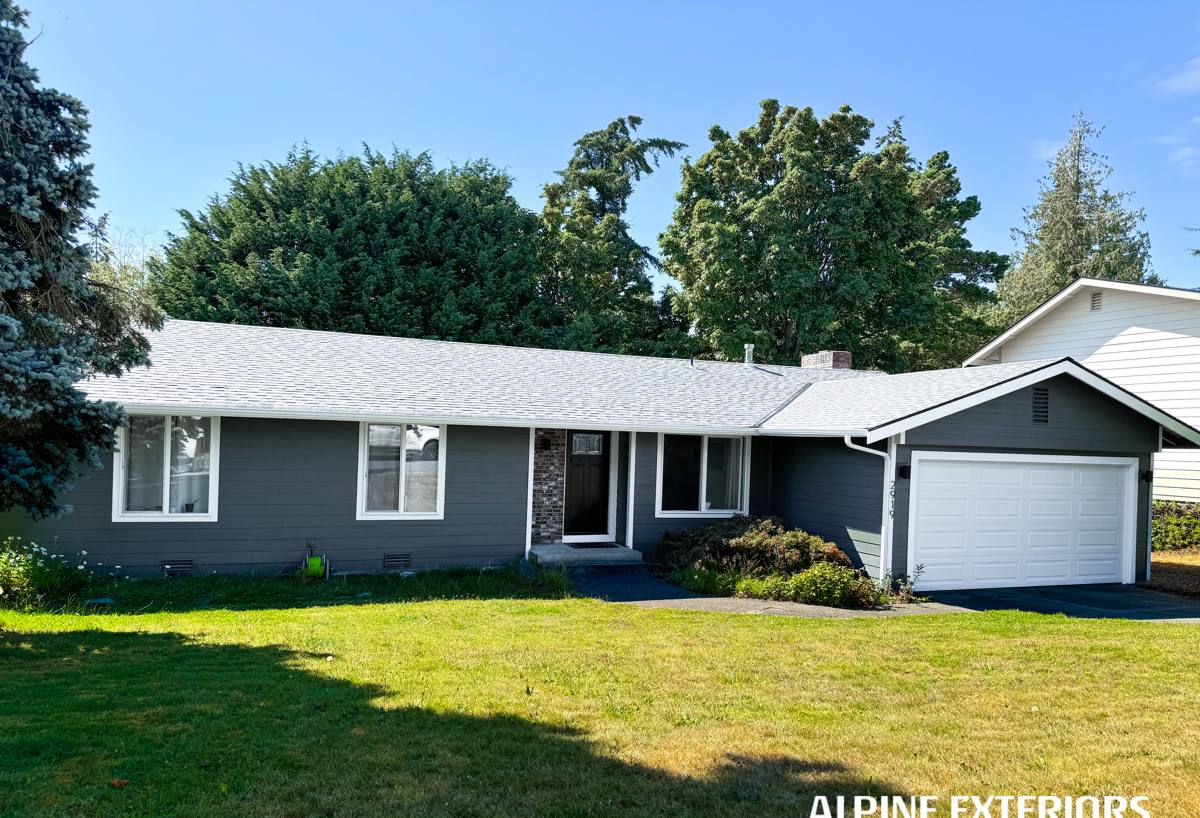
Start With What the Damage Is Actually Telling You
Not all siding problems are equal. Some are cosmetic and isolated. Others are a symptom of something happening behind the siding, where you can't see it. The first job — before deciding on repair or replacement — is figuring out which kind of problem you're looking at.
Signs that usually mean a repair is enough
- A single cracked or impact-damaged board, with no soft spots around it
- Localized caulk failure at a trim joint that's letting in wind-driven rain
- Isolated paint failure on one wall (often the south or west side, which takes the most weather)
- Loose or popped fasteners on an otherwise sound wall
- Minor moss and algae staining with no wood softness underneath
Signs that point toward replacement
- Soft, spongy siding you can press a thumb into
- Damage that shows up in multiple, unrelated areas of the house at once
- Visible warping, cupping, or delamination across whole sections
- Paint that won't hold no matter how often it's redone
- Any sign of rot, staining, or swelling at the sheathing behind a removed board
Why Moisture Is the Real Decision-Maker, Not Appearance
Homeowners naturally judge siding by how it looks, but appearance is a lagging indicator. By the time siding looks bad, moisture has usually already been working on it — and on the wall assembly behind it — for a while. This is especially true in Mount Vernon, where driving rain off the Skagit Valley regularly hits walls at an angle, and where humidity stays high enough, long enough, that materials rarely get a full chance to dry out between storms.
This is why a proper repair assessment always includes pulling a board or two in a suspect area, not just looking at the surface. If the sheathing behind the siding is dry and intact, a targeted repair can genuinely solve the problem. If it's discolored, soft, or smells musty, the siding failure is a symptom of a bigger moisture problem, and patching the visible board will just hide it for another season or two before it resurfaces — often worse, and often more expensive to fix once framing is involved.
What we look for during an inspection
| Check point | What it tells us |
|---|---|
| Sheathing condition behind removed boards | Whether moisture has already reached the structure |
| Pattern of damage (isolated vs. widespread) | Whether the cause is local (one bad joint) or systemic (failed water management) |
| Age and material of existing siding | Whether the product is near the end of its realistic service life |
| Condition of flashing at windows, doors, and roof lines | Whether water is getting in through details, not the field of the wall |
| North-facing and shaded areas | Where moss, mildew, and slow-drying moisture tend to concentrate first |
Repair or Replace: A Practical Comparison
Cost is usually the first thing homeowners want to know, and it's a legitimate factor — but it should be weighed against how long a repair will actually hold, not just what it costs today.
| Factor | Repair | Full Replacement |
|---|---|---|
| Upfront cost | Lower | Higher |
| Addresses hidden moisture damage | Only if damage is confirmed isolated | Yes — sheathing and water-resistive barrier can be inspected and corrected everywhere |
| Color and material match | Can be difficult on older or discontinued siding | Not an issue — everything is new and uniform |
| Effect on home value / curb appeal | Minimal, unless damage is highly visible | Significant, especially with a modern finish |
| Long-term maintenance burden | May resurface if underlying cause wasn't fixed | Resets the maintenance clock with a durable material |
| Best suited for | Sound siding with one or two isolated problem areas | Siding that's aging out, widely damaged, or backed by moisture-compromised sheathing |
Why Patch Jobs Behave Differently Depending on the Material
Repairability isn't just about the extent of damage — it's also about what the siding is made of. Some common materials are genuinely hard to repair well, which is worth knowing before you commit to a patch.
Vinyl
Vinyl panels are made to interlock, and finding an exact color match years later is often impossible because manufacturers change their color runs. Vinyl also expands and contracts significantly with temperature, so a patched section can visibly move or gap differently than the surrounding panels.
Engineered wood (LP SmartSide and similar products)
Engineered wood siding relies on an intact factory-applied resin coating and edge seal to keep moisture out of the wood strand core. Once that seal is compromised — from a cut edge, a fastener hole, or years of weather exposure — moisture can wick into the board itself. A patch on one board doesn't restore the seal on the boards around it, which is part of why failures in this material tend to spread rather than stay isolated.
Primed wood and cedar
Solid wood siding can be repaired board by board, but it depends entirely on ongoing paint maintenance to stay watertight. In a climate with Mount Vernon's rain totals and moss pressure, a repaired section is only as good as the paint film protecting it — and that film needs recoating on a schedule most homeowners don't keep up with.
Fiber cement
Fiber cement is dimensionally stable and doesn't absorb water the way wood-based products do, which makes true spot repairs more realistic — a damaged board can usually be swapped for a new one without disturbing the rest of the wall or triggering a color mismatch, provided the finish is a factory-applied one rather than field-painted.
When We Recommend Replacing Rather Than Patching
We don't push replacement as a default answer — plenty of houses we look at in Mount Vernon and around Skagit County genuinely just need a repair, and we'll say so. But there are situations where patching is the wrong call even if it's technically possible:
- The siding is within a few years of the end of its expected service life anyway
- Damage shows up in three or more unrelated spots, suggesting a systemic moisture or installation issue
- The existing material is discontinued or the color has faded enough that a patch will always stand out
- You're already planning to sell, and mismatched patch work will show up in a buyer's inspection
- The sheathing inspection turns up rot or moisture staining that needs to be addressed at the framing level
In those cases, replacement isn't about upselling a bigger job — it's that a repair would be spending money to delay a problem that's going to come back, often after the drywall behind it has already been affected.
What We Install When It's Time to Replace
When a house does need new siding, we only install James Hardie fiber cement. That's a deliberate standard, not a default supplier relationship. Hardie's fiber cement doesn't absorb water the way wood-based products do, it's non-combustible, and its ColorPlus factory finish is baked on and warranted separately from the substrate — which matters in a region where field-applied paint has to fight moss, mildew, and near-constant moisture for most of the year. Hardie also makes climate-specific HZ product formulations, engineered for regions like ours that see heavy rain and humidity rather than dry heat, and backs the material with a strong, transferable warranty that follows the house if you sell it.
We've chosen not to install vinyl, LP SmartSide, Cemplank, Allura, primed spruce, or cedar. Each of those has legitimate strengths, and homeowners who already have them aren't wrong to have chosen them — but when we're the ones specifying and installing new siding on a Skagit County home, Hardie is the material we're willing to put our name behind for the long haul.
A Quick Self-Check Before You Call Anyone
Before scheduling an inspection, a few minutes of your own observation can help you describe the problem clearly and get a faster, more accurate read from whoever you call:
- Press on the siding in a few spots, especially near the bottom of walls and around windows — note any softness
- Check if the damage is in one spot or scattered across the house
- Look at north-facing and shaded walls separately — moss and slow-drying moisture tend to hit these first
- Note whether paint or finish failure is recent or has been an ongoing, repeated problem
- Check attic or interior walls near the damaged area for staining, which can indicate moisture has already gotten past the siding
If you're seeing any of these signs on your Mount Vernon home, we're happy to take a look and give you a straight answer about whether a repair makes sense or whether replacement is the better long-term move — no pressure either way. Reach out for a free estimate using the form below.