 Mount Vernon
 Siding in Clear Lake: A Different Set of Problems Than Downtown Mount Vernon
Clear Lake sits apart from the flat, open farmland that most people picture when they think of Skagit County. It's a wooded, lake-adjacent community southeast of Mount Vernon, tucked closer to the foothills than the valley floor. That geography changes what a home's siding actually has to deal with day to day. Instead of open wind and flat sun exposure, Clear Lake homes tend to sit under mature fir and cedar canopy, next to a body of water that keeps humidity lingering longer than it does in town.
That combination — shade, standing moisture in the air, and a lake nearby — is a different maintenance problem than what we see on an open lot closer to Mount Vernon or out toward the coastal edge of the county. Homes here often stay damp longer after a storm passes, and north-facing or tree-shaded walls can go most of the winter without a real drying-out period. Add in the broader Skagit County pattern of driving rain off Puget Sound and the light salt air that reaches inland on the wrong wind, and you've got siding that's working harder than it looks like it should.
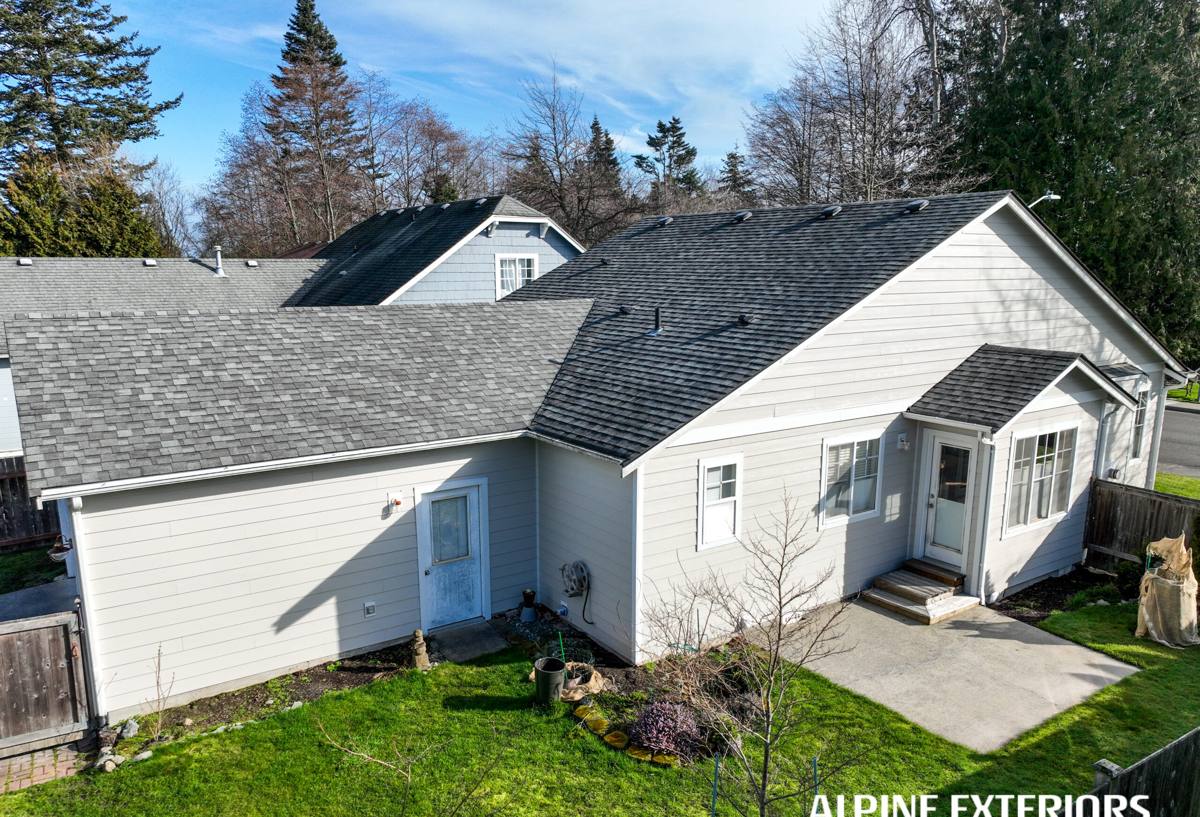
What Shade and Moisture Actually Do to Siding Over Time
Moss and Algae Get a Head Start
Moss doesn't need much — just shade, moisture, and a surface it can grip. Clear Lake's tree cover provides the first two in abundance, and a lot of siding materials provide the third without meaning to. Wood-based products with any texture or porosity give spores something to hold onto, and once moss establishes itself against a wall, it holds moisture directly against the siding surface, which is worse than the rain itself.
Slow Drying Means Longer Exposure Windows
In an open, sunny location, a wall gets wet, then gets a few hours of direct sun and wind to dry back out. Under canopy near a lake, that drying window shrinks or disappears for weeks at a stretch during the wet season. Materials that absorb moisture — even a little — end up staying damp longer here than the same product would on a home a few miles away in full sun.
Driving Rain Finds the Gaps
Skagit County storms don't always fall straight down. Wind-driven rain gets pushed sideways into laps, seams, and butt joints, which is where most siding failures actually start — not on the open field of the wall, but at the connections. A shaded, damp site makes any weakness at those joints worse, because whatever gets in has less chance to dry back out before the next storm.
What We Check on a Clear Lake Home
Before we talk about materials, we look at the site. The same siding product performs differently on a sun-exposed lot than it does under fir canopy forty feet from a lakeshore, so we walk the property first.
- Which walls sit in permanent or near-permanent shade from tree cover
- Existing moss or algae growth, and where it's concentrated
- Condition of trim, corner boards, and butt joints — the usual failure points
- Gutter and downspout performance, since poor drainage compounds every moisture problem
- Ventilation behind the current siding, especially on additions or lower-slope roof sections
- Grade and landscaping too close to the foundation, which keeps splash-back and humidity against the lowest courses
That walk-through tells us more about what a home needs than any brochure comparison of siding products. A house with three shaded, damp walls and one sunny wall isn't a uniform problem — it's four different micro-climates on one building.
Why We Install Only James Hardie Fiber Cement
We get asked about vinyl, LP SmartSide, cedar, and primed spruce regularly, and we understand why — they're familiar, and in some cases cheaper up front. We don't install any of them, and in a moss-and-shade environment like Clear Lake, the reasoning is even more direct than it would be on an open lot.
Wood-based siding, including engineered wood products, relies on a factory coating and careful field sealing to keep moisture out of the substrate. That's a manageable system in a dry, sunny location. Under tree cover near a lake, where a wall might stay damp for days after a storm, any coating failure or unsealed cut edge becomes an entry point for moisture that has nowhere to evaporate to. Vinyl sheds water reasonably well but flexes with temperature swings, can warp or become brittle over time, and doesn't hold paint if a homeowner ever wants to change the look. Cedar is a beautiful, genuinely traditional choice for this region, but it's also the material most vulnerable to exactly what Clear Lake produces in abundance — sustained moisture and shade — and it demands a maintenance schedule most homeowners don't keep up with once the novelty wears off.
James Hardie fiber cement is non-combustible, doesn't swell or rot the way wood-based products can, and comes with a factory-applied ColorPlus finish that's built to hold up under UV and moisture exposure without repainting on any regular schedule. It's not immune to moss growth on the surface — nothing sitting under a fir canopy is — but the material itself doesn't break down the way wood fiber does when moss holds moisture against it for a season at a time.
The Hardie Product Line for This Climate
James Hardie makes region-specific formulations, and for Western Washington we use their HZ5 line, engineered for cold, wet climates rather than the hot-dry formulation sold in the Southwest. On a Clear Lake home, that engineering matters more than it would somewhere drier — the product is designed around exactly the freeze-thaw and moisture-cycling conditions this site produces.
| Feature | What It Means for a Clear Lake Home |
|---|---|
| HZ5 climate formulation | Built for moisture-cycling and cold-wet conditions rather than arid climates |
| ColorPlus factory finish | Baked-on finish resists fading and doesn't rely on field-applied paint holding up under shade and damp |
| Non-combustible core | Doesn't contribute fuel in a wildfire-adjacent, tree-covered setting |
| Dimensional stability | Doesn't swell, cup, or warp the way wood-based siding can under sustained moisture |
| Transferable warranty | Follows the home through a sale, which matters in a desirable lake-area market |
Installation Details That Matter More Under Tree Cover
Fiber cement is only as good as its installation, and that's doubly true on a shaded, damp lot. A few details we hold to on every Clear Lake project:
- Correct starter strip and flashing at the bottom course, where splash-back and standing moisture concentrate
- Proper gapping and caulking at butt joints, since that's where wind-driven rain finds its way in
- Rain-screen or drainage plane details on walls with limited sun exposure, to give any incidental moisture somewhere to go
- Factory-cut edges sealed per manufacturer spec whenever a field cut is unavoidable
- Corner boards and trim installed with enough clearance to avoid trapping debris and moss-friendly organic matter
None of this is exotic. It's the difference between installers who treat every house the same and a crew that adjusts for a lot that sits in shade six months of the year next to standing water.
Beyond Siding: The Roof, Windows, and Deck Face the Same Conditions
Siding doesn't fail in isolation on a home like this. A roof shedding moss debris into gutters, windows with failed seals letting humidity into wall cavities, or a deck holding standing water against the house all feed the same underlying problem — sustained moisture with limited drying time. We handle roofing, windows, and decks alongside siding for that reason. It's easier to solve moisture and moss as one system than to fix the siding and leave the roof dumping debris onto it every fall.
Roofing
Moss on a roof under tree cover isn't cosmetic — it holds water against shingles and can work its way under tab edges over a few seasons. Roof condition and gutter performance are usually the first things we check before we even talk siding, because a poorly draining roof will undermine new siding within a year or two.
Windows
Older window flashing is a common hidden source of wall moisture, especially on shaded elevations. When we replace siding around existing windows, we check flashing and seals rather than working around a problem we can see.
Decks
A deck built tight against the house, especially on a shaded side, keeps moisture and debris against the lowest siding courses. Deck framing and ledger board connections get the same scrutiny as the siding itself.
What This Tends to Cost
Every home is different, and the site conditions described above change the scope more than the square footage does. In general terms, homeowners should expect the following factors to move the number:
| Factor | Why It Matters Here |
|---|---|
| Amount of tissue-level moisture damage found under old siding | Shaded, damp walls are more likely to have hidden sheathing repair needed |
| Trim and corner detail complexity | More cuts and joints mean more sealing and labor |
| Roof and gutter condition | Often addressed at the same time to stop debris and moss from reaching new siding |
| Access — tree cover, slope, lake-adjacent lots | Tighter or wooded lots can add setup and staging time |
| Number of stories and elevations in full shade | Shaded walls sometimes get additional drainage detailing |
We don't quote from a distance for that reason. A number based on square footage alone, without accounting for what's actually happening at the walls, isn't a real estimate.
Why a Local Crew Matters Here
Clear Lake isn't a large enough area to support siding-specific expertise from a crew that mostly works elsewhere in the county or comes up from further south. Knowing which walls on this kind of lot hold moisture longest, how aggressive the moss season gets under this particular canopy pattern, and how Skagit County's driving rain behaves against a lakeside property is the kind of thing that comes from doing the work here repeatedly, not from a general regional service radius. That's the value a Mount Vernon-based crew brings to a Clear Lake job that a crew unfamiliar with the area doesn't.
If you're dealing with moss buildup, soft spots, or aging siding on a Clear Lake home, we're happy to walk the property, look at what the shade and moisture have actually done to your walls, and put together a straightforward, no-pressure estimate using the form below.