 Mount Vernon
 Edison sits in the low, flat country of western Skagit County, where farmland runs right up against tidal water and the weather off the bay reaches homes with very little to slow it down. It's a small, low-density community, which means a lot of houses here sit more exposed than they would in a built-up neighborhood — fewer surrounding rooflines and trees to break the wind, more open sky for a storm to build over before it reaches a wall or roof. We handle siding, roofing, windows, and decks throughout this part of Skagit County, and Edison is one of the areas where the gap between an exterior built for this climate and one that wasn't shows up the fastest.
What Edison's Setting Does to a House
Homes around Edison deal with weather shaped by the tidal flats and open farmland that surround the community. Salt-laden air moves in off the water and travels further inland here than people expect, especially during winter storm cycles, and it works on exposed fasteners, flashing, and any unprotected metal on a house faster than it would further from the coast. Driving rain — rain pushed sideways by wind rather than falling straight down — is a regular event in this part of the county, and it finds its way through any seam, gap, or under-caulked joint that wouldn't matter in calmer weather. On top of that, the long moss season that much of western Skagit County contends with settles in on shaded and north-facing surfaces for a good stretch of the year, holding moisture against a house well after a storm has passed through.
None of this means an Edison home is doomed to premature exterior failure — plenty of houses in this area have held up for decades. It means the materials chosen and the details of the installation matter more here than they would somewhere drier or more sheltered, and that a generic, one-size-fits-all approach tends to reveal its weak points sooner in a place like this.
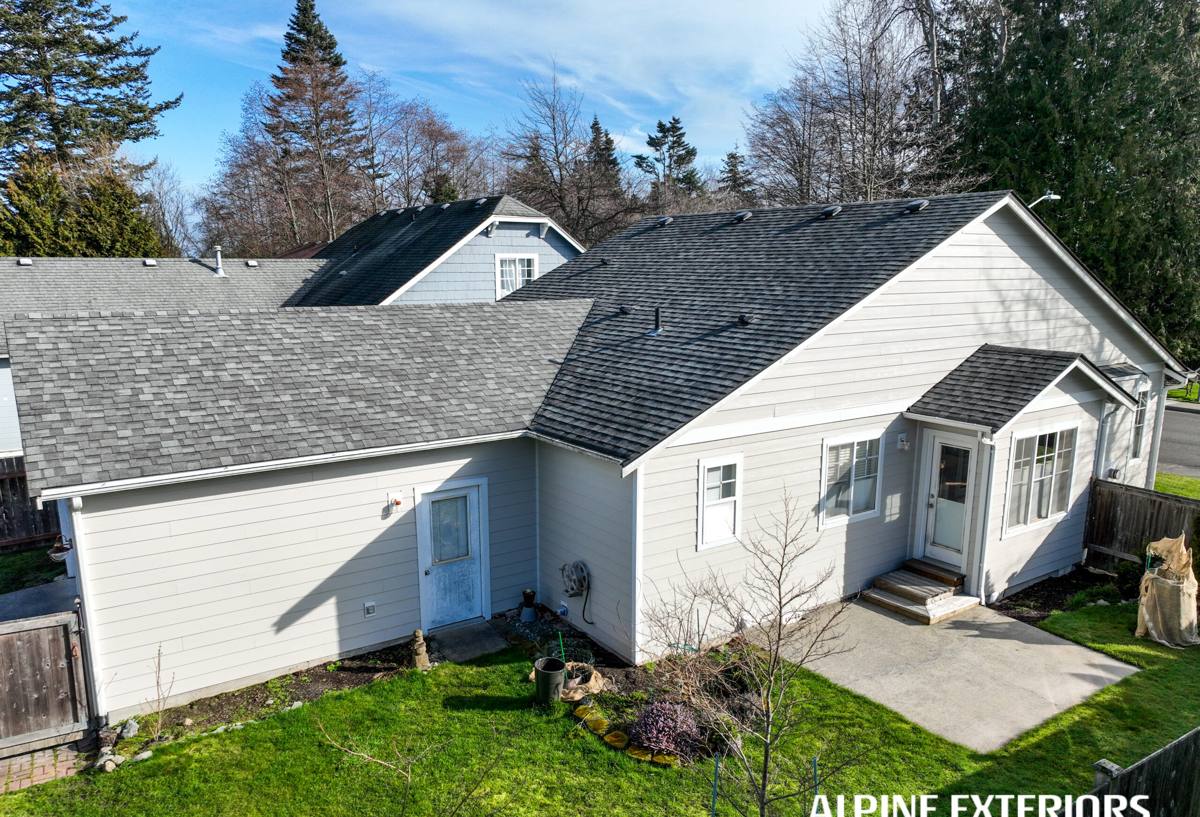
Siding: Why We Install Only James Hardie Fiber Cement
We install one siding product across every job we take on: James Hardie fiber cement. We don't offer vinyl, LP SmartSide, Cemplank, Allura, primed spruce, or cedar. That's a deliberate professional standard rather than a lack of options, and in a place like Edison it's a response to what the climate actually does to a wall system over years of exposure, not a marketing position.
Each of the alternatives has real strengths. Vinyl is inexpensive and low-maintenance in milder climates. Engineered wood products install quickly and take paint well. Cedar has genuine visual character that some homeowners want. But each also carries a trade-off we think matters too much here to put our name behind. Vinyl can become brittle with age and temperature swings, and its seams and channels are exactly the kind of gap that wind-driven rain off the bay likes to find. Wood-based products, however well treated, still have an organic core that depends on flawless field priming and caulking at every cut edge to keep sustained moisture out — a demanding standard to hold across an entire job, every time. Cedar is beautiful but organic, and it asks for a real ongoing maintenance commitment — refinishing, sealing, moss control — in a climate that doesn't offer much of a dry season to recover in between storms.
Why Fiber Cement Holds Up Differently
Fiber cement solves the core problem by not being organic in the first place. There's no wood substrate for moisture to work into, and it doesn't feed moss or mildew growth the way wood-based siding can. James Hardie also builds climate-specific HZ product lines engineered around exactly the sustained moisture and coastal exposure that a place like Edison deals with, rather than selling one generic formulation everywhere. Paired with a factory-applied ColorPlus finish — baked on under controlled conditions instead of painted on site in variable weather — it holds color and resists cracking longer than most field-applied finishes manage here.
What Correct Installation Actually Involves
A siding product is only as good as the installation behind it, and that's especially true on an exposed property. Correct Hardie installation means proper clearance from grade and rooflines, flashing that's lapped and sealed correctly at every window, door, and penetration, manufacturer-specified fastening patterns, and joint treatment matched to how much sun and shade a given wall actually gets. Skip any one of those details and there's a weak point — one that usually doesn't show up as a problem for a year or two, and then shows up as a callback.
- Flashing integrated correctly at every window, door, and roofline transition — not just caulked over after the fact
- Proper starter strip and clearance from grade, patios, and decks to keep the bottom edge out of standing moisture
- Fastener pattern and spacing matched to the specific Hardie product line and the property's wind exposure
- Joint and seam treatment appropriate to sun-exposed versus shaded, moss-prone wall faces
- Factory-finished color matched correctly at trim and touch-up points instead of a mismatched field repaint
Roofing for Wind-Driven Rain and a Long Moss Season
A roof on an exposed Edison property deals with the same directional weather as the siding, just overhead. Wind-driven rain works its way under shingles and around flashing at a much higher rate than rain falling straight down, so the details that actually matter are the ones a homeowner rarely sees during a sales pitch: correctly lapped flashing at valleys and penetrations, proper underlayment, and attic ventilation that keeps moisture from condensing where it has nowhere to go. Moss is close to a constant presence on shaded and north-facing roof planes throughout this part of the county, and left unaddressed it holds moisture against the roofing material and can work under shingle edges over time.
Because roofs here take on a heavier moisture load than a sheltered inland home would, problems tend to show up first in predictable places — valleys, chimney and skylight flashing, and whichever slope catches the prevailing weather off the water. Granule buildup in gutters, staining beyond ordinary moss, and soft or spongy spots near penetrations are all worth a look before they turn into an interior leak.
Windows: Where Most Water Problems Actually Start
Windows are one of the more common failure points on an exposed property, and it's rarely the window unit itself that's the problem — it's rushed flashing and installation around the opening. On a property catching wind and rain off open water and flat farmland with little to break it, a poorly flashed window is a direct route for moisture into the wall cavity, and that kind of leak can go undetected for a long time before it shows up as visible damage inside. We pay close attention to sill pan flashing, head flashing, and proper integration with the weather-resistant barrier behind the siding — details that don't show up in a brochure but determine whether the work actually holds up.
Signs Worth Checking
- Older or poorly sealed windows on weather-facing walls often show condensation, drafts, or fogging between panes
- Window trim and casing on the exposed side of a house typically shows wear before the rest of the exterior does
- Replacement is a good opportunity to correct flashing details that may have been done poorly on the original install
Decks Built for Open, Moisture-Heavy Exposure
Deck framing and fastening take real punishment in a climate like Edison's — sustained moisture, salt-influenced air, and long stretches without much drying time between rain events all work against untreated or poorly fastened lumber. Ledger board attachment, correct flashing where the deck meets the house, and corrosion-resistant fasteners and hardware matter as much as whatever decking material sits on top. A deck can look fine on the surface while a compromised ledger connection or rusting hardware underneath is quietly becoming a real problem.
Composite vs. Wood Decking in This Climate
| Factor | Wood Decking | Composite Decking |
|---|---|---|
| Moisture resistance | Depends on species and finish; needs regular sealing | Resists moisture absorption without ongoing sealing |
| Moss and mildew | Organic surface supports growth if maintenance lapses | Less hospitable to organic growth, though surface buildup can still occur |
| Maintenance | Annual or biennial sealing/staining recommended | Periodic cleaning; no sealing or staining required |
| Upfront cost | Generally lower | Generally higher |
| Long-term cost | Higher over time with sealing and board replacement | Lower ongoing cost, longer typical service life |
Either approach can hold up well in Edison if the framing and fastening underneath are done correctly. The decking surface is what a homeowner sees; the structure underneath is what determines how long it actually lasts.
Cost Factors for Edison Exterior Projects
We don't publish blanket pricing, because it wouldn't be an honest answer — the real cost drivers are specific to the house. The factors that move a project's cost up or down, though, are consistent enough to lay out plainly.
| Factor | How It Affects Cost |
|---|---|
| Existing exterior condition | Hidden moisture or rot damage found during tear-off adds repair scope |
| Home size and wall complexity | More corners, gables, and penetrations mean more flashing and labor time |
| Exposure level | More open, wind-exposed properties often warrant extra attention to fasteners and flashing |
| Access and site conditions | Farm access roads, tight lot lines, or difficult staging can affect labor time |
| Scope bundling | Combining siding, roofing, and window work in one project can reduce overlapping setup costs |
Why a Local Crew Matters Here
Edison isn't a dense grid of similar houses — it's a scattered mix of farmhouses and properties sitting at different distances from the water, each catching wind, rain, and salt air a little differently. A crew that works this part of Skagit County regularly develops a real feel for which walls take the worst of the weather, which roof slopes hold moss the longest, and which flashing details actually matter versus which ones are just code minimum. That kind of judgment comes from doing this work on homes like these, repeatedly, not from a general specification written for the whole country. It also means someone local is reachable years later if a warranty question or a flashing detail needs a second look.
What to Check Before Hiring for Exterior Work in This Area
- Ask specifically how the contractor handles wind-driven rain and flashing, not just which siding brand they carry
- Confirm fasteners and hardware are rated for coastal or marine-adjacent exposure, not standard-grade only
- Get a clear answer on both the manufacturer's material warranty and the contractor's workmanship warranty
- Ask how window and door flashing integration is handled, since that's where most long-term leaks originate
- Verify the contractor is licensed, bonded, and insured to perform exterior work in Washington State
What This Means for Your Home
Every property around Edison sits a little differently relative to the water, the farmland, and the prevailing weather, and the right scope of work depends on the specific house — its age, orientation, and the actual condition of the current siding, roof, windows, or deck. We're not going to recommend a full exterior overhaul when a targeted repair will do, and we're not going to install a material we don't think will hold up on this stretch of Skagit County. If you're weighing what your Edison home actually needs, we're happy to take a look and give you a straight answer.
If you'd like an honest assessment of your home's exterior, reach out for a free, no-pressure estimate. We'll walk the property, talk through what we see, and lay out options that fit the house and the budget — no pressure either way.