 Mount Vernon
 Siding Work in Blanchard, Washington
Blanchard sits in a stretch of Skagit County where the terrain does a lot of the talking: low, forested hills rolling down toward the water, damp air that rarely fully clears even on a "dry" week, and a mix of older farmhouses, newer builds, and everything in between tucked along quiet roads. Homes here don't face the same conditions as a house in a dry inland valley, and the exterior of a home should reflect that. We've worked on siding, roofing, windows, and decks throughout this part of Skagit County, and Blanchard's combination of salt-tinged air, driving rain off the water, and heavy tree cover is one of the more demanding environments we see regularly.
This page is about what that climate actually does to a house over time, how we approach exterior work for homes in this area, and why we install James Hardie fiber cement siding exclusively rather than offering a menu of cheaper alternatives.
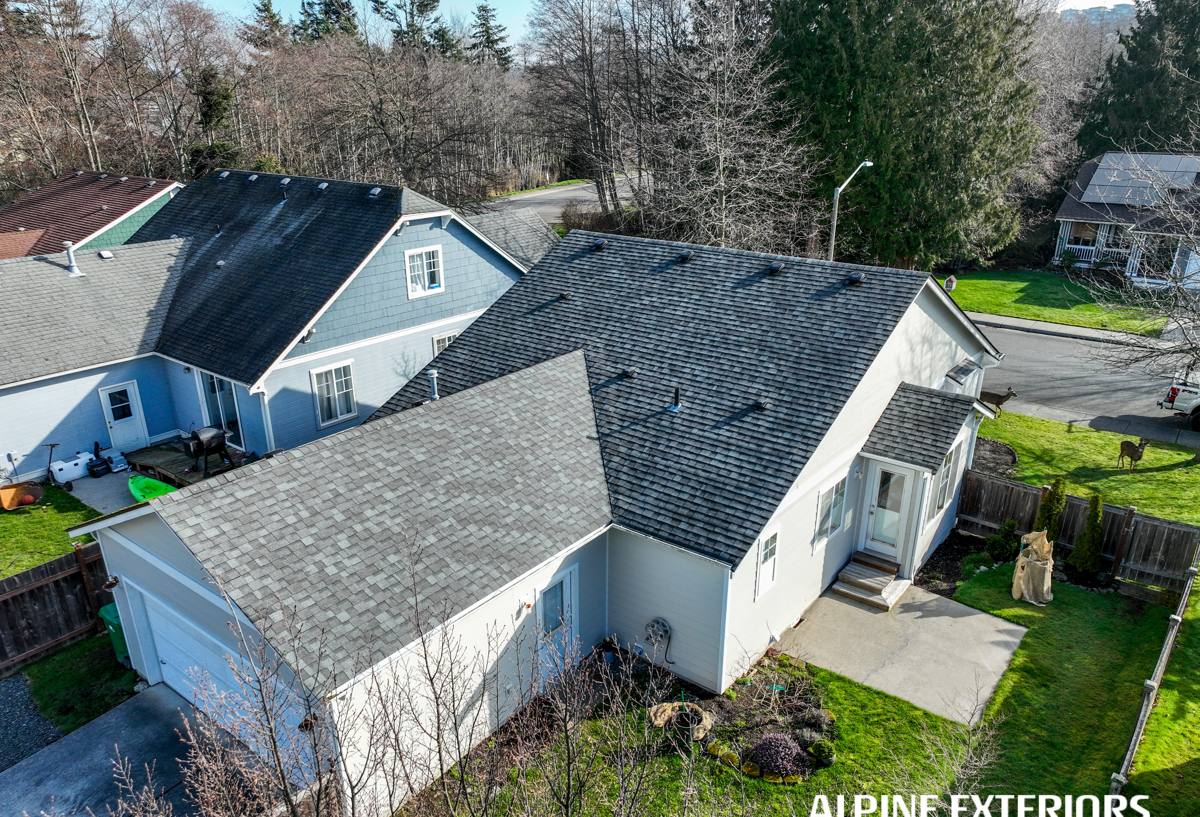
What Blanchard's Climate Does to a House
Three things drive most of the exterior wear we see on homes in and around Blanchard:
Salt Air
Proximity to Puget Sound means airborne salt moisture works its way into paint, caulk, and any exposed wood fiber. Salt air accelerates corrosion on fasteners and metal trim, and it breaks down lower-grade paint finishes faster than a homeowner further inland would ever notice on their own siding.
Driving Rain
Storms coming off the water don't just drop rain straight down — wind-driven rain gets pushed sideways into wall assemblies, working into seams, laps, and any gap around trim or penetrations. Over years, this is what turns a small installation flaw into a rot problem behind the siding, not just on top of it.
Moss Season
Skagit County's wet season runs long, and Blanchard's tree cover keeps a lot of siding in partial shade for much of the year. That combination — moisture plus shade plus organic debris from surrounding trees — is exactly what moss, algae, and mildew need to take hold. On a wood-based product, that growth doesn't just look bad; it holds moisture against the surface and shortens the material's life.
Why Material Choice Matters More Here Than in Drier Climates
In a dry climate, a homeowner can get away with a lot of siding shortcuts. In Blanchard, the environment finds every weak point — every un-primed cut edge, every seam that wasn't caulked correctly, every wood product that was one bad winter away from swelling. We've standardized on James Hardie fiber cement siding for every job we do, and we don't install vinyl, LP SmartSide, Cemplank, Allura, primed spruce, or cedar. That's not a marketing position — it's a decision based on what actually holds up when salt air, driving rain, and shade-driven moss season hit a house year after year.
Fiber cement is fundamentally different from wood-based or vinyl products in how it handles moisture. It doesn't swell, delaminate, or feed fungal growth the way wood-based siding can when the factory coating gets compromised. It doesn't warp, crack, or go brittle from UV and temperature swings the way vinyl can over a couple of decades. And because James Hardie's ColorPlus finish is baked on at the factory rather than field-applied, the color layer itself resists the fading and chalking that salt air speeds up on site-painted surfaces.
Fiber Cement vs. Common Alternatives in This Climate
| Factor | James Hardie Fiber Cement | Vinyl / Wood-Based Alternatives |
|---|---|---|
| Moisture response | Engineered to resist swelling and moisture absorption | Wood-based products can swell or delaminate if the coating is breached; vinyl can trap moisture behind panels |
| Salt air / coastal exposure | Factory-baked ColorPlus finish holds color and integrity | Field-applied paint and vinyl color both degrade faster under salt exposure |
| Moss and algae resistance | Non-organic material doesn't feed fungal growth | Wood fiber can support moss/algae growth once the surface is compromised |
| Fire performance | Non-combustible material | Wood-based products and vinyl are combustible |
| Typical lifespan when installed to spec | Multiple decades with routine maintenance | Shorter service life is common in wet coastal climates |
None of this means every alternative product is worthless everywhere — it means that in a climate like Blanchard's, the trade-offs stack up against them, and we'd rather stand behind one product system we trust than sell homeowners something we know will struggle here.
James Hardie Product Lines We Install
James Hardie makes climate-engineered product lines, and the HZ5 line is formulated for the Pacific Northwest's wet, temperate conditions — including areas like Skagit County that see prolonged damp weather and coastal moisture exposure. Depending on the home and the look a homeowner wants, we typically work with:
- HardiePlank lap siding — the most common choice, available in several textures and exposures, for a traditional horizontal siding look
- HardiePanel vertical siding — often used for board-and-batten style accents or full vertical applications
- HardieShingle siding — a shingle profile for homes wanting that texture without the maintenance of real wood shakes
- HardieTrim boards — matched trim that resists the same moisture and rot issues as the field siding
Color is factory-applied through the ColorPlus system, which matters in a climate where field-painted surfaces take a beating from UV, salt, and driving rain. It also comes with a stronger, non-prorated warranty structure than most of the alternatives we chose not to carry.
Beyond Siding: Roofing, Windows, and Decks
Siding doesn't work in isolation — it's one piece of the building envelope, and in a climate like Blanchard's, the pieces need to work together. We also handle:
Roofing
A roof that's shedding water properly, with flashing and underlayment doing their job, protects the siding and framing below it. In a moss-prone area, roof condition and siding condition tend to go hand in hand.
Windows
Window flashing and sealing are common failure points for wind-driven rain intrusion. When we replace siding around old windows, we look closely at whether the window flashing is doing its job before we close the wall back up.
Decks
Exterior decks in this climate face the same driving rain and moss exposure as siding, and materials and fastening details that ignore that reality don't last. We build and repair decks with the same climate-first approach we bring to siding.
Handling all four trades means fewer subcontractors, fewer gaps in accountability, and a crew that actually understands how the roof, walls, windows, and deck of a house interact.
What to Expect From a Local Crew
Working in Skagit County day in and day out means we've seen how this specific climate treats different products, details, and installation shortcuts over time — not in a lab, but on real homes a few miles from Blanchard. When you're vetting any contractor for exterior work in this area, a few things are worth checking:
- Ask what siding product they install and why — a contractor who installs everything usually isn't specializing in what actually performs in your climate
- Confirm they're licensed and insured in Washington, and ask to see current documentation
- Ask about their approach to flashing, house wrap, and moisture management — not just the visible siding
- Get a written scope of work, not just a total price
- Ask how they handle trim, caulking, and paint-line details around windows and doors, since that's where driving rain does the most damage
- Check whether the manufacturer's warranty transfers to future homeowners
Cost Factors for Siding Replacement
Every home is different, but the biggest cost drivers on a Blanchard-area siding project tend to be the same handful of factors:
| Factor | Why It Affects Cost |
|---|---|
| Home size and wall complexity | More linear footage, more corners, dormers, and cutouts increase labor time |
| Existing siding removal | Tear-off and disposal of old siding adds labor beyond a direct overlay job |
| Substrate and moisture damage | Rotted sheathing or framing found during tear-off needs repair before new siding goes on |
| Trim and detail work | Custom trim, window surrounds, and accent details take more time than plain lap runs |
| Product selection | Plank profile, texture, and color choice within the Hardie lineup affect material cost |
The only way to get an accurate number is a site visit — a house near the water with heavy shade and tree cover is a different scope than one on higher, more open ground, even if they're both in Blanchard.
Maintenance in a Coastal, Shaded Climate
Even the right product benefits from basic upkeep in this environment. For homes in and around Blanchard, we generally recommend:
- Rinsing siding periodically to clear salt residue and organic debris before it builds up
- Keeping tree branches and shrubs trimmed back from siding to reduce shade and improve airflow
- Checking caulking around windows, doors, and trim joints annually for gaps
- Clearing gutters and downspouts regularly so water isn't running down or pooling against the siding
- Addressing any moss or algae growth early rather than letting it establish
None of this is difficult, but skipping it in a climate this wet tends to shorten the life of any exterior product — including a good one.
Get an Estimate
If you're weighing siding, roofing, window, or deck work on a home in Blanchard, we're happy to take a look and walk you through what we're seeing and what it would take to address it. There's no pressure and no cost to get an estimate — just a straight answer based on your house and this area's climate.