 Mount Vernon
 Avon sits in the Skagit River lowlands just outside Mount Vernon, in the kind of open, low-lying farmland that gives Skagit County its identity — and its weather. Homes out here take a different kind of beating than a house tucked into town. There's less windbreak, more standing moisture in the air off the river and the fields, and a longer stretch of the year where surfaces just don't fully dry out. If you've owned a home in this area for more than a season or two, you already know what that does to paint, trim, and siding that wasn't built for it.
We're a Mount Vernon-based exterior contractor working the Skagit Valley, and Avon is well within our regular service area. This page walks through what the local climate does to a home's exterior, how we approach siding, roofing, window, and deck work for houses out here, and why we've standardized on one siding product instead of offering the usual lineup.
What Avon's Climate Does to a Home's Exterior
Avon doesn't get hurricane weather, but it gets something arguably harder on a building over time: persistent, low-grade moisture exposure. A few things stack up specifically in this part of the county:
- Salt-influenced air moving up from Puget Sound and Skagit Bay carries fine salt content that accelerates corrosion on fasteners, flashing, and metal trim, and speeds up the breakdown of lower-grade siding finishes.
- Driving rain off the water and across open farmland hits siding at an angle, not straight down — which pushes moisture into laps, seams, and butt joints that a calmer climate would never test.
- A long moss and algae season, thanks to mild temperatures and shade from mature trees on many older lots, keeps north- and east-facing walls damp for extended stretches, especially into late spring.
- Flat, low terrain near the river means slower air movement and drainage around foundations and lower wall sections, so splash-back and ground moisture linger longer than they would on a sloped lot.
None of this is unique to any one house — it's the baseline for the area. The difference shows up in which materials and installation details actually hold up against it.
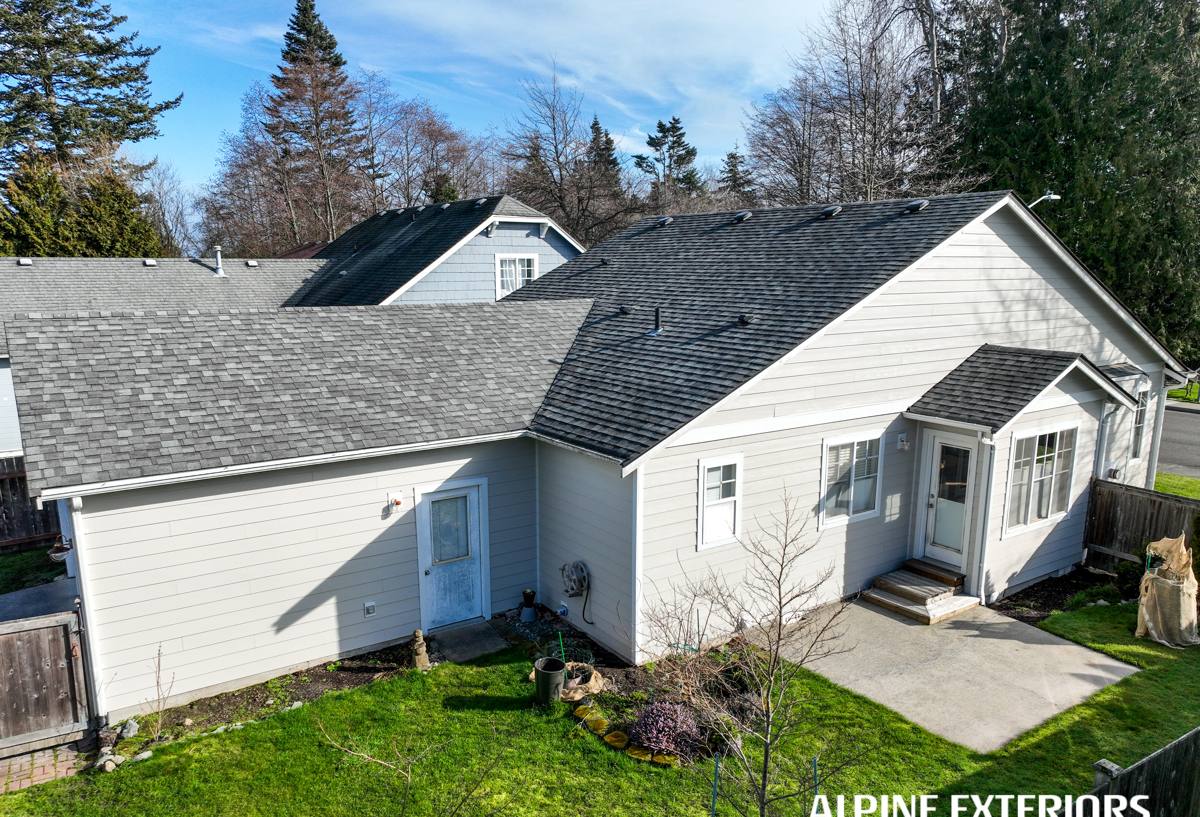
Why We Install Only James Hardie Fiber Cement Siding
We used to install a broader mix of siding products, like most contractors in this region still do. We stopped. Not because every alternative is bad, but because after years of service calls, tear-offs, and repaint jobs across Skagit County, one pattern kept repeating: the products that looked fine in the showroom or on a dry-climate spec sheet didn't hold up the same way against sustained damp, salt-tinged, moss-friendly weather like what Avon gets for most of the year.
James Hardie fiber cement is what we put on homes instead. It's not a magic material, and it still needs to be installed correctly to perform — but as a system, it gives us three things we consider non-negotiable for this climate:
- It's non-combustible. Fiber cement doesn't feed a fire the way wood-based or foam-core products can.
- It doesn't rely on paint film alone to survive moisture. The cement composition itself resists swelling, delaminating, and rot in a way that engineered wood products can't fully match, no matter how well they're primed.
- The ColorPlus factory finish is baked on under controlled conditions, not brushed or sprayed on-site, which matters a lot in a region where a two-week dry window to paint a house properly is not guaranteed.
We go into more detail on specific product comparisons elsewhere on our site. The short version for Avon homeowners: we'd rather turn down a lower-cost bid than install something we know is going to need attention again in 6-8 years out here.
Siding Material Comparison for This Climate
| Factor | James Hardie Fiber Cement | Vinyl | Engineered Wood (LP-type) |
|---|---|---|---|
| Moisture tolerance | Strong — cement composition resists swelling and rot | Sheds water but seams can trap moisture behind panels | Vulnerable if edges/cuts aren't fully sealed and maintained |
| Salt air / coastal-influenced exposure | Good — factory finish holds up well | Can chalk and become brittle over time | Finish and substrate both stressed by repeated damp cycles |
| Moss and algae resistance | Cleanable, doesn't feed growth | Cleanable, but seams collect debris | Organic substrate is more susceptible to growth if damp persists |
| Fire performance | Non-combustible | Combustible, can melt/deform | Combustible wood-based core |
| Finish longevity | Factory-applied ColorPlus, long warranty | Color molded in, can fade | Field-applied or factory primer, repaint cycles needed |
This isn't a knock on every product in the second and third columns across every climate. It's specific to what happens to a wall assembly here in the Skagit lowlands over a 10, 20, 30-year timeline.
Our Process for Avon Homes
Assessment First
Before we talk products or pricing, we walk the exterior and look at what the current siding, trim, and flashing are actually telling us. On older Avon homes, we're often looking closely at north-facing walls and areas shaded by trees or neighboring structures, since that's where moss gets a head start and where moisture tends to sit longest.
Moisture Management Comes First, Siding Comes Second
A siding job is only as good as what's underneath it. We check house wrap, flashing details around windows and doors, and drainage at the base of walls before a single new panel goes up. In a climate like this, a beautiful siding job over a compromised moisture barrier just delays the next problem — it doesn't solve it.
Installed to Manufacturer Spec
James Hardie's warranty coverage depends on correct installation — proper clearances, fastening patterns, and joint treatment. We install to that spec as a baseline, not an upsell, because a siding product is only as good as the crew putting it on the wall.
Roofing, Windows, and Decks: The Rest of the Envelope
Siding doesn't work in isolation. On a lot of the service calls we run in the Avon and Mount Vernon area, the actual water intrusion problem started at a roof edge, a window flashing detail, or a deck ledger board — and the siding just got blamed because that's where the stain showed up.
- Roofing: We evaluate roof-to-wall transitions, valleys, and flashing as part of any siding project, since a leak at the roofline will undermine even a perfectly installed wall below it.
- Windows: Window flashing and integration with the water-resistive barrier is one of the most common failure points we find on older homes in this area. When we replace siding around existing windows, we check this detail closely rather than just cutting siding to fit around a problem.
- Decks: Ledger boards and deck-to-house connections are a frequent moisture entry point, especially on homes with decks added years after original construction. We build and repair decks with that connection in mind, not just the visible surface.
Handling all four trades under one crew means fewer handoffs, fewer "that's not my scope" gaps, and a more honest read on what's actually causing a problem versus what's just showing the symptom.
Maintenance Realities for a Moss-Prone Property
Even the right siding product needs some ongoing attention in this climate. A realistic maintenance rhythm for an Avon home looks like:
- Annual visual check of north- and east-facing walls for early moss or algae growth, especially near tree lines.
- Gentle rinsing (not high-pressure blasting, which can force water behind panels or damage caulking) to keep organic growth from establishing.
- Periodic check of caulking at trim, window, and door transitions — sealant is often the first thing to fail, well before the siding itself.
- Keeping gutters and downspouts clear so wall-adjacent splash-back and overflow don't become a chronic moisture source.
This is lighter maintenance than most homeowners assume, but skipping it entirely in a climate like Skagit County's is how small issues turn into siding replacement a decade earlier than necessary.
What to Look for in a Local Exterior Contractor
- Actual experience with Skagit Valley conditions, not just a general regional service area on paper.
- Willingness to explain moisture management and flashing details, not just talk about siding color options.
- Clear answers about warranty coverage — both the manufacturer's product warranty and the contractor's own installation warranty.
- A written, itemized estimate rather than a rough verbal number.
- References or examples of completed work in the local area.
- Straight answers about why they recommend one product over another, including trade-offs.
Getting Started
If your Avon-area home is showing moss buildup, siding that's holding moisture, or you're planning ahead for roofing, window, or deck work, we're happy to take a look and give you an honest read on what's going on and what it would take to fix it properly. There's no pressure and no obligation — just a straightforward assessment from a crew that works this specific climate regularly. Reach out below for a free estimate.