 Mount Vernon
 Why Edison Homes Need Siding Built for This Exact Climate
Edison sits in the low, flat farmland of Skagit County, close enough to saltwater that homes here deal with a mix of conditions most inland Washington siding never has to survive. Salt-laden air moves in off nearby tidal waters and settles on exterior walls. Driving rain comes in sideways during fall and winter storms, not just straight down. And because the area stays damp and shaded for long stretches of the year, moss and algae get a real foothold on anything that holds moisture against its surface.
None of that is unusual for Skagit County as a whole, but Edison's exposure — open fields, marine air, minimal windbreak in a lot of spots — means the siding on these homes works harder than siding on a home tucked into a more sheltered part of Mount Vernon. A siding installation done here has to account for salt exposure, wind-driven moisture, and near-constant humidity, not just look good on install day.
What "Taking a Toll" Actually Looks Like
Over time, a siding system that isn't suited to this climate shows it in specific ways: paint that chalks and fades faster than it should, seams that let moisture behind the cladding, fastener heads that streak with rust, and a green-black film of moss or algae that keeps coming back no matter how often it's washed off. None of these are cosmetic-only problems — they're usually early signs that water is finding its way past the surface layer, which is where real damage starts.
What Correct Siding Installation Involves Here
A siding job that holds up in Edison's climate is won or lost in the details most homeowners never see once the project is done. The visible plank or panel is only part of the system.
Moisture Management Starts Before the Siding Goes Up
Before a single piece of siding is installed, the wall needs a continuous weather-resistant barrier, correctly lapped so water sheds downward and out, not into the wall cavity. Windows, doors, and any wall penetrations get flashed so that wind-driven rain — the kind Skagit County gets plenty of — can't work its way behind the siding at those vulnerable points. On homes exposed to salt air and heavy moisture, we also pay close attention to drainage at the bottom of the wall so water has somewhere to go instead of sitting against the siding's lower edge.
Fastening, Gaps, and Joint Details That Matter Long-Term
Fiber cement siding needs to be fastened at manufacturer-specified spacing and depth — over-driven or under-driven nails are one of the most common causes of early failure. Butt joints need to be caulked or flashed correctly, not just butted tight and painted over. And every board needs proper clearance from grade, roof lines, and hard surfaces so it isn't sitting in standing water or trapped moisture. These aren't optional refinements; they're the difference between siding that lasts decades in a marine climate and siding that needs attention again in a few years.
Why We Only Install James Hardie Fiber Cement
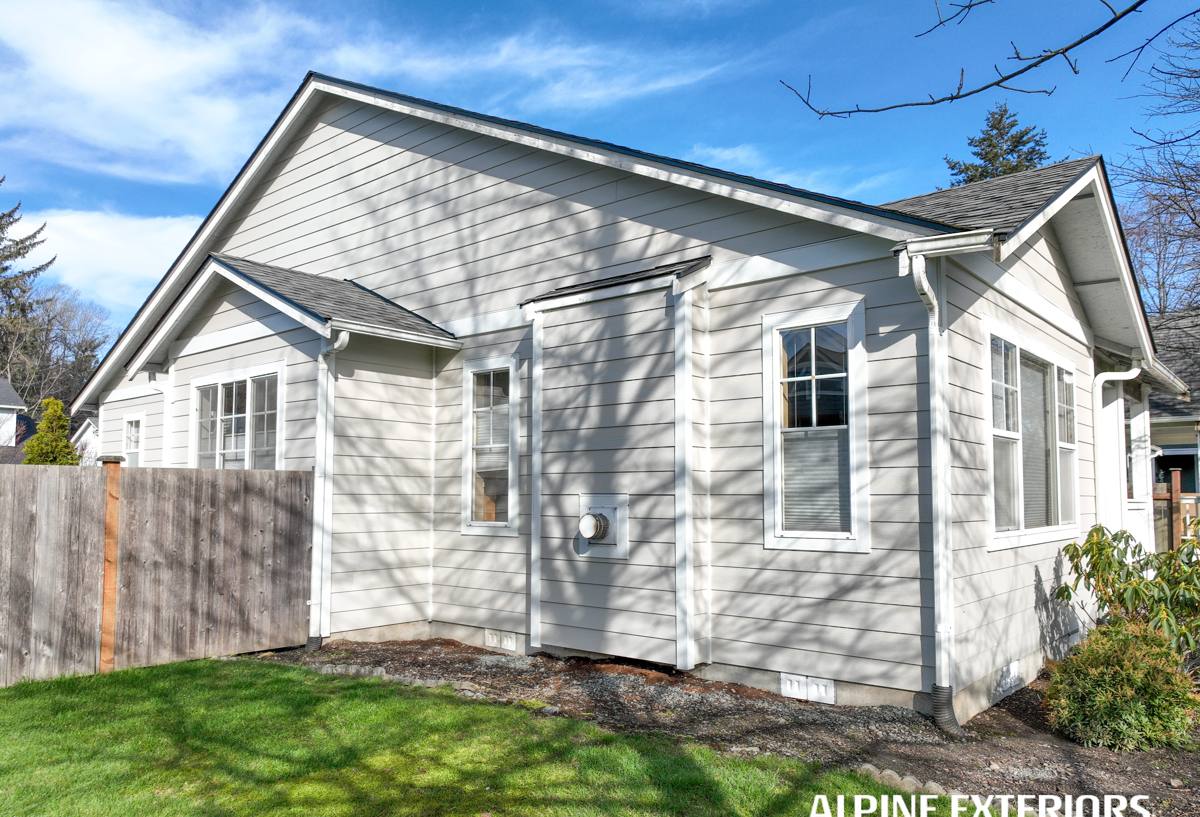
We install one siding product on every home we take on, including in Edison: James Hardie fiber cement. That's a deliberate standard, not a lack of options. We don't install vinyl, LP SmartSide, Cemplank, Allura, primed spruce, or cedar, because after years of doing this work in Skagit County's climate, we've settled on the product that gives homeowners the best combination of durability, appearance, and long-term value for what this area throws at a house.
What Makes Hardie the Right Fit for This Climate
- Non-combustible core — fiber cement doesn't burn, which matters regardless of climate but is a genuine advantage over wood-based and engineered-wood products.
- Climate-engineered HZ product lines — Hardie manufactures different formulations for different exposure zones, including versions built for the wetter, higher-humidity conditions the Pacific Northwest sees.
- Factory-applied ColorPlus finish — the color is baked on at the factory under controlled conditions, which holds up better against fading and moisture than field-applied paint on a lot of alternative products.
- Dimensional stability — fiber cement doesn't swell, warp, or rot the way wood-based sidings can when they take on repeated moisture, which is a real consideration in a climate with a long wet season.
- Strong transferable warranty — backed by a manufacturer warranty that holds up as a real asset if the home is sold, not just a marketing line.
We're not going to tell you every other siding product on the market is junk — plenty of them have legitimate use cases in the right climate and budget. But for what Edison homes are exposed to — salt air, sustained rain, and moss-friendly humidity — we've made the call that Hardie is the product worth standing behind, and it's the only one we put our name on.
Our Installation Process for Edison Homes
- On-site assessment. We look at the home's current siding, sheathing condition, trim, flashing, and exposure — a home in an open, wind-exposed spot needs different attention than one with more natural shelter.
- Removal and inspection. Old siding comes off and we check the sheathing underneath for hidden moisture damage before anything new goes up. This step is non-negotiable — covering damaged sheathing with new siding just hides a problem that will resurface.
- Weather barrier and flashing. A continuous water-resistive barrier goes on, with flashing detailed at every window, door, and penetration.
- Hardie installation to spec. Panels or planks are installed with correct fastener spacing, joint treatment, and clearances, following James Hardie's installation requirements for this climate zone.
- Trim, caulking, and finish work. Joints, corners, and transitions get sealed and finished so the whole system sheds water the way it's designed to.
- Final walkthrough and cleanup. We walk the job with the homeowner before we consider it finished, and the site is cleaned up — old siding and debris hauled off, not left for someone else to deal with.
Comparing Siding Options for Edison's Climate
Homeowners researching siding often come across several materials. Here's an honest, straightforward look at how they generally compare for a home dealing with salt air, driving rain, and a long moss season — the conditions that matter most in this part of Skagit County.
| Material | Moisture & Salt Air Behavior | Moss/Algae Resistance | Long-Term Finish |
|---|---|---|---|
| James Hardie Fiber Cement (HZ) | Engineered for high-moisture climates; dimensionally stable | Factory finish resists staining better than raw wood surfaces | Factory-baked ColorPlus finish, does not need repainting on the manufacturer's typical schedule |
| Vinyl | Can warp or become brittle with temperature swings; seams are a moisture entry point | Prone to holding surface grime and algae in shaded, damp spots | Color is through the material but fades over time and can't be repainted easily |
| LP SmartSide / Engineered Wood | Wood-based core is more sensitive to sustained moisture exposure than fiber cement | Susceptible to moss and mildew if moisture gets past the surface treatment | Requires ongoing maintenance of the factory or field-applied finish |
| Cedar / Primed Spruce | Natural wood; moisture management depends heavily on maintenance discipline | Higher susceptibility to moss, mildew, and rot without regular upkeep | Needs repainting or restaining on a recurring cycle |
What Drives Cost on an Edison Siding Project
Every home is different, and the only way to get real numbers is a walk-through estimate. But the factors that typically move the cost of a siding installation up or down are consistent from job to job.
| Factor | Why It Matters |
|---|---|
| Home size and wall complexity | More square footage and more corners, gables, and dormers mean more material and labor time |
| Condition of existing sheathing | Hidden moisture damage found during tear-off can require repair before new siding goes on |
| Siding removal and disposal | Tearing off and hauling away old material (especially old wood or vinyl) adds time and disposal cost |
| Trim, fascia, and flashing work | Homes with aging trim or flashing often need those addressed as part of a proper installation |
| Site access | Rural and open-lot properties around Edison can be easier to stage than tightly built lots, but landscaping or setback can still affect access |
| Product line and profile | Different Hardie plank widths, panel styles, and trim combinations carry different material costs |
Signs an Edison Home May Need New Siding
- Visible warping, buckling, or separation at seams and corners
- Paint that's peeling, bubbling, or chalking heavily to the touch
- Soft spots when you press on the siding, especially near the bottom courses
- Persistent moss, algae, or dark staining that returns soon after cleaning
- Rising energy bills that suggest the wall assembly is no longer doing its job
- Visible gaps, cracks, or missing caulk at joints and around windows and doors
- Interior signs like peeling wallpaper, musty smell, or staining on interior walls near exterior corners
Why Hiring a Crew That Already Works in Edison Matters
Siding installation isn't just about the product — it's about whether the crew installing it understands the specific conditions the home will face. A crew that regularly works Skagit County's marine-influenced communities already knows how to detail flashing for driving rain, how to size drainage for salt-air exposure, and how moss growth patterns in this area affect where extra attention is needed on a wall. That's knowledge you build by doing the work here repeatedly, not by reading a manufacturer's install guide once.
There's also a practical side: a crew already familiar with the area knows the realities of rural and semi-rural lots, seasonal weather windows for a clean installation, and how to schedule around Skagit County's wetter months so the home isn't left exposed longer than necessary during the project.
Caring for Your Siding After Installation
A correctly installed Hardie siding system needs very little upkeep, but a little attention goes a long way in this climate. Rinse the siding periodically to keep salt residue and organic buildup from accumulating, especially on north- and west-facing walls that stay shaded and damp longer. Keep gutters clear so water isn't sheeting down the wall face, and check caulking at trim and joints every year or two as part of normal home maintenance. Beyond that, the product is built to handle the rest.
If your Edison home's siding is showing its age, or you're planning ahead for a replacement, we're happy to take a look and walk you through what correct installation would involve for your specific home. Reach out for a free, no-pressure estimate using the form below.