 Mount Vernon
 Why Bow Homes Take a Beating From the Weather
Bow sits in western Skagit County, close enough to open water that salt-carrying air reaches most homes here on a regular basis. Add driving rain that comes in sideways off the water during fall and winter storms, plus a moss season that can run eight months out of the year under the region's cloud cover, and you have three separate stresses working on your siding at once. None of them are dramatic on their own. Together, over years, they are what actually shortens the life of a siding job.
Salt air is corrosive to exposed metal fasteners and hardware, and it accelerates the breakdown of finishes that were never engineered for a marine climate. Driving rain doesn't just wet the surface of a wall — it finds its way under laps, around trim, and through any gap in flashing that wasn't detailed correctly the first time. And moss doesn't just look bad; it holds moisture against the wall surface for weeks at a time, which is exactly the condition that rots wood-based siding and traps water behind poorly sealed seams.
None of this means siding in Bow is a losing battle. It means the material and the installation both have to be chosen for this climate specifically, not for a national-average climate that doesn't actually exist where you live.
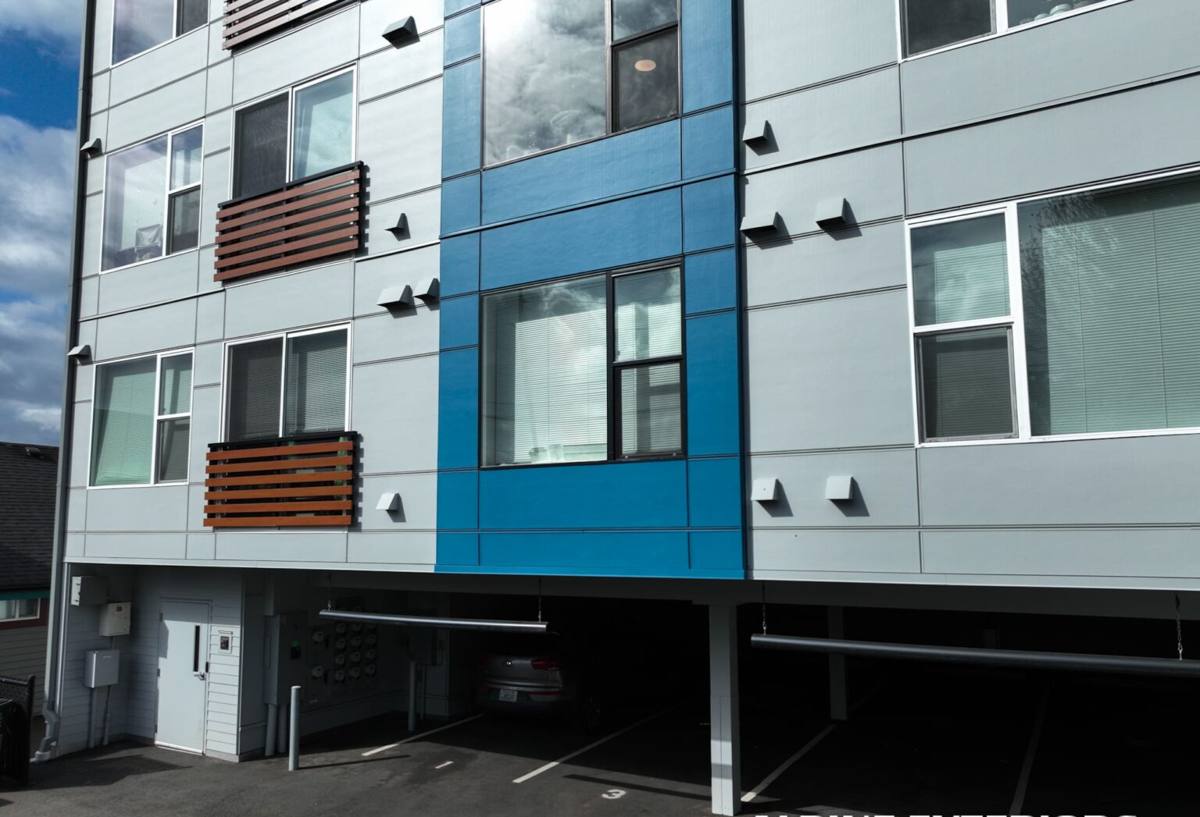
What a Correct Siding Replacement Involves
"Replacing siding" sounds like a one-step job. Done correctly, it's really four separate jobs stacked on top of each other, and skipping any one of them is how a siding job that looks fine on installation day starts failing five years later.
Full Tear-Off and Wall Inspection
We remove the old siding rather than install over it. Covering old siding with new is faster and cheaper, but it also seals in whatever moisture damage, rot, or trapped organic growth is already there — and in a climate with a moss season this long, there is almost always something back there worth finding before it's covered up for another 20 years. A full tear-off lets us inspect the sheathing itself, replace any soft or damaged sections, and start the new siding on a wall that's actually dry and sound.
Weather-Resistive Barrier and Flashing
Underneath the siding, a correctly lapped weather-resistive barrier and properly integrated flashing at every window, door, and roofline transition is what actually keeps wind-driven rain out of the wall assembly. This is the part of the job nobody sees once it's done, and it's also the part that determines whether the house stays dry through a real Skagit County winter storm or slowly takes on water behind a wall that looks perfect from the street.
Fastening and Fit
Fiber cement siding has a manufacturer-specified nailing pattern, fastener type, and gap tolerance for a reason — get it wrong and you get buckling, cracking at the fasteners, or moisture pulled in at the seams. We install to the manufacturer's written specification, not to a generic "how we've always done it" pattern, because the spec is what keeps the warranty valid and the wall performing the way it's supposed to.
Why We Install Only James Hardie Fiber Cement
We don't install LP SmartSide, vinyl, Cemplank, Allura, primed spruce, or cedar. That's a deliberate standard, not an oversight, and it's worth explaining honestly rather than just stating it.
Vinyl is inexpensive and low-maintenance, but it's a petroleum-based product that expands and contracts significantly with temperature swings, and in a climate this damp, whatever moisture gets behind it during a wind-driven rain event has nowhere to go quickly. Wood-based and wood-adjacent products like cedar, primed spruce, and OSB-core engineered siding can look excellent, but they depend on flawless, ongoing maintenance to keep moisture out — miss a repaint cycle in a climate with an eight-month moss season and the clock starts running on rot. Those aren't defects in those products; they're trade-offs, and in this specific climate we don't think they're trade-offs worth asking a homeowner to manage for 20-plus years.
James Hardie fiber cement is non-combustible, dimensionally stable, and doesn't feed rot or insects the way wood-based products can. The HZ5 product line is engineered specifically for climates like ours — freeze-thaw cycles, high humidity, and sustained moisture exposure — rather than a one-size-fits-all national formulation. The factory-applied ColorPlus finish is baked on under controlled conditions and carries its own finish warranty, which matters in a marine climate where field-applied paint is fighting salt air and UV from day one. It's also backed by a strong transferable warranty, which matters to a lot of Bow homeowners who plan to sell eventually. We standardized on it because, installed correctly, it's the product we're comfortable putting our name behind in this specific climate — not because every other product on the market is bad everywhere.
What Siding Replacement Typically Costs in Bow
Every home is different, and we don't quote a number without seeing the house, but the factors that actually move the price are consistent. The table below is meant to help you understand what you're paying for, not to substitute for an on-site estimate.
| Cost Factor | Why It Matters in Bow |
|---|---|
| Sheathing condition | Homes with a long moss season and years of trapped moisture behind old siding more often need sheathing repair once the walls are opened up |
| Home size and number of stories | More wall area and taller walls both add material and labor, and taller walls change the access and staging required |
| Trim, fascia, and flashing scope | Rural and acreage properties around Bow often have more trim detail and roofline transitions, each one a place where flashing has to be done right |
| Siding profile and accessories | Lap width, corner treatment, and trim style affect material cost and labor time independent of square footage |
| Site access | Rural lots, long driveways, and setback from the road can affect staging and delivery logistics compared to a standard in-town lot |
Our Process, Start to Finish
The steps don't change much from house to house, but the details inside each step are where the job is actually won or lost.
- On-site inspection. We look at the current siding, check for soft spots and existing moisture damage, and get a real sense of what's underneath before we ever write a number down.
- Proposal and product selection. We walk through profile, color, and trim options, and explain what each choice means for cost and long-term performance in this climate.
- Tear-off and sheathing repair. Old siding comes off, damaged sheathing gets replaced, and the wall is inspected before anything new goes up.
- Weather barrier and flashing. This is the step that determines how the house handles driving rain for the next several decades, and it happens before a single piece of visible siding is installed.
- Installation to manufacturer spec. Fastening pattern, gaps, and clearances follow James Hardie's written installation requirements, not shortcuts.
- Trim, caulking, and final details. Finish work at corners, penetrations, and transitions gets the same attention as the field of the wall.
- Walkthrough. We go over the finished job with you before we consider it done.
Checklist: What to Ask Before You Hire
Skagit County has no shortage of contractors willing to quote a siding job. Here's what separates a crew that will still stand behind the work in ten years from one that won't.
- Are they licensed, bonded, and insured to work in Washington, and can they show you proof without being asked twice?
- Do they perform a full tear-off, or do they offer to install over your existing siding to save time?
- Will they inspect and repair sheathing as part of the job, or only address what's visible from the outside?
- Do they install to the manufacturer's written specification, and will that installation keep the product warranty intact?
- What's covered under the workmanship warranty specifically, separate from the manufacturer's product warranty?
- Have they worked on homes in this area before, and do they understand how the local climate affects the job?
Signs Your Siding Is Already Failing
Siding failure in this climate is rarely sudden. It shows up as a pattern of small signs first.
- Moss or dark staining that keeps coming back low on the wall no matter how often it's cleaned
- Soft or spongy spots when you press on the siding, especially near the bottom courses or around windows
- Paint that fails or bubbles repeatedly in the same spots within a year or two of repainting
- Boards that are visibly cupping, warping, or separating at the seams
- A musty smell in a room along an exterior wall, which can point to moisture already inside the wall assembly
- Noticeably higher heating bills without another clear explanation
Any one of these is worth a look. Several at once usually means the wall assembly, not just the surface, needs attention.
Why a Crew That Already Works in Bow Matters
A siding crew that already works in and around Mount Vernon and the Bow area has seen how this specific stretch of Skagit County behaves — which walls take the worst of the wind-driven rain, how fast moss comes back on a shaded north wall near the tree line, and what rural and acreage properties need in terms of access and staging that a standard in-town lot doesn't. That's not something you can fully substitute with a generic install manual, even a good one.
It also means straightforward logistics: material delivery timed around the wet season, scheduling that accounts for how weather actually moves through this part of the county, and a crew that isn't learning the area on your house for the first time.
If you're weighing a siding replacement for a home in Bow, we're glad to come take a look and give you a straight, no-pressure estimate — no obligation, and no pressure to decide on the spot.