 Mount Vernon
 Big Lake's Microclimate Is Tougher on Siding Than Most Homeowners Realize
Big Lake sits in a pocket of Skagit County that combines several things siding has to fight at once: shade from mature trees, standing humidity off the water, driving rain that comes sideways off the Sound-influenced weather systems that move through the county, and long stretches of the year when a north-facing wall barely sees direct sun. That combination is why moss and algae show up on siding here faster than on a similar house in a more open, sunnier part of Mount Vernon. It's also why we see more soft, water-damaged trim and lap boards on lakefront and near-lake homes than almost anywhere else we work in the county.
None of that is unusual or alarming — it's just what siding on a shaded lake lot has to be engineered to handle. The problem is that a lot of products sold as "low maintenance" were never actually engineered for it. Wood-based siding absorbs the ambient moisture and stays damp longer under tree cover, which accelerates rot. Vinyl doesn't rot, but it doesn't stop the moss and grime from taking hold either, and it can't be repainted to fight back once it starts. James Hardie fiber cement is the one product in this category that's both non-combustible and formulated specifically for wet, marine-influenced Pacific Northwest conditions — which is why it's the only siding we install, on Big Lake or anywhere else in our service area.
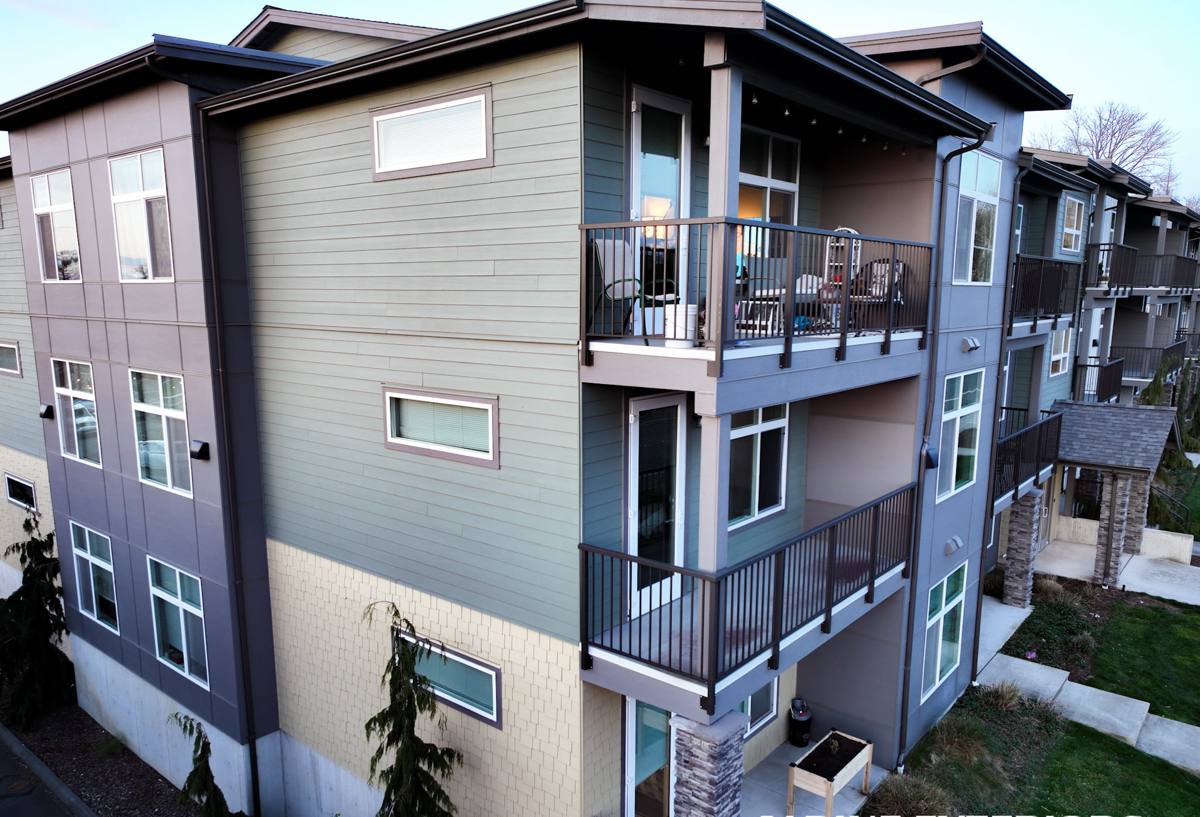
What a Correct Installation Involves on a Shaded Lake Lot
Drainage Behind the Siding, Not Just On It
The single biggest factor in how well siding performs on a shaded, humid lot isn't the siding material itself — it's what's behind it. A proper installation includes a weather-resistive barrier and a drainage gap (a rainscreen or furring strategy) that lets any moisture that gets past the cladding actually drain and dry out instead of sitting against the sheathing. On a home that's shaded most of the day and slow to dry after rain, skipping this step is where rot starts, regardless of what siding is nailed on top.
Clearances That Actually Matter Here
James Hardie's own installation instructions call for minimum clearances from grade, roofing, decks, and other flatwork — typically several inches minimum, more where possible. On lake-adjacent lots where landscaping tends to be lush and grade can creep up over the years, we see more siding installed too close to soil and mulch beds than anywhere else in our territory. That clearance is what keeps the bottom courses from wicking up ground moisture during the wet months.
Flashing and Fastening
Every horizontal joint, window head, and penetration needs correct flashing and integration with the weather barrier — caulk is not a substitute for flashing, it's a backup to it. Fasteners need to be corrosion-resistant and driven to Hardie's specified depth and location; over-driven or under-driven nails are one of the most common causes of premature siding failure we find when we're called out to fix someone else's job.
Which Hardie Products Fit a Big Lake Home
James Hardie makes several product lines, and the right pick depends on the home's style and exposure, not just personal taste.
- HardiePlank lap siding — the most common choice for traditional and craftsman-style homes; available in smooth or cedar-textured finishes.
- HardiePanel vertical siding — often used for accent gables, shed dormers, or a modern look, and pairs well with lap siding on the same home.
- HardieTrim boards — for corners, fascia, and window/door surrounds; matching the trim material to the field siding keeps moisture behavior consistent across the whole envelope.
- HZ10 engineered climate formulation — Hardie engineers its products to different climate zones, and the HZ10 line is built for wetter, more humid regions like ours, with better resistance to moisture-related freeze-thaw and moss/mildew growth than the standard formulation sold in drier climates.
For a shaded lake lot specifically, we usually steer homeowners toward the smooth or lightly textured ColorPlus finishes rather than deep, rough cedar-texture profiles — the deeper grooves in heavy textures hold moisture and organic debris longer in low-sun conditions, which gives moss more to grab onto.
Moss, Algae, and Why the Factory Finish Matters
ColorPlus Technology is James Hardie's factory-applied finish, baked on in a controlled environment rather than sprayed or brushed on site. Two things matter for a Big Lake home specifically: it holds color and resists fading better than field-applied paint under UV and moisture cycling, and it gives a harder, more consistent surface for moss and algae to attempt to colonize. It doesn't make siding moss-proof — nothing does, if a wall stays damp and shaded long enough — but it holds up to washing far better than a painted wood surface, and it doesn't need to be repainted every few years just to keep ahead of it. Combined with keeping vegetation trimmed back from the siding and gutters clear, it's the most effective long-term defense against the moss problem that's common on shaded lots in this part of the county.
Cost Factors for a Big Lake Siding Project
Every home is different, but these are the factors that move the price on jobs in this area, in roughly the order they matter:
| Factor | Why it matters here |
|---|---|
| Existing wall condition | Shaded, lake-adjacent homes more often need sheathing repair before new siding goes on, especially if the old cladding trapped moisture. |
| Siding profile and trim complexity | Multiple gables, dormers, and mixed lap/panel designs take more labor than a simple rectangular elevation. |
| Access and site conditions | Mature trees, slopes down to the water, and tight side yards common on lake lots can slow staging and material handling. |
| Drainage plane upgrade | Adding or improving a rainscreen gap where the existing wall assembly doesn't have one. |
| Finish selection | ColorPlus factory finish vs. field-applied paint after installation. |
We won't quote a number without seeing the house — anyone who does is guessing — but these are the variables worth asking about when you're comparing estimates.
Our Process for Big Lake Homes
- Walk the exterior with you. We look at current siding condition, trim, moisture staining, moss patterns, and grade clearance before talking product.
- Check what's behind the cladding. Where there's visible damage or staining, we open a section to assess sheathing before quoting a full tear-off number.
- Written scope and product plan. Which Hardie products, which finish, drainage strategy, and trim details — in writing, not verbal.
- Removal and prep. Old siding comes off, sheathing repairs happen if needed, and the weather barrier and drainage plane go in correctly the first time.
- Installation to Hardie's published specs. Correct clearances, flashing, fastener spacing and depth, and joint treatment.
- Final walkthrough. We go around the house with you before calling the job done.
Why Local Experience on This Specific Kind of Lot Matters
A crew that mostly works open, sunny subdivisions elsewhere in Skagit County can still install Hardie siding competently, but they may not think about drainage planes, moss-resistant profile selection, or grade clearance the same way a crew that works shaded, humid lake lots every season does. We've seen what happens on Big Lake and similar lots when siding is installed to a generic spec instead of the conditions actually present on site — it's almost always moisture and moss related, and it almost always traces back to skipped drainage detailing or clearance shortcuts, not the siding material itself. Working this kind of terrain regularly is what makes the difference between a job that looks fine at handoff and one that still looks fine ten years later.
Maintaining Hardie Siding on a Lake-Adjacent Home
- Rinse siding gently once or twice a year, more often on heavily shaded elevations, to keep organic buildup from taking hold.
- Keep gutters and downspouts clear so water isn't overflowing directly onto siding below.
- Trim back vegetation and tree limbs that keep any wall in constant shade or hold moisture against it.
- Inspect caulking at trim joints and penetrations annually and re-caulk as needed — caulk is maintenance, not a permanent seal.
- Check grade and mulch beds haven't crept up over the manufacturer's minimum clearance line over time.
Ready to Talk About Your Home
If you're dealing with moss buildup, soft trim, or siding that's simply reached the end of its life on a Big Lake property, we're happy to take a look and walk you through what correct James Hardie installation would involve for your specific home — no pressure, no obligation. Use the form below to request a free estimate.