 Mount Vernon
 Edison's Climate Is Harder on Siding Than Most Homeowners Realize
Edison sits out in the Skagit flats near the tidal water of Samish Bay, and that location shapes everything about how siding ages here. Homes in this pocket of Skagit County deal with a combination that inland neighborhoods don't face in the same way: salt-tinged marine air rolling in off the bay, wind-driven rain that hits siding sideways instead of falling straight down, and long stretches of shade and fog off the surrounding farmland that keep exterior walls damp for days at a time. None of these things ruin siding overnight. They wear it down slowly, one wet winter at a time, until a homeowner is dealing with soft trim, peeling paint, or siding that's failing years before it should.
Salt Air and Marine Exposure
Proximity to Samish Bay means airborne salt is a real factor on this stretch of Skagit County, not a coastal exaggeration. Salt-laden moisture accelerates corrosion on fasteners, staples, and any metal flashing or trim that isn't rated for the exposure. It also degrades cheaper paint films and coatings faster than they'd wear in a drier, inland climate, which is part of why so many older homes near the water show chalking, fading, or peeling well ahead of schedule.
Wind-Driven Rain
Flat, open land with few windbreaks means storms coming off the Sound or up the valley hit house walls at an angle instead of just running off a roof. That driving rain finds its way into any gap in the siding system — a poorly lapped seam, a missing kick-out flashing, a caulked joint instead of a properly lapped one — and once water gets behind siding in this climate, it doesn't dry out quickly.
Moss and Prolonged Dampness
Skagit Valley's moss season runs long, and Edison's mix of shade, standing agricultural moisture, and marine humidity extends it further. Moss and algae hold water against a wall surface, and on materials that aren't dimensionally stable, that constant dampness is what eventually leads to swelling, soft spots, and rot at the most vulnerable points — bottom edges, butt joints, and anywhere trim meets siding.
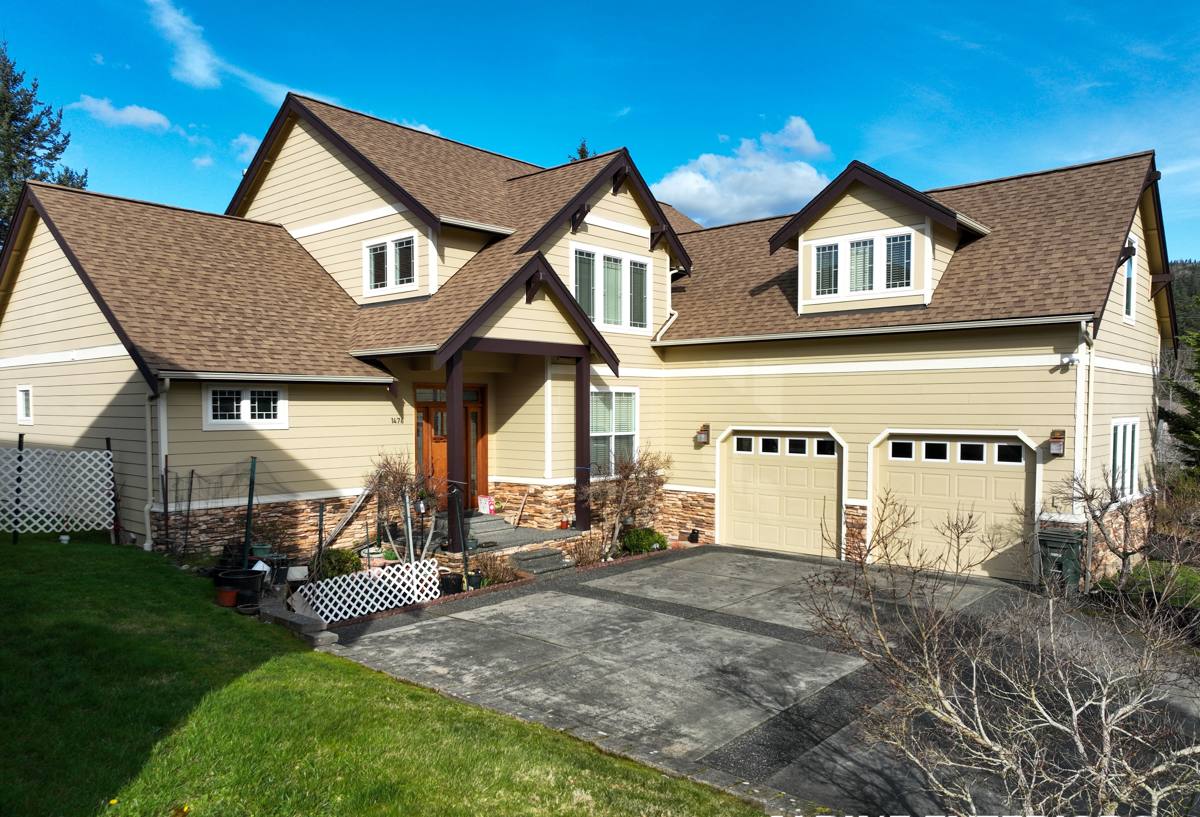
Signs an Edison Home Needs Siding Replacement, Not Another Repair
Because the damage here happens gradually, many homeowners patch the same problem spots for years before realizing the siding itself has failed. A few signs point to replacement rather than another round of caulk and paint:
- Soft or spongy spots when you press on siding near the bottom courses or around windows and doors
- Paint that's peeling or bubbling in the same areas every year, even after repainting
- Visible swelling, delamination, or a "puffy" texture on panel edges or seams
- Persistent moss or dark staining that comes back within a season of cleaning
- Warped, bowed, or separating panels, especially on the west and south-facing walls that take the worst of the driving rain
- Rust streaks running down from fasteners or trim, a sign the metal underneath is corroding
- Rising energy bills alongside drafty walls, which often means the siding and the moisture barrier behind it have both broken down
One or two of these on their own might be a repair. Several at once, especially combined with visible rot at trim boards or corners, usually means the whole system needs to come off and be replaced correctly.
What a Correct Siding Replacement Actually Involves
Siding replacement isn't just swapping old panels for new ones. In a climate that pushes water at a wall sideways and keeps it damp for extended stretches, what's underneath the visible siding matters as much as the siding itself.
Tear-Off and Inspection
A proper job starts with removing the old siding entirely, not covering over it. That's the only way to find hidden rot in sheathing, soft framing around windows, or a water-resistive barrier that's already failed. Skipping this step and re-siding over existing damage just buries the problem under a new surface.
Weather-Resistive Barrier and Flashing
Behind every panel, a correctly installed weather-resistive barrier and properly lapped flashing at windows, doors, and roof-to-wall transitions is what actually keeps wind-driven rain out of the wall assembly. Siding sheds the bulk of the water; the barrier and flashing behind it manage what gets past. In a spot like Edison, this layer isn't optional detailing — it's the difference between siding that lasts decades and siding that fails from the inside out.
Fastening and Clearances
Correct fastener type, spacing, and depth matter more here because of the salt exposure — fasteners rated for coastal-adjacent conditions resist corrosion that would otherwise streak and weaken the wall over time. Proper ground clearance and gaps at trim and roof lines also matter, since siding installed tight to grade or hard against trim traps moisture instead of letting it drain and dry.
Caulking Done Right, Not as a Crutch
Caulk has a real, limited job: sealing specific joints the system is designed to have sealed. It's not a substitute for proper flashing or lapping. A job that relies on heavy caulking to keep water out is a job that's going to need re-caulking every year or two, indefinitely.
Why We Install Only James Hardie Fiber Cement
We don't install vinyl, LP SmartSide, Cemplank, Allura, or primed wood siding, and in a climate like Edison's, that's a deliberate standard, not a preference. Fiber cement handles the specific stresses of this location — sustained dampness, moss, salt air, and driving rain — in ways that other common siding materials struggle with over time.
| Factor | James Hardie Fiber Cement | Vinyl / Engineered Wood |
|---|---|---|
| Moisture and swelling | Cement-based, dimensionally stable when wet | Wood-based products can swell and delaminate; vinyl doesn't rot but can warp |
| Moss and algae resistance | Non-organic surface resists sustained biological growth | Organic-based products are more vulnerable to fungal and moss damage over time |
| Combustibility | Non-combustible | Vinyl melts/deforms under heat; engineered wood is combustible |
| Factory finish | ColorPlus baked-on finish resists fading and chalking | Field-applied or lower-durability factory finishes vary widely |
| Warranty structure | Long, transferable manufacturer warranty on the substrate | Coverage and transferability vary, often shorter or more limited |
James Hardie also engineers its HZ5 and HZ10 product lines specifically for different climate exposures, which matters in a spot like Edison where marine humidity and coastal-adjacent conditions are more aggressive than a typical inland Skagit County lot. That climate-specific engineering, paired with the factory-applied ColorPlus finish, is a big part of why the color and surface hold up instead of chalking or peeling within a few seasons.
Our Process, From First Look to Finished Siding
- Walkthrough and assessment — We inspect the existing siding, trim, and any visible trouble spots, and talk through what we're seeing and why.
- Written estimate — A clear scope covering tear-off, any sheathing repair allowance, the Hardie product and profile, color, and total cost — no vague line items.
- Prep and protection — Landscaping, windows, and walkways get protected before tear-off begins.
- Tear-off and sheathing check — Old siding comes off completely, and any hidden rot or damage gets addressed before anything new goes up.
- Weather barrier and flashing — Installed and lapped correctly at every penetration, corner, and transition.
- Hardie installation — Fastened, spaced, and gapped to manufacturer specification and to the realities of this site's exposure.
- Final walkthrough — We go over the finished work with the homeowner before calling the job done.
What Siding Replacement Costs Depend On
Every Edison home is different, so we don't quote a number until we've seen the house, but the same handful of factors drive cost on almost every job:
| Factor | Why It Matters |
|---|---|
| Home size and wall complexity | More square footage, corners, and dormers mean more material and labor |
| Condition of what's underneath | Hidden sheathing or framing repair adds scope that's only visible after tear-off |
| Hardie profile chosen | Lap siding, shingle-style panels, and board-and-batten carry different material and labor costs |
| Trim and detail work | Corner boards, window trim, and fascia detailing add time and material |
| Site access | Tight lots, landscaping, or multi-story walls affect labor time and equipment needs |
Homeowners sometimes want a single number over the phone, but on a house they haven't seen and a job that includes tear-off, an honest contractor can't responsibly give one. What we can do is walk the house, point out what's driving cost up or down, and put it in writing.
Why Hiring a Crew That Already Works Edison Matters
Small communities like Edison don't get the same attention from larger regional contractors that Mount Vernon proper does, and that shows up in ways homeowners notice after the fact — a crew unfamiliar with how exposed a given wall really is, or how much moss pressure a shaded, low-lying lot actually sees compared to a drier site a few miles inland. A crew that already works this stretch of Skagit County knows to check the west and southwest walls more carefully, knows what the driving rain off the flats does to poorly flashed trim, and doesn't treat every job like a generic siding swap.
Working locally also means straightforward accountability. If something needs a callback after the job is done, we're not driving in from out of the area to handle it.
After Installation: Keeping Hardie Siding Performing in This Climate
Correctly installed James Hardie siding is low-maintenance, not zero-maintenance. In Edison's conditions, a homeowner still gets the most out of it by:
- Rinsing off accumulated moss, pollen, and salt residue once or twice a year
- Keeping gutters clear so overflow doesn't run down the wall face
- Trimming back vegetation that shades siding and keeps it damp longer than it needs to be
- Having caulked joints and trim checked periodically, since caulk is a maintenance item even on a well-built wall
None of that is heavy upkeep — it's the difference between siding that reaches the far end of its expected life and siding that needs attention sooner because moisture had a chance to sit against it season after season.
If your Edison home is showing any of the signs above, or you're just planning ahead before the next wet season sets in, we're happy to walk the property and give you a straightforward, no-pressure look at what's going on and what it would take to fix it right. Use the form below to request a free estimate.