 Mount Vernon
 Why Conway Roofs Take a Different Kind of Beating
Conway sits low in the Skagit River delta, close enough to Skagit Bay that salt-laden air is a regular part of the weather, not an occasional visitor. Add in wind-driven rain off the Sound, long stretches of overcast humidity, and shade from the mature trees and hedgerows common on delta properties, and you get a roofing environment that's tougher on materials than most inland Skagit County neighborhoods. Fasteners corrode faster. Moss and algae get a longer growing season because roofs rarely get a full dry-out between storms. Flashing and underlayment take more abuse because rain here doesn't fall straight down — it drives sideways under eaves, into valleys, and around chimneys and vent pipes.
None of this means Conway roofs fail faster than they should. It means they need to be built and replaced with this specific climate in mind — not with a generic install that would be fine forty miles east in a drier microclimate.
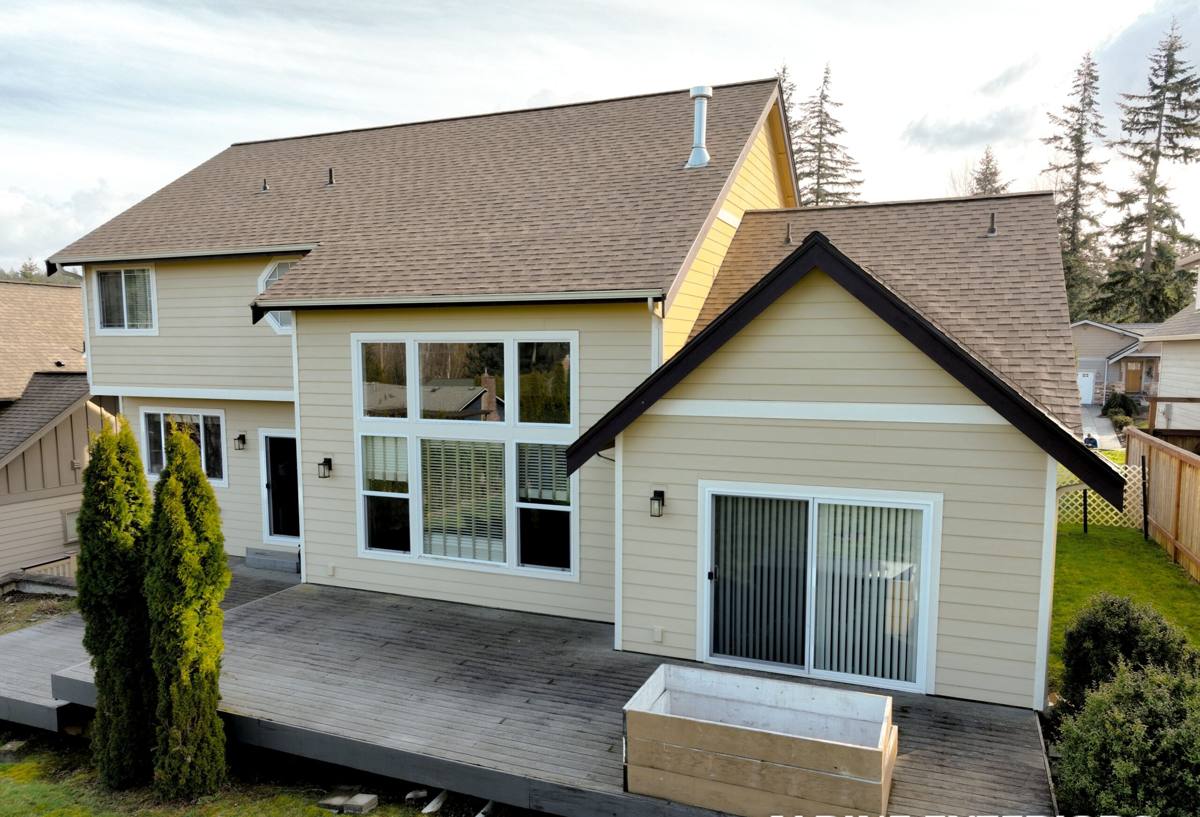
Signs Your Conway Home Needs a Full Replacement, Not Another Patch
Patching has its place, but on an older delta-area roof it often just delays a decision that's already been made by the weather. Here's what usually tips a roof from "repair" to "replace":
- Granule loss heavy enough that you can see bare, shiny patches on asphalt shingles
- Moss established at the shingle edges and butt joints, not just on the ridge or north-facing slope
- Soft or spongy decking felt underfoot, or visible sagging between rafters
- Daylight visible through the attic at eaves, ridge, or around pipe boots
- Staining or streaking on interior ceilings, especially near exterior walls or chimneys
- Multiple recent repairs to different areas of the same roof in the same year or two
- Roof age past 20–25 years for asphalt shingle, or visible curling/cracking regardless of age
If you're seeing two or more of these, a replacement almost always costs less over five years than continuing to chase leaks one at a time.
Roofing Materials That Hold Up in the Skagit Delta
Every roofing material can technically be installed near salt water. Not every material handles it the same way over 20+ years. Here's how the common options compare for a Conway-area home:
| Material | Salt air / corrosion behavior | Moss resistance | Typical lifespan here |
|---|---|---|---|
| Architectural asphalt shingle | Good — use corrosion-resistant fasteners and flashing | Moderate; benefits from zinc/copper strips at the ridge | 20–25 years |
| Standing seam metal | Very good with proper coating; avoid dissimilar-metal contact points | High — sheds debris and dries fast | 40–50 years |
| Cedar shake | Fair; needs regular maintenance in damp climates | Low without diligent upkeep — traps moisture | 20–30 years with maintenance |
| Composite/synthetic shingle | Good — inert to salt corrosion | Moderate to high depending on product | 30–40 years |
We don't push one material on every job. A steep, tree-shaded roof that never fully dries out is a different conversation than an open, wind-exposed roof closer to the bay. Cedar shake can look great on the right Conway property, but we're upfront that it asks more of an owner in a marine climate — more inspection, more moss treatment, more attention — and we'll tell you that plainly rather than sell around it.
What a Correct Roof Replacement Actually Involves
A roof replacement is more than swapping old shingles for new ones. In a moisture-heavy environment like Conway, the layers underneath the visible surface matter as much as the surface itself.
Tear-Off and Deck Inspection
We remove the existing roofing down to the deck rather than layering over it. This is the only point in the job where rot, soft spots, or under-ventilated sheathing are actually visible. Delta-area homes with a history of moss or slow leaks often have small pockets of deck damage around valleys, chimneys, or old pipe boots that a re-roof-over-existing job would simply bury for another decade.
Underlayment and Flashing
Given how much wind-driven rain Conway gets off the bay, we treat underlayment as a real second line of defense, not a formality — synthetic underlayment with self-adhered ice-and-water membrane at eaves, valleys, and any roof-to-wall transition where rain tends to get pushed sideways. Flashing at chimneys, skylights, and sidewalls gets replaced, not reused, and fasteners and flashing metal are chosen to resist salt-air corrosion rather than standard-grade hardware that can start rusting within a few seasons this close to the water.
Ventilation
Balanced intake and exhaust ventilation keeps the attic closer to outdoor temperature and humidity, which slows moss growth from underneath and prevents condensation from soaking the new decking from the inside. This is easy to skip and hard to notice until a roof underperforms its warranty — we check it on every replacement, not just the ones where it's obviously missing.
Our Process, Start to Finish
- On-site assessment — we walk the roof (or inspect from a lift on steeper pitches), check the attic for ventilation and moisture signs, and measure for an accurate material estimate.
- Written estimate — a clear breakdown of material choice, tear-off scope, and any deck repair contingencies, so there are no surprise change orders mid-job.
- Scheduling around weather — we watch the forecast closely for Conway jobs specifically, since an open roof deck and a fast-moving Pacific storm system don't mix. Materials and dry-in supplies are staged before tear-off starts.
- Tear-off and deck repair — old roofing removed, deck inspected, any soft or damaged sheathing replaced and documented.
- Underlayment, flashing, and ventilation install — the layers that actually determine how the roof performs in wind-driven rain and salt air.
- New roofing installation — installed to manufacturer spec, which matters for warranty coverage as much as appearance.
- Site cleanup and magnetic sweep — yard and driveway cleared of debris and stray fasteners.
- Final walkthrough — we go over the finished roof and attic ventilation with you before calling the job done.
Cost Factors for a Conway Roof Replacement
Every roof is different, so we don't quote a number until we've seen yours. But these are the factors that move the price up or down on most Skagit County delta homes:
| Factor | Why it matters |
|---|---|
| Roof size and pitch | Steeper pitches and larger footprints take longer and use more material and safety setup |
| Deck condition | Rotted or soft sheathing found during tear-off adds material and labor to repair before new roofing goes on |
| Material choice | Standing seam and composite products cost more upfront than asphalt shingle but last longer with less maintenance |
| Number of penetrations | Chimneys, skylights, and multiple vent pipes each need individual flashing work |
| Access and tree cover | Overhanging trees near the bay-side wind corridor may need trimming coordination for safe tear-off and material staging |
| Layers of existing roofing | Homes with a prior layer left in place take longer to strip down to bare deck |
As a rough starting point, a straightforward asphalt shingle replacement on an average single-story Conway home typically lands in the low-to-mid five figures, with metal and premium composite systems running higher. We'll give you an exact figure after we've actually looked at your roof.
Why a Crew That Already Works Conway Matters
Conway is a small, low-lying community, and its roofing needs aren't identical to a subdivision roof in Mount Vernon proper or a hillside home elsewhere in Skagit County. A crew that regularly works this specific area already has a feel for how far the salt air corridor reaches, how quickly moss re-establishes on shaded delta lots, and which flashing and fastener upgrades are worth the extra cost here versus optional elsewhere. That familiarity shows up in fewer callbacks and a roof that's built for the actual conditions it will sit under for the next two or three decades — not a generic install pulled from a drier part of the county.
It also means straightforward logistics: we know how weather moves through the delta and plan tear-off scheduling accordingly, rather than gambling an open roof deck against an incoming system.
Protecting Your New Roof Through Moss Season
A correctly installed roof still benefits from basic upkeep, especially given how long the moss-growing window is this close to the bay. A little maintenance goes a long way toward getting the full lifespan out of the investment:
- Clear gutters and downspouts at least twice a year — clogged gutters back up water under the roof edge
- Trim back overhanging branches to cut down on shade, debris buildup, and moss-friendly moisture
- Have moss treated or gently removed before it builds up thick mats, rather than after
- Check attic ventilation isn't blocked by insulation or storage items
- Walk the perimeter after major windstorms to look for lifted shingles or displaced flashing
- Keep an eye on zinc or copper moss-control strips and reapply treatment as recommended
None of this requires climbing on the roof yourself — most of it can be checked from the ground or the attic.
If your Conway roof is showing its age or you just want an honest read on what shape it's really in, we're happy to take a look. The estimate is free, there's no pressure, and you'll get a straight answer about repair versus replacement either way — just fill out the form below to get started.