 Mount Vernon
 Clear Lake's Climate Is Hard on Siding
Clear Lake sits in a part of Skagit County where shade, moisture, and standing humidity work together against exterior siding. Many homes here are tucked among trees along the lake, which keeps yards cool and green but also keeps siding wet longer than it would be on an open lot. Add in the driving rain that moves through this part of Washington for much of the year, plus the salt-tinged marine air that pushes inland from Puget Sound and the bays around Skagit County, and you get a climate that's genuinely tough on exterior building materials.
The result is a long moss season — often stretching from early fall through late spring — on any siding surface that stays shaded and damp. Moss doesn't just look bad. It holds water against the siding face, slows drying time after every rain, and creates the exact conditions that cause paint failure, wood rot, and fastener corrosion over time. On lake-adjacent lots with heavy tree cover, that cycle repeats every season unless it's addressed correctly.
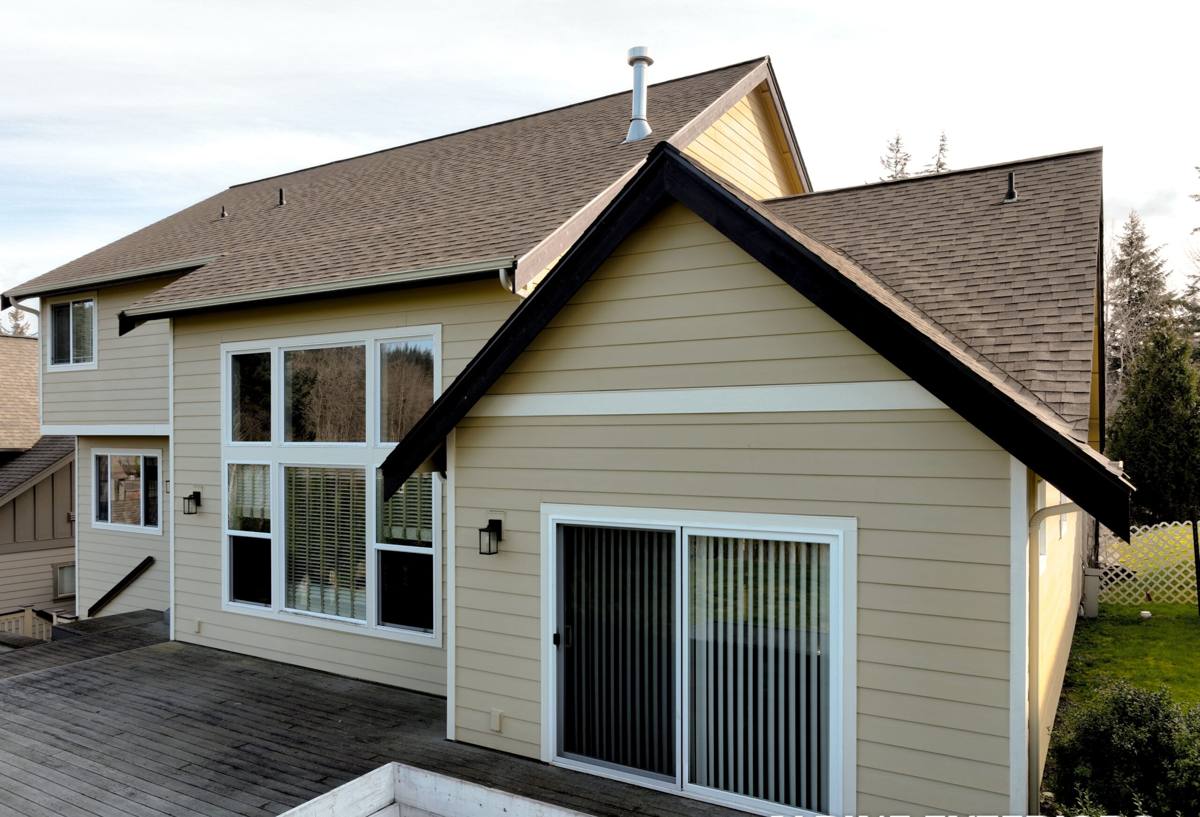
Signs Your Siding Needs Repair, Not Just a Repaint
A lot of siding problems get masked with paint or caulk instead of actually fixed. That buys a season or two, then the same spot fails again — usually worse. Here's what to look for before it gets to that point:
- Soft or spongy spots when you press on the siding, especially near the bottom courses
- Paint that keeps peeling or bubbling in the same location no matter how often it's redone
- Dark streaking, green or black growth, or persistent moss in shaded corners and under eaves
- Visible gaps or separation at board seams, corners, or where siding meets trim
- Cracked, shrunk, or missing caulk around windows, doors, and penetrations
- Swelling, bubbling, or delamination along bottom edges or butt joints
- Rust streaks or popped/backed-out fasteners
- Small holes or crumbling texture, which can point to insect activity in wood-based siding
Why small problems don't stay small here
In a drier climate, a cracked seam or failed caulk joint might sit for a year without doing real damage. In Clear Lake's shaded, moisture-heavy conditions, water gets behind the siding faster and dries out slower. Once moisture reaches the sheathing or framing, rot can spread well beyond the visible damage — which is why a repair that only addresses the surface almost always comes back.
What a Correct Siding Repair Actually Involves
A real repair isn't cosmetic. It starts with figuring out why the siding failed in the first place, not just patching what's visible. That typically means:
- Finding the water source — failed flashing, a caulk joint that gave out, poor grading against the foundation, or a gutter that's been overflowing onto the wall below
- Removing the damaged material and inspecting what's underneath — house wrap, sheathing, and framing all need to be checked for hidden rot or mold before anything goes back up
- Correcting the water management detail — this is the step that actually stops the problem from recurring, whether that's new flashing, a kickout at a roof-to-wall intersection, or resealing a penetration properly
- Replacing with matched material installed to the correct fastener pattern, gap spacing, and clearance
- Refinishing to match the surrounding siding as closely as possible
Skip step 3 and you're just setting up the next repair call in a year or two.
Common Repair Scenarios We See Around Clear Lake
Moss and moisture staining on shaded walls
Lakeside lots with mature tree cover are beautiful, but the north- and east-facing walls that never see direct sun stay damp longest. These are almost always the first place we see paint failure and moss buildup.
Rot at ground-contact and lower courses
Splashback from rain, lawn irrigation, and grading that slopes toward the house all concentrate moisture at the bottom few feet of a wall — a common failure point on older wood siding especially.
Caulk and trim failure around openings
Window and door trim joints take the brunt of driving rain. Once the sealant there fails, water tracks behind the siding rather than running off the surface.
Impact damage from trees and limbs
Wooded, lake-adjacent properties see more storm-related limb and debris damage than open subdivisions. A cracked or punctured section left unrepaired becomes an entry point for the moisture problems above.
Mismatched materials from past patch jobs
It's common on older homes around the lake — including places that started as smaller cabins and were added onto over the years — to find two or three different siding materials patched together from past repairs. That patchwork usually performs worse than the original siding did.
Repair or Replace? What We Actually Look At
Not every siding problem needs a full re-side, and not every siding problem should be patched. The right call depends on a few honest factors:
| Factor | Leans Toward Repair | Leans Toward Full Replacement |
|---|---|---|
| Extent of damage | Isolated to one or two wall sections | Recurring failures across multiple elevations |
| Sheathing/framing condition | Dry, solid wood behind the damaged area | Soft or rotted sheathing found during inspection |
| Age of existing siding | Mid-life, otherwise sound material | Near or past its expected service life |
| Underlying cause | A single fixable detail (flashing, caulk, one gutter) | Systemic issue — original install lacked proper water management |
| Homeowner's timeline | Planning to stay a few more years, budget-conscious | Long-term hold, wants to stop recurring calls for good |
We'll tell you honestly which side of that table your home falls on — including when a repair is the right, cheaper answer and a full re-side isn't necessary yet.
Our Process for a Clear Lake Repair Call
- On-site assessment — we look at the visible damage and everything around it, not just the spot you called about
- Moisture check — probing suspect areas to see how far water intrusion has actually traveled
- Written scope and explanation — what's failing, why, and what fixing it correctly involves, in plain language
- The repair itself — removal, inspection, correction of the water management detail, and reinstallation
- Finish match — getting the repaired section to blend with the rest of the wall as closely as the materials allow
Why We Repair and Replace With James Hardie Fiber Cement
Most of what we find on repair calls around Clear Lake isn't Hardie siding — it's older wood, vinyl, or engineered wood panel products that have reached the point where moisture, moss, and years of shade have caught up with them. When a repair calls for replacing a section, we install James Hardie fiber cement rather than patching in whatever was there before.
The reasoning is straightforward: fiber cement doesn't absorb and swell the way wood-based products can, it doesn't feed the moss and mildew cycle the same way, and it's engineered to hold up in exactly this kind of wet, shaded, marine-influenced climate. Hardie's factory-applied ColorPlus finish also means a color-matched repair section holds its finish far longer than a field-painted patch on other materials — an important detail on a home where you're trying to blend new siding into old. On wooded lots like many around the lake, fiber cement's non-combustible composition is also worth factoring in, since it doesn't contribute fuel the way some other claddings do.
We don't install LP SmartSide, vinyl, or cedar as part of our standard work, and that applies to repairs too. If a repair section needs full replacement, we do it in Hardie — matched to the correct HZ product line for this climate — rather than propping up a material we don't stand behind long-term.
Why a Crew That Already Works Clear Lake Matters
Siding repair done right depends on understanding the specific conditions on a given property — not just general siding knowledge. A crew that regularly works lake-adjacent, tree-shaded properties in Skagit County already knows which walls fail first, what moss patterns typically mean, and what flashing details actually hold up against sustained driving rain. That local pattern recognition is the difference between a repair that solves the problem and one that just delays the next call.
It also matters for the parts of the job homeowners don't see up front — knowing what Skagit County permitting requires for exterior work, showing up for a warranty follow-up instead of disappearing after the invoice, and giving you a straight answer about whether a repair will actually hold or whether you're better off planning for replacement.
If you're seeing moss buildup, paint failure, soft spots, or damage on your Clear Lake home, we're glad to take a look and give you a straightforward assessment — no pressure, no upsell, just an honest read on what your siding needs. Fill out the form below to schedule a free estimate.