 Mount Vernon
 Why Decks in Blanchard Take More Abuse Than You'd Expect
Blanchard sits close enough to open water that salt-laden air is a daily fact of life, not an occasional nuisance. Combine that with the driving rain that blows in off Puget Sound through the fall and winter, and you've got two forces working against every deck in the area at once. Salt air accelerates corrosion in metal fasteners and hardware, while wind-driven rain gets pushed sideways into joints, ledger connections, and end grain that a calmer climate would leave alone.
Then there's moss season, which in this part of Skagit County isn't really a season so much as most of the year. Anything horizontal — deck boards, stair treads, the tops of railings — collects moisture and organic debris that moss and algae thrive on. Left alone, that green film holds water against the wood around the clock, which is a much bigger problem than the slip hazard it creates.
None of this means a deck in Blanchard is doomed. It means the wood species, fasteners, flashing details, and maintenance schedule that work fine in a drier inland climate often fall short here. A repair that doesn't account for that just buys you a few extra seasons before the same failure shows up again.
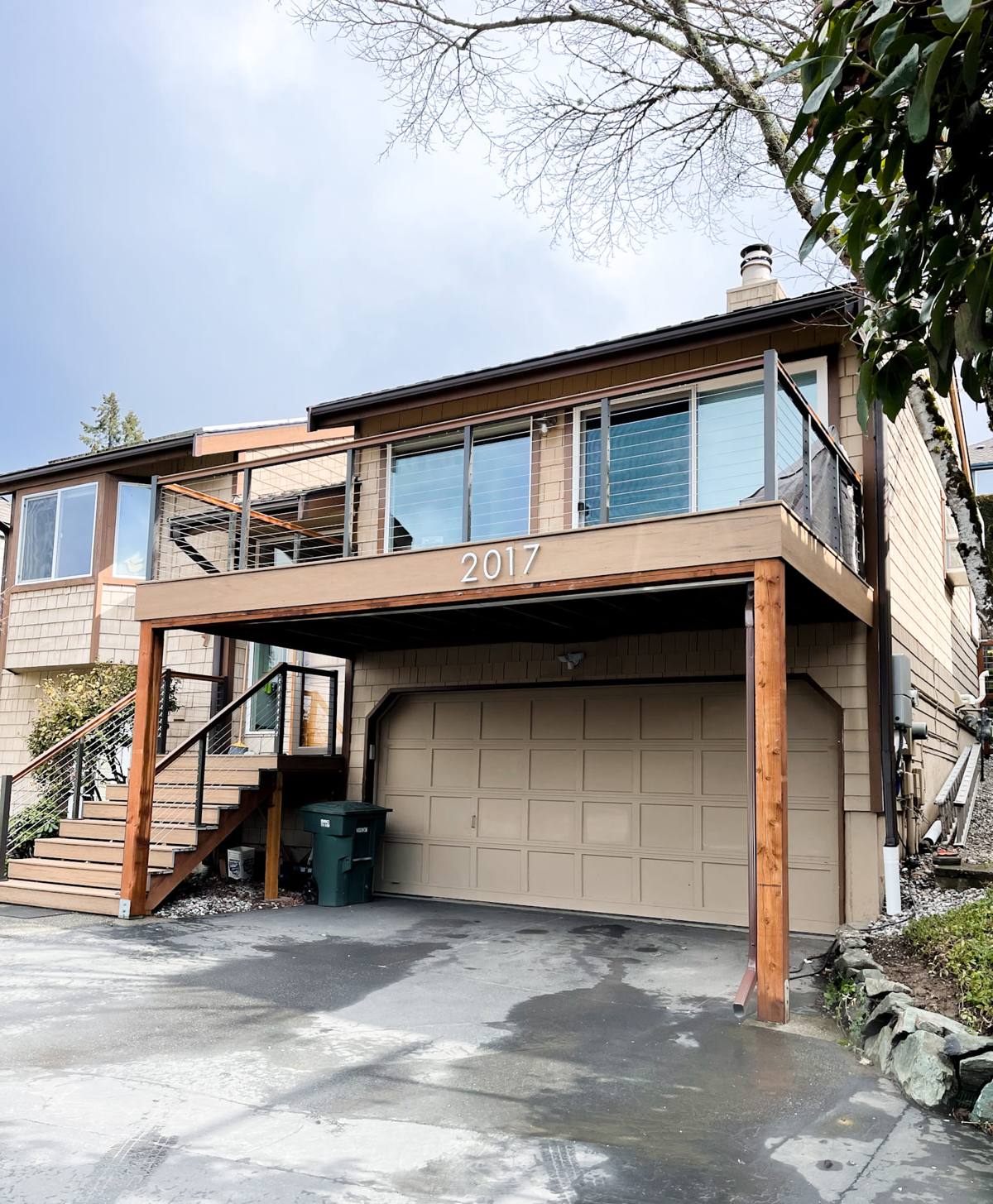
Signs Your Deck Needs Repair — Not a Full Rebuild
Surface-Level Damage You Can See
Most homeowners call us because of something visible: boards that have cupped or checked, a railing that wiggles when you lean on it, stair treads that feel spongy, or dark streaking where moss has been scraped off but the stain underneath is gone. These are real problems, but they're often localized. A handful of damaged boards, a loose railing post, or worn fasteners don't necessarily mean the whole structure is compromised.
Structural Problems That Aren't as Obvious
The damage that actually threatens safety is usually hidden: a ledger board pulling away from the house, joists that have softened where they meet the ledger or rim joist, post bases sitting in standing water, or corroded joist hangers that have lost their holding strength. This is the damage that driving rain and long wet stretches cause over years — moisture works its way into joints and connections long before it shows up as visible rot on the surface. A deck can look fine from the top and still have a framing problem underneath.
This is why we don't quote deck repair over the phone or from a photo. What's wrong with a deck in Blanchard is frequently different from what it looks like at first glance, and the only way to know is to get underneath it.
What a Correct Deck Repair Actually Involves
Inspecting the Framing First
Before we touch a single board on the surface, we check the framing: ledger attachment and flashing, joist condition (especially where joists meet the house or sit near grade), post and beam connections, and any spots where water has clearly been pooling. If the framing is sound, a lot of surface damage can be repaired without disturbing the structure. If it's not, replacing decking over a weak frame just hides the real problem for a while.
Fasteners and Hardware Matter as Much as Lumber
In a salt-air environment, the fasteners often fail before the wood does. Standard galvanized screws and nails can corrode faster near the water than they would further inland, which weakens connections even when the surrounding lumber still looks solid. Correct repair means matching hardware to the environment — stainless steel or high-grade coated fasteners and connectors rated for corrosive exposure — not just replacing what's there with the same grade that failed.
Flashing and Water Management
A repair that replaces rotten boards but ignores how water is getting into the structure in the first place isn't really a fix. Ledger flashing, proper gaps between boards for drainage, and grading or drainage away from post bases all matter more here than they would in a drier climate, because the wood gets far less time to dry out between rain events.
Repair or Replace? What Actually Drives That Decision
Homeowners often assume any deck problem means starting over. Usually it doesn't. The honest answer depends on how much of the structure is affected and how the deck was built in the first place.
| Factor | Favors Repair | Favors Replacement |
|---|---|---|
| Framing condition | Solid, dry, no soft spots at connections | Rot at ledger, joists, or multiple post bases |
| Extent of surface damage | Scattered boards or one railing section | Most of the decking surface cupped, splintering, or gray throughout |
| Age and original construction | Built to code, reasonably recent | Older deck with undersized framing or outdated connections |
| Fastener and hardware condition | Isolated corrosion, easily replaced | Widespread corrosion at structural connectors |
| Typical cost range | Often a few hundred to a couple thousand dollars | Can run several thousand depending on size and material |
That last row is a general guide, not a quote — every deck is different, and the only way to get an accurate number is an in-person look. But the pattern holds: catching problems while they're still localized almost always costs less than waiting until the whole structure is compromised.
Our Deck Repair Process
- Inspection. We walk the deck, check underneath it, and test framing, ledger attachment, and post bases — not just the surface.
- Honest assessment. We tell you what's actually wrong, what's optional, and what shouldn't wait, in plain terms.
- Written estimate. You get a clear scope of work and price before anything starts, with repair and — if relevant — replacement options laid out separately.
- Repair work. Damaged framing, boards, railings, and hardware get replaced with materials matched to this climate, not just whatever's cheapest.
- Water management check. We confirm flashing, drainage, and board spacing are doing their job before we call it finished.
- Walkthrough. We show you what was done and talk through what basic upkeep will keep it in good shape.
Materials We Use — and Why We're Selective About Them
Wood decking still makes sense for a lot of homes, but it needs the right species, proper sealing, and a real maintenance commitment to hold up against this much rain and moss pressure. Composite and PVC decking cost more upfront but trade ongoing sealing and staining for a different maintenance profile — they don't rot, but they still need regular cleaning to keep moss and algae from building up on the surface, and not every composite product handles moisture at the edges and cut ends the same way.
We don't push one material as a universal answer. What we do insist on is being straightforward about the trade-offs: wood costs less initially but needs more attention over time; composite costs more initially but shifts the maintenance burden rather than eliminating it. For hardware, we hold a firm line — stainless steel or corrosion-rated fasteners and connectors near the water, every time, even when it costs more than standard hardware. That's a standard we apply because we've seen what happens when it's skipped, not because of any one brand's shortcomings.
Living With Moss Season: A Maintenance Checklist
A correct repair buys you years, but Blanchard's climate means a deck still needs regular attention to stay ahead of moss and moisture damage. This is the basic routine worth keeping up between inspections:
- Sweep debris off the deck surface regularly, especially in fall when leaves and needles pile up in corners and against the house
- Clean moss and algae off boards and stairs before they build up a thick film — a stiff brush and a deck-safe cleaner beats letting it sit
- Check that gaps between boards are still clear so water can drain instead of pooling
- Look underneath once or twice a year for standing water at post bases or signs of new staining on joists
- Re-seal or re-stain wood decking on the manufacturer's recommended schedule, not just when it looks faded
- Check railings and stair connections for looseness before winter, when wet wood and freeze-thaw cycles put the most stress on joints
Why Hiring a Crew That Already Works Blanchard Matters
A deck repair crew that mostly works drier inland areas will often default to standard-grade fasteners, generic sealing schedules, and framing details that assume the wood gets more time to dry between storms. That's not incompetence — it's just a different climate. Here, those defaults lead to repeat problems: hardware that corrodes early, boards that stay damp longer than they should, connections that loosen faster than expected.
Working across Mount Vernon and the surrounding Skagit County communities, including Blanchard, means we see the same salt-air corrosion patterns and moss buildup on a regular basis, and we've adjusted our fastener choices, flashing details, and maintenance recommendations accordingly. That's not a marketing point — it's the difference between a repair that lasts and one that needs redoing in a few years.
If your deck in Blanchard has soft spots, loose railings, persistent moss, or you just want an honest read on its condition, we're happy to take a look. The estimate is free, there's no pressure, and you'll get a straight answer about what actually needs doing — use the form below to get started.