 Mount Vernon
 Building a Deck That Can Handle Avon's Weather
Avon sits in the flat, low-lying farmland just outside Mount Vernon, close enough to the tidal flats of Skagit Bay that salt-tinged marine air moves through on a regular basis. A deck out here isn't just an outdoor living space — it's a structure that has to survive months of standing moisture, wind-driven rain off the valley, and a moss season that can run from October clear into May. Build it the way a deck gets built in a dry climate and you're looking at soft boards, rusted hardware, and a slick, mossy surface within a couple of seasons. Build it right for Skagit County, and it'll outlast the mortgage.
We build custom decks for homes throughout the Mount Vernon area, and Avon comes with its own specific set of demands: soggy valley soil, salt-laden air rolling in off the bay, and enough shade and moisture in most yards to grow moss on anything that sits still. This page covers what actually matters when you're putting a deck on an Avon property — the materials, the structure underneath, and the details that keep water out of places it doesn't belong.
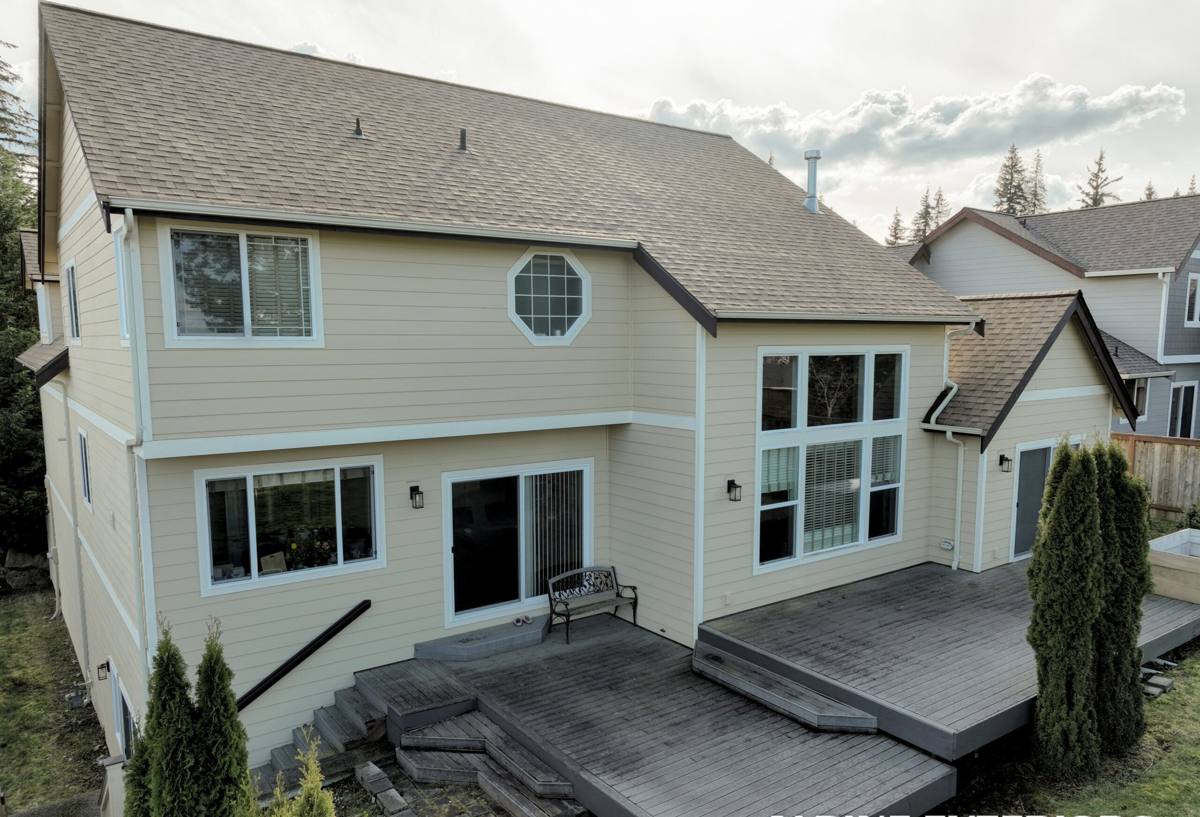
What the Skagit Valley Climate Does to an Unprotected Deck
Moss and Algae
Moss doesn't care whether it's growing on a roof or a deck board — it needs shade, moisture, and time, and Avon supplies all three for a good part of the year. On a deck, moss and algae aren't just a cosmetic problem. They hold water against the wood, they make painted or unsealed surfaces dangerously slick underfoot, and on composite decking they can stain grain patterns if left to build up over a season. Deck orientation, gap spacing between boards, and how much air can move underneath the structure all affect how bad this gets.
Driving Rain and Standing Water
Rain in this part of Skagit County rarely falls straight down — wind off the valley pushes it sideways, which means water gets driven up under railings, into fastener holes, and against any vertical trim that isn't properly flashed. Add a low water table and heavy clay-and-silt soil common to the valley floor, and you get ground that stays saturated for weeks after a storm. A deck built without enough drainage slope, without gaps for airflow, or with footings set too shallow will hold that moisture right where it does the most damage.
Salt-Laden Air
Avon isn't oceanfront, but it's close enough to Skagit Bay and Puget Sound that salt-bearing air reaches inland on a regular basis, especially with the wind patterns that move through the valley. Salt air accelerates corrosion on any fastener, bracket, or hanger that isn't rated for it. We've seen decks where the boards were still solid but the hidden hardware holding them together had rusted to the point of failure — which is exactly why the hardware spec matters as much as the decking material on top.
Decking Material Options for Avon Homes
There's no single "best" decking material — there's the right material for your budget, your maintenance tolerance, and how much shade and moisture your particular lot deals with. Here's how the common options actually perform in this climate:
| Material | Moisture & Moss Behavior | Maintenance | Typical Lifespan Here |
|---|---|---|---|
| Pressure-treated wood | Absorbs water; needs sealing to resist moss staining and swelling | Annual cleaning and re-sealing recommended | 10-15 years with upkeep |
| Cedar | Naturally rot-resistant but still needs finish to fight moss and graying | Periodic cleaning, refinishing every few years | 15-20 years with upkeep |
| Capped composite | Won't rot or absorb water; moss and algae sit on the surface and rinse off easier | Occasional washing, no sealing or staining | 25-30+ years |
| PVC decking | Fully waterproof core; best resistance to staining in shaded, damp spots | Lowest maintenance of the group | 25-30+ years |
For a shaded Avon lot with a lot of tree cover, we lean toward capped composite or PVC precisely because they don't give moss and algae the organic material to latch onto that wood does. For a sunnier, more open lot, cedar or a quality pressure-treated deck with a real maintenance routine behind it can still make sense, especially if the budget or the look calls for real wood. We'll walk the site with you and give you a straight answer on which one fits, not just the one with the best margin.
Footings, Framing, and Skagit Valley Soil
What holds a deck up matters more than what's on top of it. Valley floor soil around Avon tends to be silty, holds water, and can shift seasonally as it saturates and dries out. Footings that are too shallow, undersized, or poured without accounting for local drainage and soil conditions will move over time — and a deck that racks or settles unevenly puts stress on every board and railing connection above it.
We dig footings to the depth the structure actually needs for the soil conditions on your lot, not a one-size-fits-all minimum. Where drainage is poor, we'll grade around footings and posts so water has somewhere to go instead of sitting against buried concrete and hardware all winter. Joists get spaced and sized for the actual span and expected load — not stretched past what the framing lumber is rated for just to save a few boards.
The Ledger Board Connection: Where Your Deck Meets Your Siding
This is the detail that gets skipped more than any other, and it's the one that causes the most expensive damage later. Where a deck attaches to the house, the ledger board has to be flashed correctly so water running down the siding — or driven sideways by wind, as it often is here — can't get behind the house wrap and into the wall framing. We've opened up enough rotted wall sheathing behind badly-flashed ledger boards to know this isn't a theoretical risk in this climate; it's one of the more common sources of hidden water damage on houses with an attached deck.
Because we work on siding as much as decks, we treat the ledger connection as a siding detail, not just a deck detail — proper flashing, correct fastener spacing into structural framing rather than just sheathing, and a gap or drainage path so water that does get behind the board has somewhere to go. It's a small part of the total job that has an outsized effect on whether your wall stays dry for the next twenty years.
Fasteners and Hardware That Won't Corrode
Every bracket, joist hanger, screw, and bolt on a deck is a place water and salt air can start a corrosion problem you won't see until it's already advanced. We spec hardware for the environment it's actually going into, not the cheapest option that meets a bare code minimum.
| Hardware Type | Why It Matters Here |
|---|---|
| Stainless steel fasteners | Resist the accelerated corrosion that salt-laden marine air causes in standard coated screws over time |
| Hot-dip galvanized structural hardware | Heavier zinc coating than standard galvanized; holds up better under sustained moisture exposure |
| Coated joist hangers rated for treated lumber | Chemicals in modern pressure-treated wood corrode standard hardware faster; rated coatings resist that reaction |
| Structural post bases, not buried posts | Keeps wood posts out of direct soil contact, cutting off one of the biggest sources of rot at ground level |
None of this hardware costs much more than the standard version, but the labor to replace it after it fails — usually discovered because a railing feels loose or a board starts to sag — costs far more than getting it right the first time.
Railings, Stairs, and Skagit County Code
Railings and stairs are where deck injuries actually happen, and they're also where Skagit County's building code is most specific: guard height, baluster spacing, stair rise and run, and graspable handrail requirements all have defined minimums that inspectors check. Beyond code minimums, we build railings with the same climate concerns as the decking itself — connections that won't loosen as wood swells and shrinks through the wet season, and materials that won't turn into a slip hazard once moss finds a foothold on a horizontal rail cap.
Most custom deck projects over a certain size or height require a permit through the county, and stairs and guards are usually where a project gets flagged if they're not built to spec. We pull the permits and build to what the inspector is actually going to check, so this isn't something you have to manage yourself.
Our Process, Start to Finish
Every deck project runs the same way, whether it's a small ground-level platform or a full multi-level deck off the back of the house:
- On-site walk-through to look at the lot's drainage, sun and shade exposure, and how the deck will tie into the existing structure
- Design and material conversation based on your budget, maintenance tolerance, and how the space will actually get used
- A written estimate that spells out materials, hardware, and scope — no vague allowances
- Permit drawings and submittal to Skagit County where required
- Footings and framing, built to the soil and span conditions on your specific lot
- Ledger flashing, decking installation, and railings and stairs built to code
- Final walk-through with you before we call the job done
We don't start cutting lumber before the framing and flashing plan is settled, and we don't consider a deck finished until the railings are solid and the water has somewhere to go.
Keeping a New Deck Looking Good Year After Year
Even a well-built deck needs some seasonal attention in a climate like this one. A short, honest maintenance routine goes a long way:
- Sweep leaves and organic debris off the deck surface before they trap moisture underneath
- Rinse or lightly scrub composite and PVC boards once or twice a year to keep algae film from building up
- Re-seal or re-stain wood decking on the schedule the product actually calls for, not "whenever it looks bad"
- Check railing connections annually for looseness, especially after the first full wet season
- Keep gutters and downspouts near the deck clear so runoff isn't dumping directly onto or under the structure
- Look underneath the deck once a year for standing water or debris blocking airflow to the framing
We build decks for the long haul, but a few minutes of upkeep twice a year is what actually gets you the full lifespan out of the materials — especially in a spot like Avon where moss and moisture don't take a season off. A crew that already works this specific stretch of Skagit County knows which lots drain well and which ones need extra attention to footings and flashing before the first board ever goes down, and that local familiarity shows up in how long the deck lasts, not just how it looks the first year.
If you're planning a custom deck in Avon and want a crew that already knows how Skagit County soil, weather, and code work together, we're glad to walk your property and give you a straight, no-pressure estimate. Fill out the form below and we'll set up a time to take a look.