 Mount Vernon
 Siding Repair in Bow: Getting to the Real Cause, Not Just the Visible Damage
Bow sits on the water side of Skagit County, close to Samish Bay, in a stretch of the county where farmland, timber, and shoreline all meet within a few miles of each other. Houses out here, whether they're older farmhouses, newer builds on acreage, or homes closer to the water, all deal with the same combination of conditions year-round: salt-laden air moving off Samish Bay and the Salish Sea, rain that arrives sideways as often as it falls straight down, and a moss season that can run most of the year on shaded, north-facing, or tree-covered walls. Siding repair in Bow is rarely as simple as pulling one bad board and nailing up a new one. What you can see is usually a symptom. The cause is almost always moisture that's been working behind the wall longer than the visible damage lets on.
This page covers siding repair specifically for Bow, not full siding replacement and not other exterior systems. It walks through why siding fails here, what a repair actually needs to include to hold up, and how we handle a repair call when we're out at a home in this part of the county.
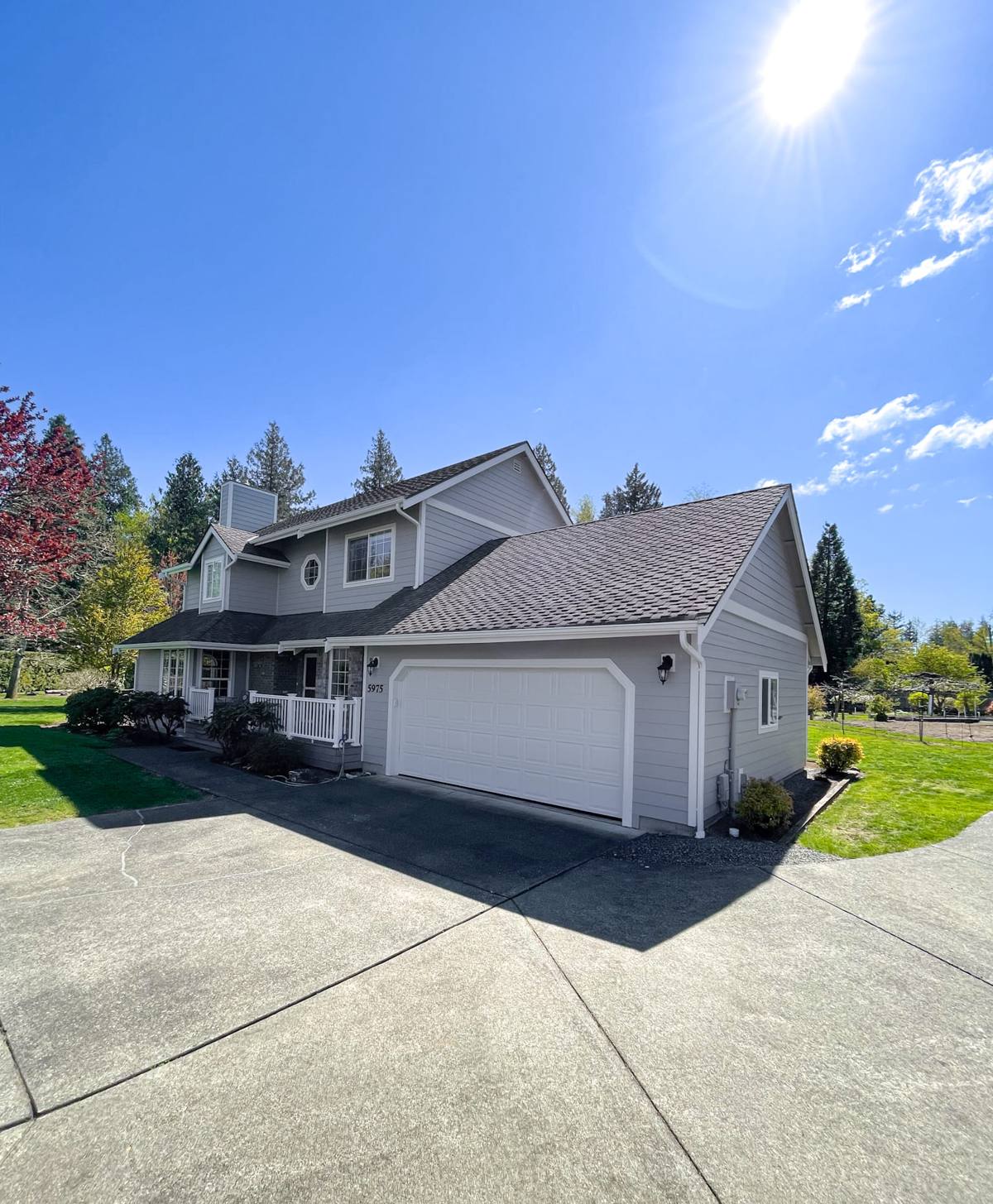
Why Bow's Climate Is Hard on Siding
Salt Air and Fastener Corrosion
Bow's proximity to Samish Bay means salt air reaches homes here well beyond the immediate waterfront, carried inland on the prevailing wind. Salt accelerates corrosion in nails, screws, and any exposed metal flashing or trim. A repair that swaps out a damaged board but reuses corroded fasteners underneath, or skips checking the flashing behind it, is a repair that's likely to need doing again within a few years rather than lasting for decades.
Driving Rain Finding the Gaps
Rain in this part of Skagit County tends to come in on a wind off the water rather than falling straight down, which pushes moisture into seams, laps, and joints that a straight-down rain would never reach. Siding installed with tight caulk joints, correct overlaps, and proper flashing sheds that kind of weather without issue. Siding installed with shortcuts, gaps at butt joints, missed flashing at trim, or caulk substituted for flashing, starts leaking at exactly the points driving rain hits hardest.
A Moss Season That Barely Lets Up
Tree cover and low winter sun angles keep some walls around Bow damp for much of the year, especially on properties with mature trees or north-facing exposures. Moss and algae don't just look bad; they hold moisture directly against the surface, keeping that section of wall wetter for longer after every rain. On lower-grade or more porous materials, that sustained dampness is what eventually leads to swelling, soft spots, and finish failure. On fiber cement, it's primarily a surface and finish issue rather than a structural one, but it still needs to be addressed before it gets ahead of you.
What We Actually Find Once We Open Up Damaged Siding
Most repair calls start with a homeowner pointing at one obvious problem spot: a soft board, a stain, a crack near a window. What's underneath that spot often tells a bigger story.
- Water staining or discoloration on the house wrap or sheathing behind the visible damage, extending past the boundaries of the bad board
- Corroded fasteners that have lost holding strength even where the siding itself still looks fine
- Missing or improperly lapped flashing at windows, trim, or wall penetrations near the damaged area
- Soft or delaminated sheathing where moisture has been sitting behind the siding for an extended period
- Caulk used to seal a joint that should have had metal flashing instead
- Moss or algae growth that has kept a section of wall damp long enough to affect the finish underneath
This is why we don't quote siding repair off a photo, and why we're cautious about pricing a "quick patch" before opening the area up. The visible damage tells you where to start looking. It doesn't tell you how far the actual problem goes.
Repair or Replace: How We Make the Call
Not every damaged section needs full replacement, and not every repair should stop at just the board that looks bad. A few factors drive which way we recommend going.
| Factor | Points Toward Repair | Points Toward Wider Replacement |
|---|---|---|
| Extent of moisture intrusion | Limited to one board or joint, sheathing behind it is dry and sound | Staining or soft sheathing extends across multiple courses or a wide section of wall |
| Age and condition of surrounding siding | Rest of the wall is sound, well-fastened, and reasonably current | Surrounding siding is near end of life, mismatched, or already showing early wear |
| Cause of the damage | Isolated impact damage or a single failed caulk joint | Systemic flashing failure, chronic moss buildup, or a design issue affecting more than one wall |
| Material match | Existing Hardie profile and color are available or close enough to blend | Discontinued profile, faded finish, or non-Hardie product that won't match a new Hardie repair |
Where the cause is a one-time event, an impact strike, a single missed caulk joint, a targeted repair is usually the right call. Where the cause is systemic, chronic shade and moisture exposure, a long-neglected flashing detail, siding that's simply aged out, patching one section just delays the same failure showing up on the next one over.
What a Correct Repair Actually Involves
A repair that holds up in Bow's climate is more than pulling a bad board and nailing up a new one. On every repair, we work through the same core steps:
- Remove enough siding to see the full extent of the damage, not just the section that looks bad, so nothing hidden gets covered back up.
- Inspect the sheathing and house wrap underneath for soft spots, staining, or gaps, and address that before new siding goes back on.
- Correct or replace flashing at any window, trim, or penetration near the repair rather than caulking over a flashing problem.
- Replace corroded fasteners in the surrounding area, not just install new ones on the replacement board.
- Match the replacement material and finish as closely as possible, using Hardie profiles and ColorPlus finishes so the repair doesn't stand out as an obvious patch.
- Re-seal and re-flash properly so the repaired section sheds wind-driven rain the same way the rest of the wall does.
Skipping any of those steps is how a repair turns into a temporary fix instead of a lasting one, and how a homeowner ends up paying for the same repair twice.
Why We Only Repair With James Hardie Fiber Cement
We install James Hardie fiber cement exclusively, and that standard applies to repair work as much as full siding jobs. We don't patch a Hardie wall with vinyl or engineered wood, and we don't recommend those products for repair work on any home we service, for the same reasons we don't install them new.
- Non-combustible core: Fiber cement doesn't add fuel to a fire the way wood-based siding can, which matters for insurance and safety alike.
- Factory-applied ColorPlus finish: The finish is baked on under controlled conditions, so a repaired section holds its color and resists fading far better than a field-painted patch would.
- Climate-engineered HZ5 formulation: Hardie's HZ5 product line is built for regions with heavy moisture and freeze-thaw exposure, matching western Skagit County's climate more closely than a general-purpose formulation.
- Dimensional stability: Fiber cement doesn't swell or warp the way some engineered wood products can after repeated wet-season exposure, which is exactly the failure mode we're trying to repair out of a wall, not reintroduce.
- Warranty continuity: Repairs done to spec, with Hardie material, keep the product warranty intact instead of creating a gap where mixed materials were used.
Warning Signs Worth Calling About Before They Spread
A lot of the repairs we do would have cost less, and involved less disruption, if they'd been caught a season or two earlier. Signs worth acting on include:
- Soft spots when you press on siding near the bottom courses, around windows, or beneath rooflines
- Visible cracking, especially near corners, seams, or fastener points
- Persistent moss or algae growth that keeps coming back on the same section of wall
- Paint or finish that's peeling, bubbling, or discoloring in one localized area rather than evenly across the house
- Gaps opening up at caulk joints, corner trim, or around window and door casings
- A musty smell or visible staining on an interior wall that lines up with an exterior trouble spot
Catching these early is almost always cheaper than waiting. A localized repair costs a fraction of what it costs to fix the same problem after it's spread across a wall section or worked its way into the sheathing.
How We Approach a Siding Repair Call in Bow
We start with an inspection, not a quote over the phone. That means walking the affected area, checking beyond the obviously damaged section, and, where needed, opening up enough siding to see what's actually happening behind it before giving you a number. From there, we explain what we found in plain terms: what's causing the damage, what it will take to fix it correctly, and whether that's a targeted repair or something wider. We give you the honest option, not the easiest one to sell. If a small patch will genuinely hold, that's what we recommend. If the underlying cause means a patch won't last, we'll tell you that too, and explain why.
Why a Crew That Already Works Bow Matters for Repair Work
Siding repair depends on correctly diagnosing why something failed, and that's harder to do well without a working sense of how this specific stretch of Skagit County behaves on real houses. A crew that repairs siding regularly out toward Samish Bay has already seen how shaded, tree-covered walls behave differently from open, sun-exposed walls a short drive away, and how wind-driven rain off the water finds its way into gaps that a drier inland climate would never expose in the first place. That pattern recognition is what separates a repair that actually solves the problem from one that just replaces the board and waits for the same issue to resurface next wet season. It also means faster, more accurate diagnosis on the first visit, instead of a repair that gets revisited two or three times before the real cause gets found.
If you've noticed soft spots, staining, cracking, or persistent moss on your Bow home's siding, we're happy to take a look and give you a straightforward assessment of what's going on and what it will take to fix it right. Reach out using the form below to schedule a free, no-pressure estimate.