 Mount Vernon
 Why Siding Fails Differently in Anacortes
Anacortes sits close enough to saltwater that homes there deal with a different set of siding stresses than a house a few miles inland in Mount Vernon proper. Salt-laden air accelerates corrosion on fasteners and trim metal, wind off the water drives rain sideways into wall assemblies that were only ever designed to shed water falling straight down, and the shaded, moisture-heavy microclimates common around the island and its tree cover keep siding damp longer between dry spells. None of that is exotic or rare — it is just the normal weather pattern for this part of Skagit County, and siding either handles it or it doesn't.
Add in a moss and algae season that can run most of the year in the shadier, north-facing parts of a lot, and you get a specific failure pattern: staining and soft spots low on the wall, deterioration around window and door trim where caulking has failed, and hidden water damage behind siding that still looks okay from the driveway. Repair work in Anacortes has to account for all of that, not just patch the visible crack.
What "Coastal Adjacent" Really Means for a Wall System
Anacortes isn't oceanfront in the way a beach town is, but it's close enough to tidal water that airborne salt reaches siding, fasteners, and flashing on a regular basis. Salt accelerates galvanic corrosion on nails, screws, and any exposed metal trim. Combined with near-constant humidity, it also keeps wood-based products — trim boards, fascia, older wood or wood-composite siding — wetter for longer stretches than the same product would experience in a drier inland town. That's the core reason repair decisions here can't be copy-pasted from a generic siding checklist.
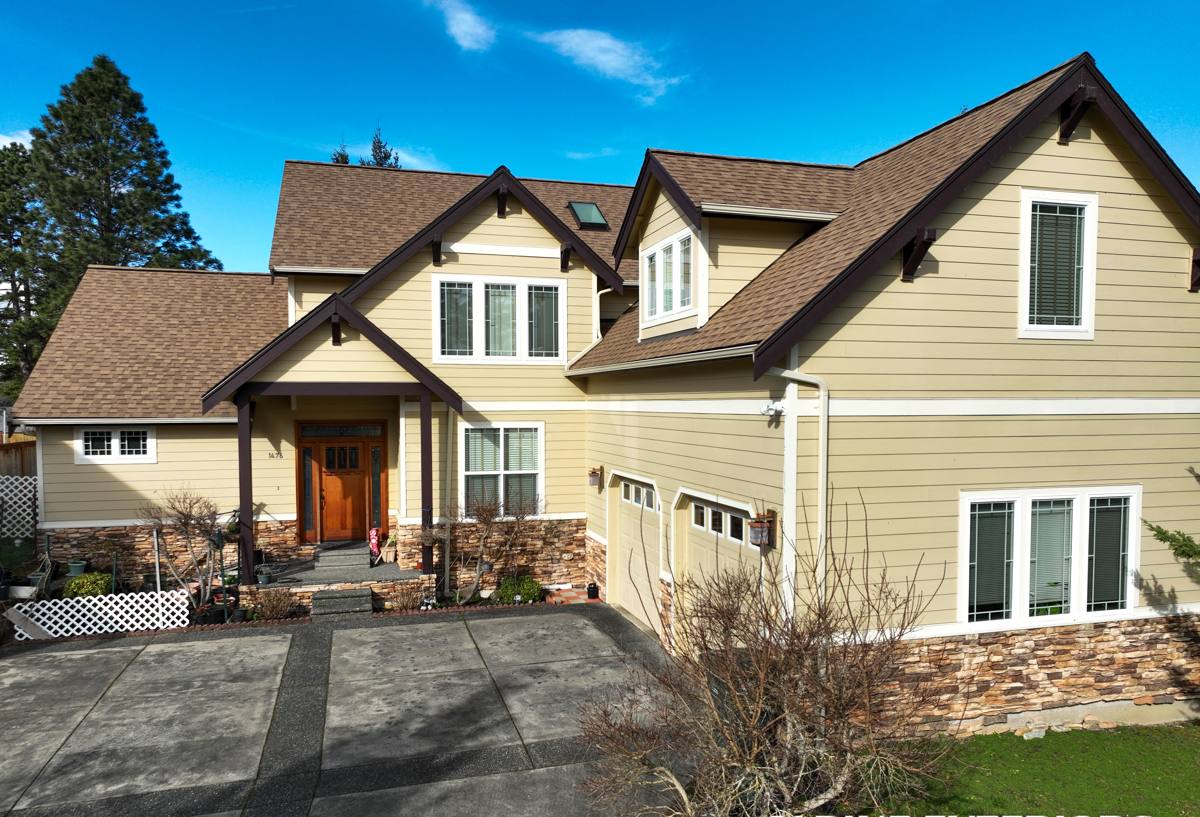
Signs Your Siding Needs Repair, Not Just a Look
Most siding problems don't announce themselves as an emergency. They show up as small signals that get ignored until a section of wall is genuinely compromised. On Anacortes-area homes, these are the ones we see most often:
- Soft, spongy, or crumbling spots when you press on the siding, especially near the bottom of walls or below windows
- Persistent black or green staining that keeps coming back within weeks of cleaning
- Cracked, warped, or bowed panels, particularly on wood-based or engineered wood products
- Caulking that has pulled away, cracked, or gone brittle around trim, windows, and corner boards
- Paint that's peeling or bubbling in a localized area rather than uniformly across the house
- Visible gaps at panel seams or fastener heads that have backed out or rusted through
- A musty smell or slight discoloration on interior walls that share a wall line with a suspect exterior area
Any one of these on its own might be minor. Several clustered in the same area of the house — especially on a north or west-facing wall that stays shaded and catches weather off the water — usually means moisture has been getting behind the siding for a while.
What a Correct Siding Repair Actually Involves
A repair that just replaces the visible damaged board and moves on is a repair that's likely to fail again in a year or two. In a climate like this, the visible damage is often a symptom, not the whole problem. A repair job worth paying for includes:
Diagnosis Before Demolition
Before pulling a single board, we need to understand why that section failed. Was it a caulking failure that let water track behind the panel? A flashing detail that was never installed correctly in the first place? Standing moisture from grade or landscaping pushed up against the wall? Fixing the board without fixing the cause just buys a short delay before the same spot fails again.
Checking What's Behind the Siding
Once panels are pulled, we look at the water-resistive barrier, the sheathing, and the framing underneath. In older homes, especially those with wood or LP-style siding that has been leaking for a while, it's common to find soft sheathing or even framing damage that needs to be addressed before any new siding goes back up. Skipping this step is the single most common reason a "repair" turns into a bigger problem down the line.
Matching Materials Correctly
If the home already has James Hardie fiber cement siding, a proper repair matches the exact plank profile, exposure, and ColorPlus finish so the repaired section doesn't stand out. If the home has an older material — cedar, LP SmartSide, vinyl, or an unbranded composite — we'll tell you honestly whether a like-for-like patch makes sense or whether that section (or the whole elevation) is a better candidate for replacement with Hardie, given what we already know about how that older product tends to perform in this climate.
Correct Flashing and Water Management
Every seam, window head, and penetration gets proper flashing and house-wrap integration — lapped correctly so water sheds outward, not into the wall. This is the detail that's most often missed or done poorly on the original installation, and it's usually the actual root cause when we're called out to look at recurring damage.
Repair Approach by Siding Material
What a repair looks like depends heavily on what's currently on the wall. Here's how it typically breaks down on the homes we see around Anacortes and Mount Vernon:
| Existing Siding | Common Failure Pattern Here | Typical Repair Approach |
|---|---|---|
| James Hardie fiber cement | Failed caulk joints, isolated impact damage, fastener corrosion | Targeted panel replacement with matching ColorPlus finish; usually straightforward |
| Cedar / wood siding | Rot, moss growth, paint failure from trapped moisture | Often more extensive; damaged boards and sheathing frequently need replacement |
| LP SmartSide / engineered wood | Edge swelling, delamination at seams exposed to driving rain | Section replacement; we'll discuss whether a broader switch to Hardie makes sense |
| Vinyl siding | Cracking from impact, warping, sun and salt-air brittleness over time | Panel swap where available; matching older discontinued colors can be difficult |
We're honest about this table when we're standing on your property: if a repair is genuinely the right call, we'll do the repair. If the underlying material is the reason the damage keeps recurring, we'll say so plainly instead of patching the same spot every couple of years.
Repair vs. Replace: How We Help You Decide
Not every damaged section needs a full re-side, and not every "small patch" request is actually a small job once we're inside the wall. A few honest factors guide that call:
- Extent of the damage — isolated to one or two boards, or spread across an elevation?
- Condition behind the siding — sound sheathing and framing, or evidence of long-term moisture intrusion?
- Age and material of the existing siding — a 25-year-old wood product nearing the end of its service life is a different conversation than a 5-year-old Hardie installation with one damaged plank
- Whether the original installation had a systemic flaw — like missing flashing or incorrect fastening — that will keep causing failures in other spots
- Your plans for the home — a full re-side may make more financial sense if you're already planning other exterior work
We'd rather lose a bigger job by telling you a $600 repair will hold for years than sell you a full re-side you don't need yet — and we'd rather tell you up front that a patch is a temporary fix than let you find that out the hard way in another Skagit County winter.
Our Process for Anacortes-Area Repairs
- On-site assessment. We inspect the damaged area and the surrounding wall, not just the spot you called about, since problems in this climate rarely stay isolated.
- Behind-the-wall check. Where damage suggests possible moisture intrusion, we open the area enough to check sheathing and framing condition before quoting a fix.
- Honest scope and estimate. You get a clear explanation of what's actually wrong, what it will take to fix it correctly, and what it costs — with repair and replacement options laid out if both are reasonable.
- Correct repair execution. Matching materials, proper flashing and water management details, and fastening to manufacturer spec — not just a board swap.
- Cleanup and a straight answer on what to watch. We'll tell you if there's anything else on the house worth monitoring, rather than upselling work that isn't needed yet.
Why a Crew That Already Works Anacortes Matters
Siding repair here isn't the same trade as siding repair in a dry inland climate. A crew that regularly works Anacortes and the surrounding Skagit County coastline already knows what wind-driven rain does to west-facing walls, how quickly moss re-establishes on shaded siding, and which flashing shortcuts show up over and over on homes built or re-sided without accounting for the marine air. That local pattern recognition is the difference between a repair that actually addresses the cause and one that looks fine on move-out day and fails again in eighteen months.
It also means we're not guessing about travel logistics, permitting norms, or the practical realities of working around tighter island lots and older neighborhood streets — we already know what a repair job on this side of the county actually requires to schedule and execute cleanly.
Why We Repair With — and Recommend — James Hardie
When a repair calls for replacing more than a patch-sized section, we use James Hardie fiber cement siding, and it's not a brand preference — it's a direct response to what this climate does to siding. Hardie's HZ5 product line is engineered for climates with significant moisture exposure, it's non-combustible, and it holds its factory ColorPlus finish far longer than field-applied paint on wood or engineered wood products. That matters directly in a repair context: a Hardie patch matched into an existing Hardie wall keeps its color and profile match for years, and new Hardie installed to replace a failed wood or composite section gives you a wall that isn't going to be back on our repair list in three years because moss and moisture found the same weak point again.
We don't install LP SmartSide, vinyl, Cemplank, Allura, or primed spruce and cedar siding — not because those products have no merit, but because we've standardized on the one system that consistently holds up to what Anacortes and the rest of Skagit County throw at a wall, and we'd rather tell you that honestly than sell you a repair on a product we don't stand behind long-term.
Maintenance That Extends Your Repair
A correctly done repair still needs basic upkeep to get its full life out of it, especially in a moss-prone, salt-air environment:
- Rinse siding annually to clear salt residue, pollen, and early moss growth before it takes hold
- Trim back vegetation and tree cover that keeps any wall section shaded and damp
- Check caulking at trim, windows, and repaired seams every year or two and recaulk before it fully fails
- Keep gutters clear so overflow isn't running down the wall face directly above a repaired area
- Watch grade and landscaping so soil or mulch isn't holding moisture against the base of the wall
What Repairs Typically Cost
Exact pricing depends on the extent of damage, what's found behind the siding, and material match, but here's a general sense of scope:
| Repair Scope | What It Usually Involves |
|---|---|
| Minor / cosmetic | Caulk renewal, one or two board replacements, no hidden moisture damage found |
| Moderate | Several boards, some sheathing repair, flashing correction at one problem area |
| Extensive | Full elevation affected, significant sheathing or framing repair, likely worth comparing against a broader re-side |
We won't quote a number over the phone without seeing the wall — too much of the real cost depends on what's underneath the siding, not just what's visible from the yard.
If you're seeing staining, soft spots, or failed caulking on your Anacortes or Mount Vernon home, we're happy to take a straightforward look and give you an honest read on what it needs. Reach out for a free, no-pressure estimate using the form below.