 Mount Vernon
 Why Decks in Kulshan Ridge Wear Out Faster Than Homeowners Expect
Kulshan Ridge sits in a part of Skagit County where a deck's real enemy isn't the sun — it's moisture that never fully lets up. Salt-tinged air moving in off Puget Sound and the Skagit delta accelerates corrosion on fasteners, hinges, and any metal hardware that isn't rated for it. Layer on driving rain that comes in sideways during fall and winter storms, and you get water finding its way into joints, ledger connections, and end grain that a fair-weather deck in a drier part of the state would never have to deal with.
Then there's moss. Mount Vernon's moss season isn't a two-month nuisance — it's closer to seven or eight months of the year where shaded and north-facing sections of a deck stay damp enough for moss and algae to take hold. Moss doesn't just look bad. It holds moisture directly against the decking surface, keeps wood fibers wet long after a storm has passed, and turns boards slick and dangerous underfoot. On a deck that already has failing fasteners or soft framing underneath, moss buildup is often the first visible symptom of a bigger structural problem.
We've replaced enough decks in this neighborhood to know the failure pattern is consistent: it starts at the ledger board and the areas that don't get sun, and it works outward. By the time boards are visibly cupping or springy, the framing underneath has usually been compromised for a while.
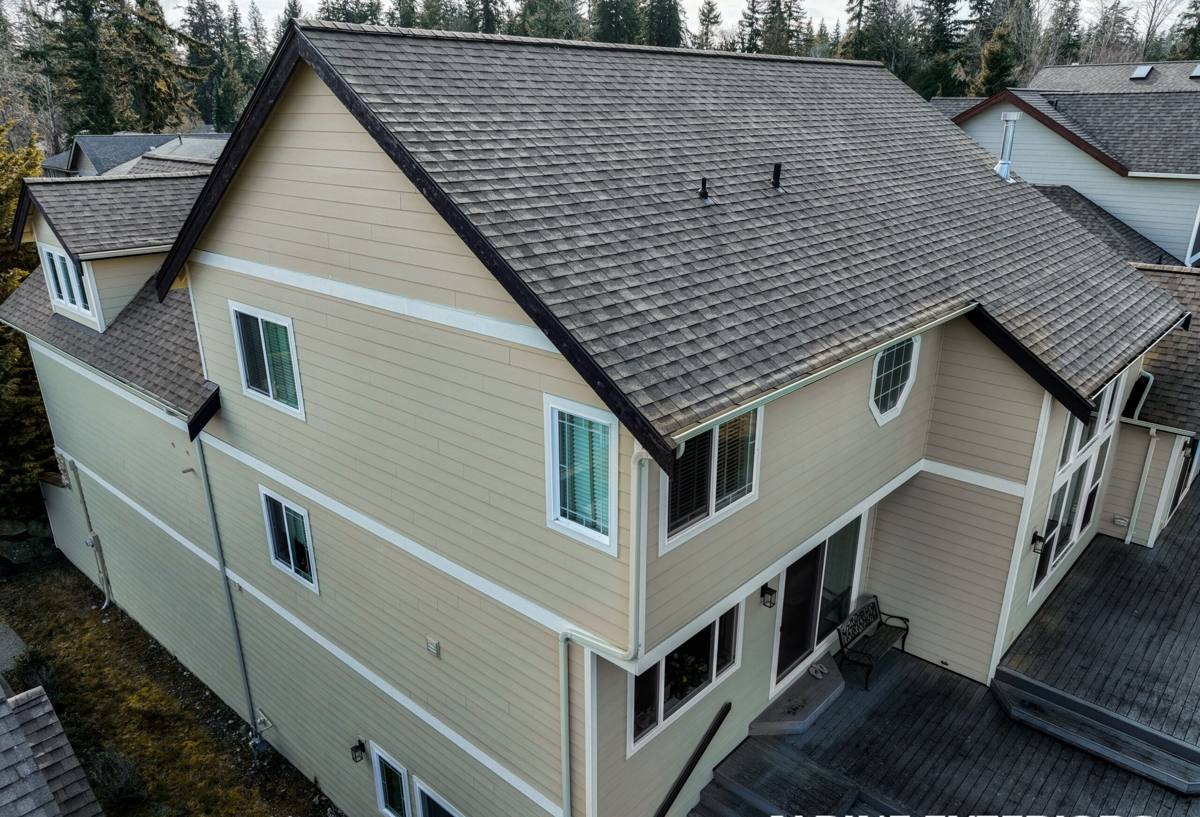
Signs Your Deck Needs Replacement, Not Repair
Not every deck problem calls for a full tear-off. But in this climate, patching the wrong deck just delays a bigger repair bill. Here's what tells us a deck is past the point of spot repair:
- Soft or spongy decking boards, especially near the house or in shaded corners
- Visible gaps, cracking, or splitting where boards meet the ledger board
- Rust streaks running down from fasteners or joist hangers
- A ledger board that's separating from the house rim joist, even slightly
- Persistent moss or black staining that comes back within weeks of cleaning
- Wobble or give in the railing posts when you push on them
- Footings that have visibly shifted, settled, or heaved
- A deck older than 20-25 years that's never had the substructure inspected
If you're only seeing one or two of these and the framing underneath tests solid, repair may still make sense. Once the ledger connection or multiple footings are involved, replacement is almost always the more honest recommendation — repeated patch repairs on a failing structure end up costing more over a few years than doing it right once.
Choosing the Right Decking Material for a Wet, Mossy Climate
Material choice matters more here than in drier regions, because whatever you pick has to handle standing moisture, moss growth, and salt-air exposure for years without constant upkeep. There's no single "best" material — it's a trade-off between upfront cost, maintenance, and how the material behaves when it's wet more often than it's dry.
Pressure-Treated Wood
Still the most affordable option and a solid choice if you're willing to stay on top of cleaning and resealing. In Skagit County's climate, that maintenance schedule is closer to annual than every few years — moss and mildew will find untreated or under-sealed wood quickly, especially on shaded sections of a deck.
Cedar
Naturally more rot- and insect-resistant than treated fir, and it looks better doing it. It still needs regular sealing to keep moisture out of the grain, and in persistently damp, low-sun areas of a yard it can develop moss and graying faster than homeowners expect from a "naturally resistant" wood.
Composite and PVC Decking
Higher upfront cost, but composite and PVC boards don't absorb water the way wood does, which matters a lot when a deck spends half the year damp. They still get algae and moss film on the surface in shaded spots — no decking material is immune to that here — but the material itself isn't rotting underneath it, and cleaning is usually a matter of washing the surface rather than treating the wood.
| Material | Upfront Cost | Maintenance in This Climate | Typical Lifespan |
|---|---|---|---|
| Pressure-Treated Wood | Lowest | Annual cleaning/sealing recommended | 10-15 years |
| Cedar | Moderate | Regular sealing, moss control in shade | 15-20 years |
| Composite/PVC | Highest | Periodic surface washing, no sealing | 25-30+ years |
What we recommend depends on the specific deck — how much shade it gets, whether it faces prevailing weather, and what the homeowner is comfortable maintaining. We'll walk through that honestly during the estimate rather than push whatever has the highest margin.
What a Correct Deck Replacement Actually Involves
A deck is only as good as what's underneath the boards. Most of the failures we see in Kulshan Ridge trace back to shortcuts taken at the framing and connection points — not the decking surface itself.
Ledger Board and Flashing
This is where the deck attaches to the house, and it's the single most common failure point in this climate. Correct flashing keeps rain from tracking behind the ledger board and into the house rim joist. We install proper metal flashing with a drip edge and use structural lag screws or through-bolts rated for the load — not the undersized nails sometimes used on older decks.
Footings and Frost Depth
Footings need to be sized and set to local frost depth and soil conditions, not just poured to whatever depth is convenient. Undersized or shallow footings are a common cause of the shifting and heaving we see on older Kulshan Ridge decks, especially where drainage around the foundation isn't great.
Fasteners and Hardware
Given the salt-air exposure this area gets, we use fasteners and joist hangers rated for coastal/corrosive environments — not standard galvanized hardware that starts showing rust streaks within a few years. It costs a little more upfront and saves the deck from premature hardware failure.
Joist Spacing and Ventilation
Proper joist spacing for the decking material, plus enough airflow underneath the deck, helps framing dry out between rain events instead of staying wet for days. This is a small detail that makes a real difference over a 20-year lifespan in a climate that doesn't dry out quickly.
Our Process for a Kulshan Ridge Deck Replacement
- On-site assessment — we inspect the existing structure, footings, and ledger connection to confirm replacement is the right call, not just an upsell
- Material walkthrough — honest pros and cons for your specific deck's sun/shade exposure and maintenance appetite
- Permit handling — we pull the required permit through the City of Mount Vernon (or the county, depending on exact location) so the work is inspected and legal
- Demo and disposal — full removal of the old deck, including buried or rotted footings if they need to be replaced
- Framing and flashing — ledger, joists, footings, and hardware built to hold up in this specific climate, not a generic spec
- Decking and railing installation — installed to the manufacturer's spacing and fastening requirements for proper drainage
- Final walkthrough — we go over the finished deck with you, including a maintenance rundown specific to the material you chose
Permits and Local Considerations
Deck replacement in Mount Vernon generally requires a building permit once you're rebuilding the structure rather than just replacing boards on an existing sound frame — this covers footings, framing, and railing height/spacing for code compliance. We handle the permit application and coordinate the required inspections as part of the job, so you're not the one chasing down city paperwork. If your property has specific setback or drainage considerations tied to its location, we account for that during the design and footing layout rather than after the fact.
What Affects the Cost of a Deck Replacement
Every deck is different, so we don't quote a number without seeing the site, but the main cost drivers are consistent:
| Factor | Why It Matters |
|---|---|
| Deck size and shape | More square footage and complex angles mean more material and labor |
| Material choice | Composite/PVC costs more upfront than wood but less in long-term upkeep |
| Footing condition | Failed or undersized footings need full replacement, not reuse |
| Height and railing requirements | Elevated decks need more substantial framing and code-compliant railing |
| Access to the site | Tight side yards or limited equipment access can add labor time |
As a broad range, straightforward wood deck replacements tend to run less than composite or elevated multi-level rebuilds — but the honest answer is that we'll give you real numbers after seeing your deck, not a ballpark that doesn't hold up.
Why It Matters That We Already Work in Kulshan Ridge
A crew that's replaced decks throughout this neighborhood already knows which lots tend to have drainage issues, which sides of a house stay shaded and mossy longest, and what the local permitting process actually looks like day to day. That's not a marketing point — it's fewer surprises during the job, and a deck built with this specific climate in mind rather than a generic spec sheet. We're a local Mount Vernon crew, and Skagit County's weather is what we build for every day, not an exception we plan around occasionally.
If your deck is showing any of the wear signs above, or you're just ready to stop maintaining a structure that's past its useful life, we're happy to take a look. Reach out for a free, no-pressure estimate using the form below — we'll walk the deck with you and give you a straight answer on repair versus replacement.