 Mount Vernon
 James Hardie Siding, Installed by People Who Already Work in Sedro-Woolley
Sedro-Woolley sits at the upper end of the Skagit Valley, where river-bottom flatland starts to give way to timber country and the foothills of the North Cascades. It's close enough to Mount Vernon that our crew is on these streets on a regular basis, and far enough up the valley that its weather has its own personality — a mix of lingering valley moisture, driving rain funneled up from Puget Sound, and a moss season that barely takes a break most years. Siding here has to hold up to all of that at once, which is a big part of why we install exactly one fiber cement product on every Sedro-Woolley home we work on: James Hardie.
This page isn't a general pitch for siding replacement. It's specifically about James Hardie fiber cement — the product lines, the factory finish, what correct installation actually requires in this climate, and why the "local" part of a local crew is worth more than it sounds like on a flyer.
Why This Climate Rules Out a Generic Siding Choice
Three conditions do most of the damage to exterior siding in this part of Skagit County: salt air moving in off Puget Sound and getting pulled up the valley on windier weather systems, driving rain that Pacific storm fronts push sideways into walls instead of straight down onto roofs, and a long moss season that keeps shaded, north-facing siding damp for weeks at a stretch. None of the three is unique to Sedro-Woolley, but together they add up to a climate that's noticeably harder on exterior materials than a national-average spec sheet assumes.
Materials that absorb moisture into their structure — solid wood, primed spruce, engineered wood products with a wood-fiber core — take the worst of this. They swell, they cup, and cut edges that aren't perfectly sealed become slow leak points that don't show up as a problem until years later. A material that doesn't absorb water into its structure has a real advantage in a climate that rarely gives a wall a long dry stretch to recover in, and that's the starting point for why we standardized on fiber cement here.
The James Hardie Product System
"James Hardie siding" isn't one single product — it's a system of fiber cement components engineered to work together, and it's worth knowing what's actually going on your house before you sign anything.
Lap Siding
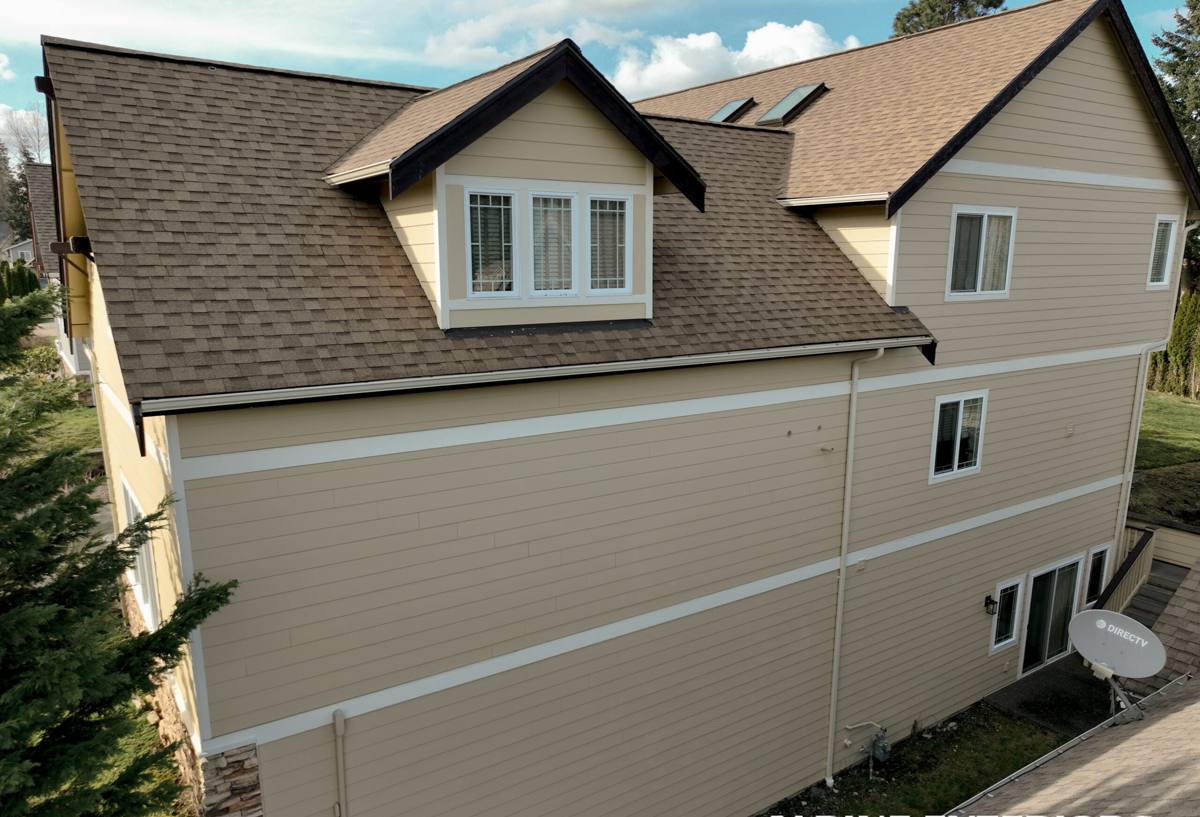
HardiePlank lap siding covers the majority of wall area on most Sedro-Woolley homes we work on. It comes in a range of plank widths and either a smooth or a wood-grain ("cedarmill") texture, so a home keeps a traditional lap-siding look without an organic core underneath it.
Panel and Shingle Profiles
HardiePanel vertical siding and HardieShingle staggered-edge siding use the same fiber cement base in different profiles — used across a whole home for a different architectural look, or as an accent on gables, dormers, and other details where a lap profile isn't the right fit.
Trim
HardieTrim boards finish out corners, window and door casings, fascia, and frieze boards in the same fiber cement material, so the whole exterior envelope gets consistent moisture and fire performance instead of mixing in a wood trim package that ages differently than the siding around it.
The HZ5 Engineered Line
James Hardie engineers its siding differently by climate zone, and the HZ5 line is built for regions with significant moisture exposure and freeze-thaw cycling — a closer match to Skagit Valley conditions than the warmer-climate formulations Hardie sells elsewhere in the country. We spec HZ5 products on Sedro-Woolley jobs for that reason, not because it happens to be the only option on the truck.
ColorPlus Technology: Why the Finish Matters as Much as the Board
A lot of siding trouble that looks like a "material problem" is really a finish problem — paint that was field-applied under whatever weather the jobsite happened to have that day. James Hardie's ColorPlus finish is baked on in a factory under controlled conditions before the boards ever reach a jobsite, giving it a more consistent, durable bond than site-applied paint typically achieves, especially in a climate with this much wet-dry cycling. It also means trim and accessories can be factory-matched to the field color, instead of a painter eyeballing a match on a ladder years later.
Hardie offers a wide range of ColorPlus colors organized into coordinated palettes, so trim, accent, and field colors are designed to work together rather than leaving a homeowner to guess. We walk through the current color and profile options during the estimate, since exact availability shifts over time.
What the Warranty Actually Covers
James Hardie backs its siding with one of the stronger warranty structures in the fiber cement industry — a lengthy, non-prorated coverage period on the substrate itself, a separate warranty covering the ColorPlus finish, and coverage that's transferable if the home changes hands. That transferability matters for resale value in a market like this one, not just peace of mind while you own the home.
The part homeowners don't always hear up front: warranty coverage assumes the product was installed to Hardie's specification. The wrong fastener, an incorrect nailing pattern, missing clearance from grade, or a skipped flashing detail can complicate a claim even when the siding material itself did nothing wrong. Installation quality and product choice aren't separable when it comes to what you're actually covered for down the road.
What Correct Installation Requires Here
Fiber cement siding installed to spec and fiber cement siding installed "close enough" perform very differently over ten or twenty years, and the gap shows up faster in a wet valley climate than it would somewhere drier. On every Sedro-Woolley Hardie job, correct installation means:
- Manufacturer-specified fastener type, spacing, and embedment depth for the specific Hardie product being installed
- Proper clearance between the bottom edge of the siding and grade, decks, patios, and roof lines, where standing moisture collects
- Flashing integrated in the correct sequence with the water-resistive barrier at every window, door, and wall penetration — never caulk used as a substitute for flashing
- Continuous, correctly lapped house wrap behind the siding with no gaps or reversed laps
- Joint and seam treatment suited to the wall's actual sun and shade exposure, since shaded, moss-prone faces need more attention than sun-exposed ones
- Factory-matched trim and touch-up so repairs and accessories don't turn into a visible patchwork over time
Skipping any one of these is usually invisible on the day the job wraps up. It shows up two, five, or ten years later as a soft spot, a stain, or a callback — and by then it's a repair bill, not a warranty claim.
Why the "Local" Part of Local Crew Matters
Sedro-Woolley isn't a satellite market we drive out to occasionally — it's part of the same Skagit Valley service area we work out of every week. That has practical consequences beyond convenience.
Permit and Code Familiarity
Permitting requirements and inspection expectations vary by jurisdiction, and a crew that pulls permits in this part of Skagit County regularly moves through that process faster than one encountering it for the first time on your job. It also means fewer surprises mid-project.
Scheduling Around a Real Wet Season
Fiber cement installation depends on workable weather windows for cutting, fastening, and sealing joints correctly. A crew that already tracks this valley's weather patterns schedules around them instead of getting caught mid-install by a system rolling up from the Sound.
Faster Response After the Job Is Done
Touch-ups, warranty questions, and the occasional follow-up after a big storm are all faster to handle when the crew isn't driving in from outside the area. That responsiveness matters more with siding than with most exterior work, since small issues left unaddressed tend to compound in this climate rather than stay small.
Accountability That Doesn't End When the Truck Leaves
A crew whose reputation lives in this valley has a direct incentive to get the details right the first time, because the next Sedro-Woolley homeowner they talk to may well be your neighbor.
Our Process for a Sedro-Woolley Hardie Installation
- Inspection first. Before we quote anything, we walk the exterior and read what the current siding and trim are telling us — soft spots, staining patterns, failed caulk lines, and gaps at penetrations like hose bibs and vents. We pay particular attention to shaded and tree-adjacent walls, where moss and slow-drying moisture problems tend to start first.
- Substrate check. Once old siding comes off, we check the sheathing and framing underneath before anything new goes up. Water-damaged substrate gets repaired, not covered over — skipping this step is the most common shortcut behind "new" siding that fails within a handful of years.
- Installation to manufacturer spec. Nailing pattern, clearances, flashing sequencing, and joint treatment are set to Hardie's published specifications for the HZ5 product line, not a generalized approach used everywhere the crew works.
- Final walkthrough. We walk the finished job with the homeowner, check seams and caulking, and cover basic long-term care — mainly what a normal maintenance rinse should look like and what early moss regrowth tends to signal.
Cost Factors on a Sedro-Woolley Hardie Project
| Factor | Why It Moves the Price |
|---|---|
| Total siding square footage and home shape | More wall area, corners, and cut lines mean more material and labor hours |
| Existing siding removal | Layered old siding or water-damaged sheathing underneath adds tear-off and repair time before any new siding goes up |
| Plank width and profile choice | Certain HardiePlank widths and HardieShingle or HardiePanel accents involve more detailed cutting and layout than a standard lap job |
| Trim and architectural detail | Gables, dormers, multiple roof lines, and extensive trim work all add labor beyond flat wall coverage |
| Story count and access | Second-story and hard-to-access walls require additional staging, equipment, and time |
| ColorPlus color and finish selection | Standard versus premium color offerings can shift material cost within the Hardie product line |
What to Confirm Before You Hire Anyone for This Job
- Current Washington state contractor license and proof of insurance
- A written estimate that names the specific Hardie product line and profile, not just "fiber cement siding"
- A clear answer on how they handle flashing sequencing and the water-resistive barrier, not a vague "we seal everything"
- Confirmation the crew regularly works in Skagit County and knows the permitting process here
- References or examples of completed work at least a few years old, so you're seeing how the installation actually held up
- A clear explanation of what's covered by the manufacturer warranty versus the installer's own workmanship guarantee
If you're planning a re-side in Sedro-Woolley, dealing with siding that's showing its age, or just want a straight answer about what James Hardie would actually involve on your home, we're glad to take a look. Reach out below for a free, no-pressure estimate.