 Mount Vernon
 Why Riverside Decks Wear Out Faster Than the Rest of the House
Riverside sits close enough to tidal water and the Skagit River corridor that homes here deal with a specific combination of punishment: salt-tinged air moving in off the water, driving rain that comes sideways instead of straight down, and a moss season that can run eight months out of the year in a wet stretch. None of that is dramatic on its own. It's the combination, repeated year after year, that wears a deck out from the inside before it ever looks bad from the porch.
Salt air accelerates corrosion on any exposed metal — nails, screws, joist hangers, bolts — long before the wood itself fails. Driving rain doesn't just wet the surface; it gets pushed under boards, into end grain, and behind ledger flashing that was never quite sealed right the first time. And moss doesn't just look bad. It holds moisture against the decking surface for weeks at a stretch, which is exactly the condition that rots wood and delaminates composite from the inside.
A deck built for a dry-climate spec sheet doesn't hold up here. One built for Skagit County conditions does.
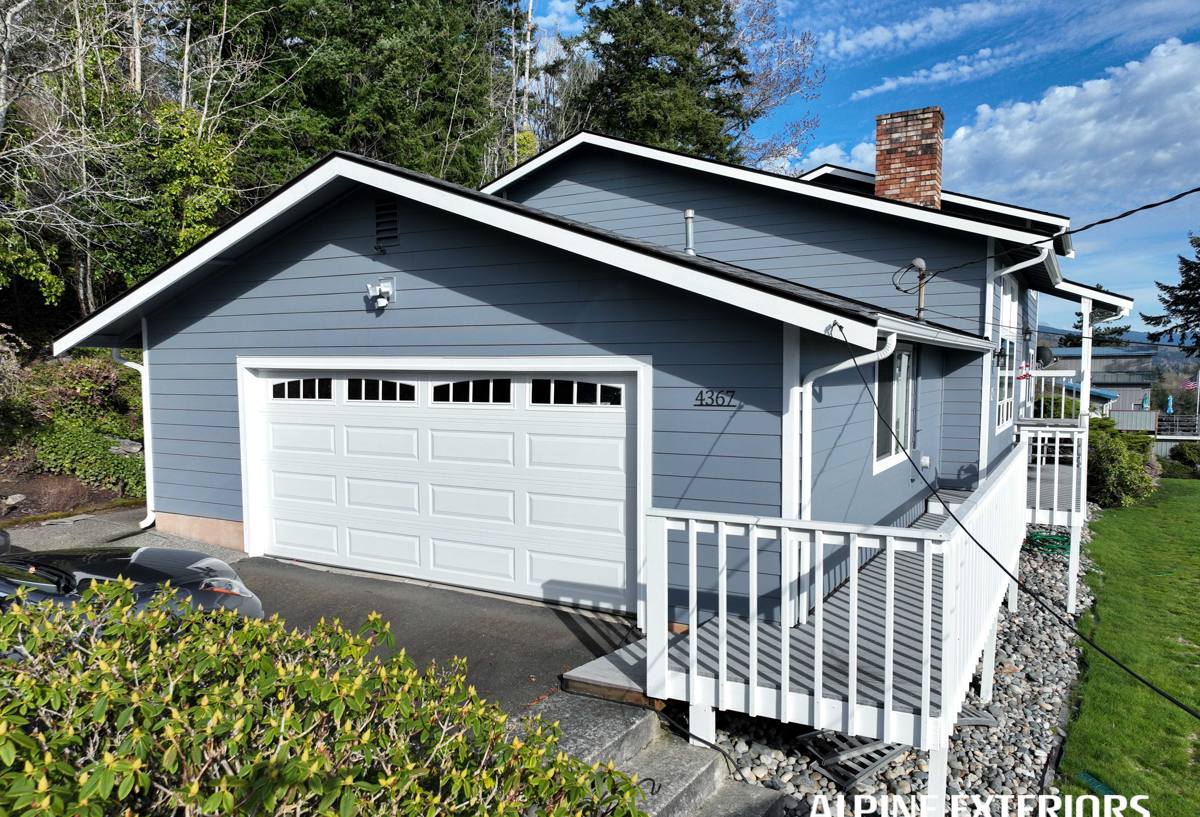
Signs a Riverside Deck Needs Replacing, Not Patching
Homeowners often ask whether a deck can be repaired instead of replaced. Sometimes it can — but there's a point where patching individual boards is just delaying a bigger, more expensive failure. Here's what tells us a full replacement is the honest recommendation:
- Soft or spongy spots in the decking, especially near the house or in shaded corners where moss holds moisture
- Rust streaking from fasteners or visible corrosion on joist hangers and structural hardware
- Gaps or separation where the deck ledger meets the house — a common entry point for water damage behind the siding
- Posts or footings that have shifted, settled, or show rot at ground contact
- Railings that flex or feel loose when leaned on
- A deck surface that's more moss and algae than usable wood for a good part of the year, even after cleaning
- Structural framing you can probe with a screwdriver and feel it sink into soft wood
If it's just a handful of surface boards showing wear and the framing underneath is sound, repair is a legitimate option and we'll say so. If the framing, ledger connection, or footings are compromised, replacement is the only honest answer — patching over structural rot just hides the problem for another season.
What a Correct Deck Replacement Actually Involves
It Starts Below the Surface
The decking boards are the part everyone notices, but they're the last thing installed and usually the least likely part to fail structurally. A correct replacement addresses the structure first:
- Footings — checked or replaced to current frost and load requirements, not just reused because they're already in the ground
- Framing and joists — pressure-treated lumber rated for ground contact where applicable, spaced and sized to code for the deck's actual load
- Ledger attachment — properly flashed where the deck meets the house, since this single connection point is the most common source of hidden water damage in this climate
- Hardware — corrosion-resistant, coated fasteners and joist hangers rated for treated lumber, not standard hardware that reacts with the chemicals in treated wood
Then the Visible Layer
Decking, railing, stairs, and any fascia or skirting go on last. This is where material choice matters most for how the deck looks and performs over the next 15 to 25 years — covered in detail below.
Choosing the Right Decking Material for Riverside Conditions
There's no single "best" decking material — there's a best material for this climate, this budget, and how much maintenance a homeowner actually wants to do. Given the salt air and long wet season here, we weigh options against real-world moisture exposure, not just a spec sheet.
| Material | How It Handles Local Conditions | Maintenance | Typical Lifespan |
|---|---|---|---|
| Pressure-treated wood | Solid performer if properly sealed and re-sealed on schedule; moss and mildew show fastest here without upkeep | Annual cleaning, re-sealing every 1-3 years | 10-15 years |
| Cedar | Naturally rot- and insect-resistant, but still needs sealing against driving rain and moss; softer surface | Regular sealing, periodic cleaning | 15-20 years |
| Composite decking | Resists moisture absorption well; quality matters — lower-grade composites can hold surface moisture and grow moss without airflow underneath | Periodic washing, no sealing | 25-30 years |
| PVC/capped composite | Best moisture and moss resistance of the group; fully sealed surface sheds water and doesn't absorb salt-laden moisture | Occasional washing | 25-30+ years |
We don't push one product line across every job. What we do insist on is proper ventilation and drainage underneath whatever material is chosen — composite and PVC decking still need airflow beneath the boards, or moisture gets trapped against the framing regardless of what the surface is made from. A beautiful composite deck installed tight to the ground with no airflow will still rot the joists underneath it in this climate.
Our Process, Start to Finish
Every deck replacement in Riverside follows the same sequence, whether it's a small back deck or a full wraparound:
- On-site assessment — we inspect the existing deck, footings, ledger connection, and framing to determine what's salvageable and what isn't
- Written estimate — clear scope, material options, and a straightforward price, not a vague range
- Permit handling — we pull the required permit and coordinate inspections so the homeowner doesn't have to chase paperwork
- Demolition and disposal — old decking and framing removed and hauled off
- Structural rebuild — footings, framing, and ledger flashing installed or replaced to code
- Decking, railing, and stairs — installed per the chosen material's manufacturer specs, including proper fastener spacing and gapping for drainage
- Final walkthrough — we go over the finished deck with the homeowner before calling the job done
Permits and Code Requirements in Skagit County
Most deck replacements in Mount Vernon and unincorporated Skagit County require a building permit, especially when the deck is attached to the house, elevated, or being rebuilt from the framing up. Requirements can vary by lot and by whether the footprint or height is changing from the original structure. Railing height, guard spacing, and stair rise/run all have to meet current code, even if the deck being replaced was built to older standards.
We handle the permit application and inspection scheduling as part of the job. Skipping this step to save time is a common shortcut in this trade — one that leaves the homeowner holding an uninspected, potentially non-compliant structure if it's ever an issue at resale or with insurance.
What Affects the Cost of a Riverside Deck Replacement
Every deck is different, so we don't quote sight-unseen prices. But these are the factors that move the number most:
| Factor | Why It Matters |
|---|---|
| Deck size and shape | Square footage and the number of angles, levels, or stairs directly drive material and labor |
| Framing condition | Footings or ledger work needed beyond standard replacement adds time and material |
| Decking material | Pressure-treated wood costs less upfront; composite and PVC cost more but need far less upkeep over time |
| Railing style | Basic wood or composite railing versus cable, glass panel, or custom designs |
| Site access | Decks over slopes, near water, or with limited equipment access take longer to build safely |
| Permit and inspection scope | Larger or elevated structures may require engineering review, adding time to the front end |
As a rough guide, a straightforward pressure-treated replacement typically runs less than a comparable composite or PVC rebuild, but the gap narrows over the life of the deck once you factor in sealing, staining, and moss removal on wood every year or two. We'll walk through the real numbers for your specific deck during the estimate — not a generic per-square-foot figure that doesn't account for your framing or site.
Why It Matters to Hire a Crew That Already Works Riverside
A deck built to a generic spec — the kind you'd find in a big-box installation guide — often looks fine for the first year or two anywhere in the country. Whether it holds up in Riverside specifically depends on details that only show up when a crew has actually worked this ground: how close the water table sits for footing depth, how much airflow a given lot gets versus a shaded, moss-prone yard next door, and how the prevailing wind off the water drives rain into a ledger connection that would be fine in a drier part of the state.
That local pattern recognition is what separates a deck that needs attention again in five years from one that's still solid at twenty. We're not guessing at how Skagit County weather treats a deck — we're building to what we've already seen it do.
If your Riverside deck is showing its age, or you're not sure whether it needs a repair or a full replacement, we're happy to take a look. Fill out the form below for a free, no-pressure estimate — no obligation, just an honest read on what your deck actually needs.