 Mount Vernon
 Why Little Mountain's Climate Is Hard on Siding
Little Mountain sits on the edge of Mount Vernon, elevated and tree-covered enough that homes here deal with a different mix of weather stress than a house down in the flats. You get wind-driven rain funneling through the trees, damp shade that never fully dries out between storms, and enough proximity to Puget Sound air that salt exposure is a real factor even a few miles inland. Add Skagit County's long, gray moss season — often eight months or more of the year where humidity and low sun angle keep north- and west-facing walls perpetually damp — and you have a climate that punishes any siding material with a weak point in its moisture defense.
This isn't a marketing exaggeration. It's the reason so many older homes in this area show soft trim, bubbling paint, or streaked moss growth on siding that's barely fifteen years old. The material itself matters, but so does how it's installed, because in this climate the installation details are what decide whether siding lasts twenty-five years or needs attention in eight.
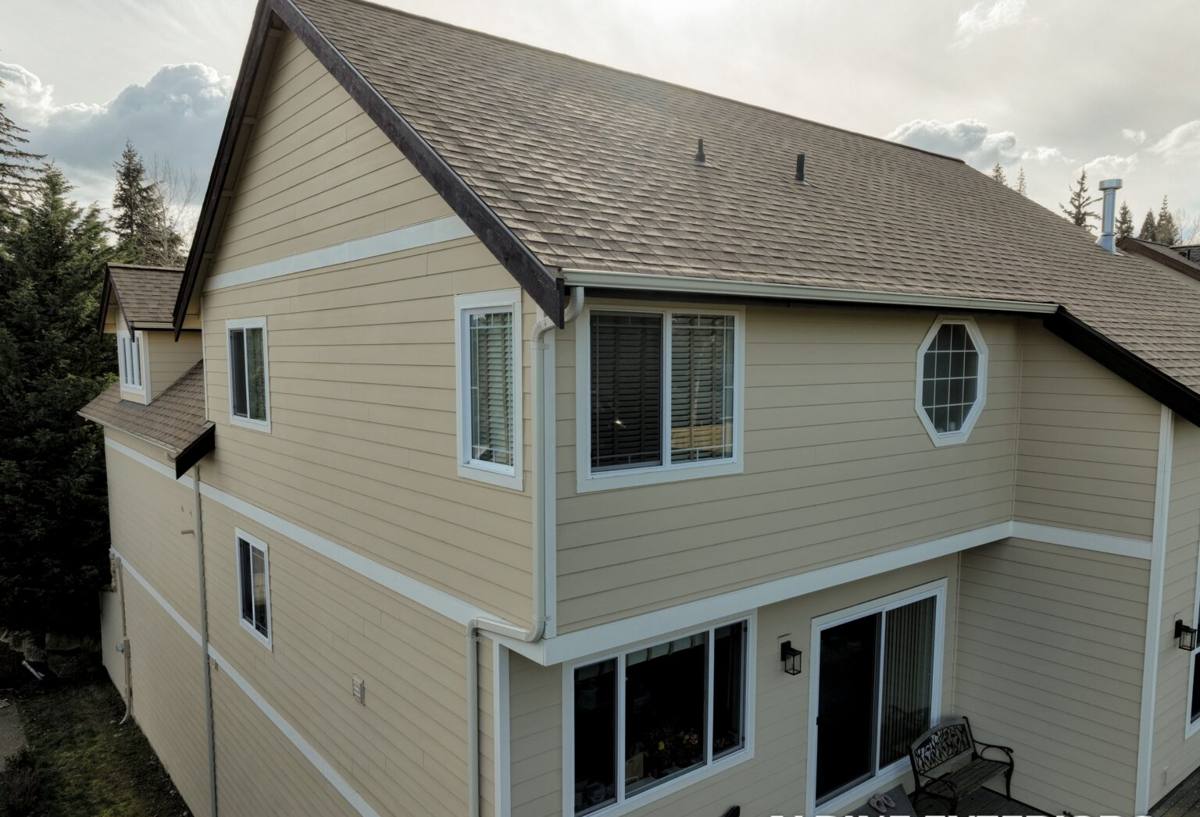
What Fiber Cement Has to Do Right Here
Handle Moisture Without Absorbing It
Fiber cement siding is dimensionally stable and doesn't swell, rot, or delaminate the way wood-based products can when they stay wet. That matters on a lot with heavy shade and slow-drying walls, because the siding isn't fighting a losing battle against trapped moisture the way untreated wood trim or engineered wood siding can under the same conditions.
Shrug Off Salt-Laden Air
Salt air accelerates corrosion in fasteners and trim hardware, and it can degrade a weak paint film faster than inland weather would. James Hardie's ColorPlus factory finish is baked on and formulated to resist fading and moisture intrusion better than field-applied paint, which is one of the reasons it holds up better in this kind of exposure than repainted or site-finished materials.
Resist a Long Moss Season
Fiber cement itself doesn't feed moss growth the way wood fiber can, but moss and algae will still colonize any siding surface that stays damp and shaded long enough — including fiber cement. The real defense against moss isn't the panel material alone; it's correct water management behind and around it, so moisture doesn't linger against the wall in the first place.
Why We Only Install James Hardie
We don't install vinyl, LP SmartSide, Cemplank, Allura, primed spruce, or cedar. That's a deliberate standard, not a sales pitch. In a climate like Little Mountain's, the weak points in those alternatives — vinyl's expansion and impact fragility in cold snaps, engineered wood's sensitivity to sustained moisture at cut edges, and the shorter or less consistent factory finishes on some competing fiber cement products — are exactly the failure modes this climate is good at finding. James Hardie's HardiePlank and HardiePanel lines are engineered in HZ5 formulation for the Pacific Northwest's wet, temperature-swinging conditions, backed by a real transferable warranty, and finished with ColorPlus coating that's designed to outperform field paint over time. That combination is why it's the only system we put our name behind.
| Factor | James Hardie Fiber Cement | Vinyl | Engineered Wood (LP-type) |
|---|---|---|---|
| Moisture resistance | Non-combustible, dimensionally stable, doesn't absorb and swell | Won't rot but can trap moisture behind it if installed tight | Vulnerable at cut edges and joints if moisture gets in |
| Salt air / coastal exposure | ColorPlus finish engineered for UV and moisture resistance | Can become brittle and discolor over time | Finish and substrate can degrade faster near moisture and salt |
| Fire performance | Non-combustible core material | Combustible, can deform under heat | Combustible |
| Long-term maintenance | Factory finish reduces repainting cycle | Low maintenance but fades and chalks over decades | Requires vigilant caulking and paint upkeep |
| Warranty structure | Strong transferable manufacturer warranty when installed to spec | Varies widely by product tier | Warranty often excludes moisture-related failure |
What a Correct Installation Actually Involves
Water Management Behind the Cladding
The siding panel is the last line of defense, not the only one. A correct install starts with a properly lapped weather-resistant barrier, correctly flashed windows, doors, and penetrations, and a drainage plane that lets any moisture that does get behind the siding find its way back out instead of sitting against the sheathing. In a climate that stays damp for most of the year, skipping or rushing this step is where premature siding failures actually start — not with the panel material itself.
Clearances and Fastening
James Hardie specifies minimum clearances from grade, roof lines, decks, and other siding terminations, along with specific fastener patterns and gapping at butt joints. These aren't cosmetic guidelines — they control how the siding expands, contracts, and sheds water over its life. Fastening too tight, skipping gaps, or burying the bottom edge too close to grade are common shortcuts that void warranty coverage and create the exact moisture traps that lead to moss buildup and paint failure.
Trim, Caulking, and Paint Details
Corner boards, trim, and caulk joints are where a lot of installations quietly fail years down the road. We use compatible, high-quality caulking at joints that need it, and we don't caulk joints that are designed to move or drain — sealing those over traps water instead of letting it escape.
Our Process on a Little Mountain Job
- Walk and assess — we look at existing siding, trim condition, moisture staining, and any rot or sheathing damage before quoting anything.
- Tear-off and sheathing check — old siding comes off and we inspect the sheathing underneath for damage that needs repair before new siding goes on.
- Weather barrier and flashing — house wrap, window and door flashing, and drainage details go in correctly the first time.
- Hardie panel or plank installation — installed to manufacturer clearance, fastening, and gapping specifications.
- Trim and detail work — corner boards, trim, and caulk joints finished to shed water, not trap it.
- Final walkthrough — we go over the finished job with the homeowner before calling it done.
Signs Your Little Mountain Home Needs Attention
- Persistent moss or algae streaking on north- or west-facing walls that comes back soon after cleaning
- Soft spots, bubbling, or peeling paint around trim, corners, or the bottom courses of siding
- Visible gaps, warping, or separation at siding joints and butt seams
- Staining or discoloration that tracks water paths down from windows, roof lines, or gutters
- Siding that feels spongy or shows swelling, especially near ground level or under deep shade
- Interior signs like musty smells or damp drywall on exterior-facing walls
Any one of these on its own might just need cleaning or a caulk touch-up. Several together, especially on a shaded or wind-exposed wall, usually means moisture is getting past the cladding and it's worth having someone look at what's underneath.
Cost Factors to Expect
| Factor | Why It Matters |
|---|---|
| Sheathing condition | Rot or moisture damage found during tear-off adds repair scope before new siding can go on |
| Home size and wall complexity | More corners, gables, and trim detail means more labor and material |
| Product line and profile | Lap width, panel style, and ColorPlus color selection affect material cost |
| Existing siding removal | Full tear-off versus siding over an already-sound wall system changes labor time |
| Access and site conditions | Tree cover, slope, and staging access on a wooded lot can affect scheduling and setup |
We don't quote broad numbers on a page like this because every Little Mountain property is different — tree cover, wall exposure, and existing condition all move the estimate. A walkthrough gives an honest number, not a guess.
Why Hiring a Crew That Already Works This Area Matters
Little Mountain's mix of shade, elevation, and wind-driven rain isn't the same as siding a house out in the open flats of the Skagit Valley or a dry inland neighborhood. A crew that's already worked this specific terrain knows where moss tends to build up first, which wall orientations take the worst of the driving rain, and how tree cover changes drying time after a storm. That local pattern recognition shows up in small decisions — where to add extra flashing attention, how tight to run clearances near dense landscaping — that a generic install plan won't account for.
It also means fewer surprises. A crew unfamiliar with this kind of site can misjudge how much moisture is already trapped behind existing siding, or underestimate how much prep work a shaded, damp wall actually needs before new cladding goes up correctly.
Get an Honest Look at Your Siding
If you're seeing moss buildup, paint failure, or just want to know whether your current siding is holding up the way it should, we're happy to take a look. The estimate is free, there's no pressure, and if your siding doesn't need replacing yet, we'll tell you that too.