 Mount Vernon
 Kulshan Ridge sits in a part of Skagit County where the weather doesn't do siding any favors. Homes here take on salt-tinged air, long stretches of driving rain, and a moss season that can run most of the year on shaded walls. If you're planning a siding project in this neighborhood, both the product and the installation need to be matched to what this stretch of the Pacific Northwest actually does to a house year after year — not treated as a generic siding upgrade.
What Kulshan Ridge's Climate Does to Siding Over Time
Mount Vernon sits close enough to Puget Sound and the Skagit River delta that homes here deal with a mix of coastal-influenced weather most inland siding jobs never see. It's not one dramatic event that causes problems — it's the accumulation of hundreds of wet, mild, low-sun days every year.
Salt Air and Driving Rain
Salt-laden air corrodes exposed metal fasteners, degrades some paint systems faster than manufacturers' lab tests predict, and speeds up the breakdown of anything not rated for coastal exposure. Combine that with driving rain that gets pushed sideways into wall assemblies during winter storms, and you have two separate stresses working on the same siding at the same time: chemical attack from the air and physical water intrusion from wind-driven rain. Siding that isn't dimensionally stable, or that relies on caulked seams and butt joints to stay watertight, tends to show its weak points here faster than it would in a drier climate.
A Moss Season That Doesn't Really End
Shaded north-facing walls, mature landscaping, and long stretches of overcast, damp weather add up to a moss and algae season that, realistically, never fully shuts off in this part of Skagit County. Porous or textured siding surfaces give moss spores something to grab onto and hold moisture against the wall. Once moss establishes itself, it doesn't just look bad — it keeps the substrate underneath wetter, longer, which is exactly the condition that causes rot, paint failure, and fastener corrosion to accelerate.
Why James Hardie Fits This Environment
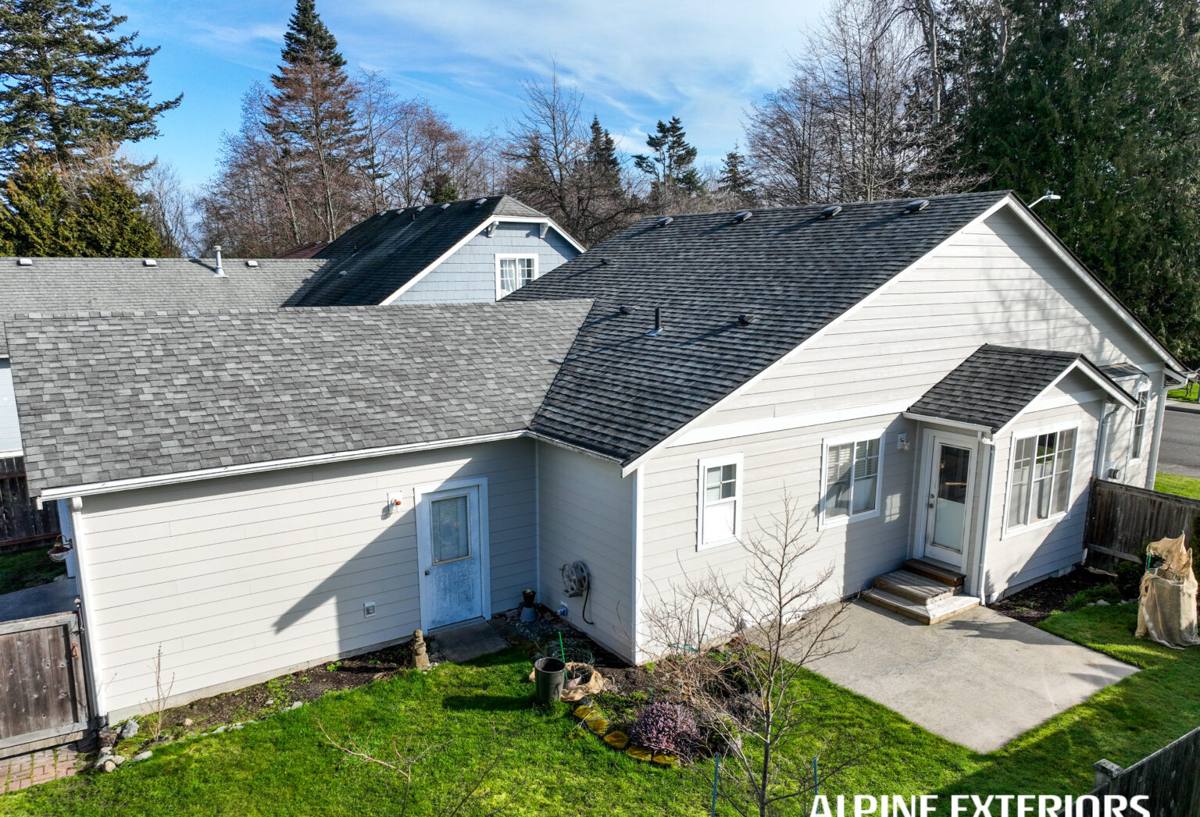
We install James Hardie fiber cement siding exclusively, and a neighborhood like Kulshan Ridge is a good example of why. Fiber cement doesn't absorb moisture the way wood-based products do, it won't rot, and it holds its shape through repeated wet-dry cycles instead of warping, cupping, or delaminating.
HZ5 Engineered for the Pacific Northwest
James Hardie makes climate-specific formulations, and the HZ5 line is engineered for regions with prolonged wet weather and freeze-thaw cycling like ours. It's built to resist moisture-related damage in a way that a one-size-fits-all siding product isn't. That distinction matters more in Skagit County than it would somewhere dry, because the product is being tested by real weather almost every week of the year, not just during a handful of storms.
ColorPlus Factory Finish vs. Field Painting
James Hardie's ColorPlus finish is baked on at the factory under controlled conditions, with more coats and better adhesion than a field-applied paint job can typically achieve, especially in a climate where it's hard to find enough consecutive dry days to paint correctly. A factory finish also resists the fading and chalking that field-applied coatings are more prone to under repeated damp-and-dry cycling. It's not that site-painted siding can't look good on day one — it's that the finish has to survive years of this specific weather, and a factory-cured finish starts from a stronger baseline.
What a Correct James Hardie Installation Involves
James Hardie siding performs the way it's rated to perform only when it's installed to the manufacturer's specifications. In a climate like ours, the margin for error is smaller than it would be somewhere dry, because any gap in the water management gets tested constantly instead of occasionally.
Clearances, Flashing, and Fastening
A correct installation includes proper clearance between the bottom edge of the siding and grade, decks, patios, and roof lines, so water has somewhere to go instead of wicking up into the board. It means flashing at every window, door, and horizontal transition, installed so water sheds outward rather than behind the siding. It means fastening at the pattern and depth Hardie specifies — overdriven or underdriven nails are one of the most common causes of early siding failure, and it's not something you can see from the ground once the job is finished. It also means correct joint treatment at butt seams, since those are the points most exposed to wind-driven rain.
Where We See Installations Go Wrong
Most of the problems we get called out to fix on other people's siding jobs trace back to a handful of shortcuts: caulk used in place of proper flashing, siding installed tight to grade or hardscape with no drainage gap, fasteners driven at the wrong depth, and house wrap or weather barrier details that were rushed rather than lapped and sealed correctly. None of these mistakes are visible on installation day. They show up two, five, or ten years later as staining, soft spots, or paint failure — usually right around the time a homeowner assumed the siding was simply doing its job.
Comparing Siding Options for a Climate Like This
We only install James Hardie, but homeowners in Kulshan Ridge are often weighing it against other products before they call us. Here's how the common options actually compare under this region's conditions:
| Siding Type | Moisture Behavior | Moss/Algae Resistance | Maintenance | Typical Lifespan |
|---|---|---|---|---|
| James Hardie Fiber Cement | Does not absorb water, dimensionally stable | Factory finish resists buildup better than porous surfaces | Occasional wash; repaint only if ever needed, decades out | 30+ years with correct install |
| Vinyl | Sheds water but seams and panels can flex, warp, or gap over time | Grime and moss can collect in laps and grooves | Low, but panels aren't repairable individually if damaged | 20-30 years, shorter in harsh sun/wind exposure |
| Cedar | Absorbs moisture; performance depends heavily on upkeep | Prone to moss and mildew without regular treatment | Regular staining/sealing required, especially here | 15-25 years with diligent maintenance |
| LP SmartSide | Engineered wood strand product; treated to resist moisture but still wood-based | Susceptible if coating is compromised or seams open up | Caulk and touch-up maintenance at seams and edges | 20-30 years, install-sensitive |
Our Process on a Kulshan Ridge Project
Every job follows the same sequence, adjusted for the specific house:
- On-site inspection of the existing walls, trim, and moisture barrier condition, not just a walk-around estimate.
- Product and ColorPlus color selection based on the home's exposure — sun-facing versus shaded, wind-exposed versus sheltered.
- Removal of old siding and inspection of sheathing underneath for hidden rot or prior water damage before anything new goes up.
- Installation of house wrap or weather barrier, flashing at every penetration, and James Hardie panels or plank installed to manufacturer clearance and fastening specifications.
- Final walkthrough covering caulking points, trim details, and what maintenance (if any) the homeowner should expect going forward.
Why Hiring a Crew That Already Works This Neighborhood Matters
A siding crew that already works Kulshan Ridge and the surrounding parts of Mount Vernon isn't guessing at how this microclimate behaves — they've seen which walls take the worst of the driving rain, which ones stay shaded and mossy longest, and how the permitting and inspection process runs with the city and Skagit County. That's the difference between a crew that installs Hardie correctly on paper and one that installs it correctly for this specific place. It also means faster, more accurate estimates, because they're not learning the neighborhood's quirks on your job.
Keeping Hardie Siding Looking Right After Installation
James Hardie siding is low-maintenance compared to wood or vinyl, but "low-maintenance" isn't "no-maintenance," especially with the moss and algae pressure this area sees. A simple annual routine keeps it looking the way it did on installation day:
- Rinse the siding once or twice a year with a garden hose and soft brush — skip the pressure washer, which can force water behind panels or damage caulk lines.
- Keep shrubs and trees trimmed back from the walls so shaded sections get airflow and sunlight instead of staying damp.
- Check caulking at trim, window, and door joints annually and have any cracked or shrunk sections redone before winter rains set in.
- Address any moss or algae growth early with a gentle wash rather than letting it establish and hold moisture against the surface.
- Have any impact damage or fastener issues repaired promptly — small gaps are far cheaper to fix than the water damage they can lead to.
If you're weighing siding options for a home in Kulshan Ridge, we're happy to walk the property, look at how the sun and rain hit your specific walls, and put together a straightforward, no-pressure estimate for a James Hardie installation built for this climate.