 Mount Vernon
 Burlington's Climate Puts Real Stress on Siding
Burlington sits in the flood plain and river-valley air of Skagit County, close enough to Puget Sound and the Skagit River delta that salt-laden moisture is a regular part of the weather, not an occasional event. Add the long stretch of wet months typical of Western Washington, and Burlington homes deal with three separate stresses on their exterior walls: airborne salt, driving rain that gets pushed sideways into wall assemblies during winter storms, and a moss and algae season that can run most of the year on shaded or north-facing walls.
None of these problems are dramatic on their own. The damage they cause is slow — swelling seams, soft trim, peeling paint, dark streaking — which is exactly why so many homes in this area end up needing siding work sooner than the homeowner expected. A siding product and installation method that ignores any one of these three factors will show it within a few years.
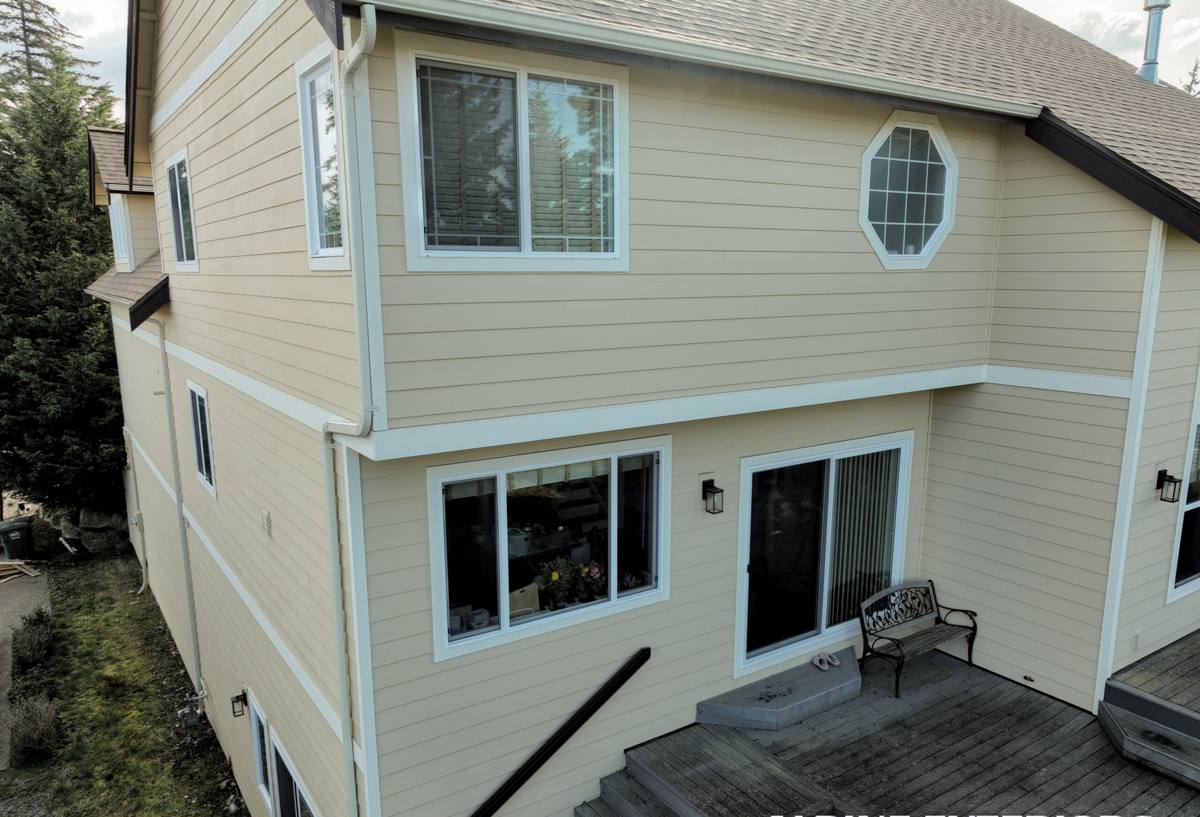
Why We Standardized on James Hardie, and Nothing Else
We do not install vinyl, LP SmartSide, Cemplank, Allura, primed spruce, or cedar. That's not a marketing position — it's a decision based on what holds up under exactly the conditions Burlington gets. Wood-based and wood-composite sidings depend on an intact factory coating or field-applied paint to keep moisture out; once that layer is compromised at a cut edge, a fastener hole, or a butt joint, the underlying wood fiber can swell, rot, or delaminate. In a climate with this much sustained moisture and salt exposure, that's not a hypothetical — it's a maintenance timeline.
James Hardie fiber cement is cement, sand, and cellulose fiber. It doesn't rot, it isn't a food source for moss or algae the way wood substrates can be, and it holds paint and factory finish far longer because the material itself isn't moving with moisture the way wood does. It's also non-combustible, which matters more each year as wildfire smoke and ember exposure become a bigger consideration even on the wet side of the state. We install Hardie because it's the product that matches what this region actually does to a house, not because it's the only option on the market.
What We're Not Saying
Cedar and engineered wood sidings aren't bad products when installed and maintained correctly — cedar in particular has real appeal and a long history in this region. The trade-off is ongoing maintenance: refinishing schedules, caulk inspections, and vigilance about trapped moisture that most homeowners underestimate when they're comparing sticker prices. We'd rather install a product that removes that burden than sell a lower up-front cost that turns into a recurring bill.
The Right Hardie Product Line for This Area
James Hardie engineers its siding by climate zone, and homes in the Skagit Valley fall into the HZ5 category — the line built for wetter, more moisture-variable climates rather than the hotter, drier HZ10 line used in the Southwest. HZ5 planks and panels are formulated to perform through freeze-thaw cycling, sustained damp periods, and the kind of wind-driven rain Burlington gets off the valley and the Sound. Specifying the correct zone isn't a minor detail — it affects the moisture and durability performance of the board itself, before installation is even considered.
On top of that, ColorPlus Technology — Hardie's factory-applied, baked-on finish — matters more here than in a drier climate. A factory finish cures under controlled conditions and bonds to the fiber cement in a way field-applied paint can't fully replicate, and it comes with its own finish warranty. For a wall that's going to see months of damp weather every year, a finish that isn't dependent on ideal on-site painting conditions is a real advantage.
What a Correct Installation Involves
Fiber cement siding is only as good as the assembly behind it. Most siding failures we get called out to inspect trace back to installation shortcuts, not the product itself. On Burlington homes, we pay particular attention to:
- Rain screen gap: a drainage space behind the siding so any moisture that gets past the cladding can drain and dry instead of sitting against the wall sheathing.
- Flashing at every penetration: windows, doors, hose bibs, vents, and deck ledgers all need proper head flashing and kick-out flashing, not just caulk.
- Correct fastener placement and spacing: per Hardie's published fastening schedule, matched to the local wind exposure category, not a generic pattern.
- Gapped and back-primed cuts: factory-finished planks need touched-up cut edges and proper joint gapping so the ColorPlus finish isn't compromised where boards are trimmed on site.
- Butt joint treatment: sealed or flashed correctly so horizontal joints — the most common failure point on any lap siding — don't become an entry point for driving rain.
- Ground and hardscape clearance: proper clearance from soil, decks, and pavement so splashback and standing moisture don't wick into the bottom course.
Every one of these is a place where a rushed crew can save an hour and cost the homeowner a callback five years later. It's also why installer experience matters as much as the product choice.
ColorPlus Finish vs. Field-Applied Paint
| Factor | ColorPlus Factory Finish | Field-Applied Paint |
|---|---|---|
| Cure conditions | Controlled, baked-on in a factory environment | Dependent on weather window at time of install |
| Coverage consistency | Uniform across every board | Varies with applicator, temperature, humidity |
| Warranty | Separate finish warranty from Hardie | Typically covered only by the paint manufacturer, if at all |
| Repaint interval | Significantly longer than field paint in wet climates | Shorter, especially on sun- and rain-exposed elevations |
| Touch-up need | Minor, mainly at field cuts | Full-wall maintenance over time |
Our Process on Burlington Projects
- On-site walk and assessment: we look at wall orientation, moisture exposure, existing damage, and drainage before quoting anything.
- Written scope with product spec: plank profile, HZ5 specification, and ColorPlus color called out in writing, not left vague.
- Tear-off and sheathing check: we inspect what's behind the old siding — sheathing, house wrap, and framing — before closing anything up.
- Weather-resistive barrier and rain screen installation: the drainage plane goes in correctly before a single piece of siding is hung.
- Flashing at all penetrations: done before siding, not patched afterward.
- Hardie installation to manufacturer fastening spec: matched to Burlington's wind exposure.
- Final detailing and walk-through: trim, caulking review, and a homeowner walk-through before we call the job done.
What Drives Cost on a Burlington Home
| Cost Factor | Why It Matters |
|---|---|
| Home size and wall complexity | More corners, gables, and cutouts mean more labor and material waste |
| Condition behind existing siding | Rot or moisture damage found at tear-off adds repair scope |
| Plank profile and reveal size | Wider reveals and specialty profiles cost more than standard lap |
| Trim and accessory scope | Corner boards, frieze boards, and trim detailing add labor |
| Access and site conditions | Steep lots, tight setbacks, or limited equipment access affect labor time |
We give a broad range on a phone call at most, and a firm number only after seeing the house — anyone quoting a precise price before that isn't looking closely enough at what's actually behind your walls.
Why It Matters That We Already Work in This Area
A crew that works Burlington and the surrounding Skagit Valley regularly already knows which elevations take the worst of the weather, how local wind patterns push rain into walls, and what moisture problems tend to show up on homes of a certain age or construction type in this area. That familiarity shows up in small decisions — where to add extra flashing attention, which details to double-check — that a crew unfamiliar with the region might not think to prioritize.
It also means we're not disappearing after the job. Warranty support, follow-up questions, and any future exterior work are easier with a contractor who's local and plans to keep working in the same neighborhoods for years, not one passing through on a single job.
A Practical Checklist Before You Hire Anyone
- Ask what siding brand and product line they install, and whether it's climate-zone specific for this area.
- Ask them to explain their rain screen and flashing approach — not just "we caulk everything."
- Get the product line, color, and plank profile in writing before work starts.
- Ask how they handle sheathing or framing damage found during tear-off, and how that's priced.
- Confirm whether they're a licensed, insured contractor and ask for proof.
- Ask about warranty coverage — both the manufacturer's and the installer's workmanship warranty.
If your Burlington home's siding is showing moss staining, soft trim, peeling paint, or you're just planning ahead, we're happy to take a look and give you a straightforward, no-pressure estimate. Use the form below to get started.