 Mount Vernon
 Why Big Lake Roofs Take a Different Kind of Beating
Big Lake sits in a pocket of Skagit County that gets the worst of both worlds: open water exposure that funnels wind straight at rooflines, and enough tree cover around the shoreline and surrounding properties to load roofs with debris and shade every winter storm. Add in the salt-tinged marine air that moves inland from Puget Sound and the Skagit River valley's driving rain, and you've got a roof environment that ages faster than it would twenty or thirty miles east.
Storm damage here rarely looks like a single dramatic event. More often it's an accumulation — a windstorm lifts a few shingle tabs, the next atmospheric river pushes rain up under the gap, and by the time a stain shows up on a ceiling, the underlayment has been wet for weeks. Homes right around Big Lake, with mature fir and cedar overhanging the roof, see this pattern more than most.
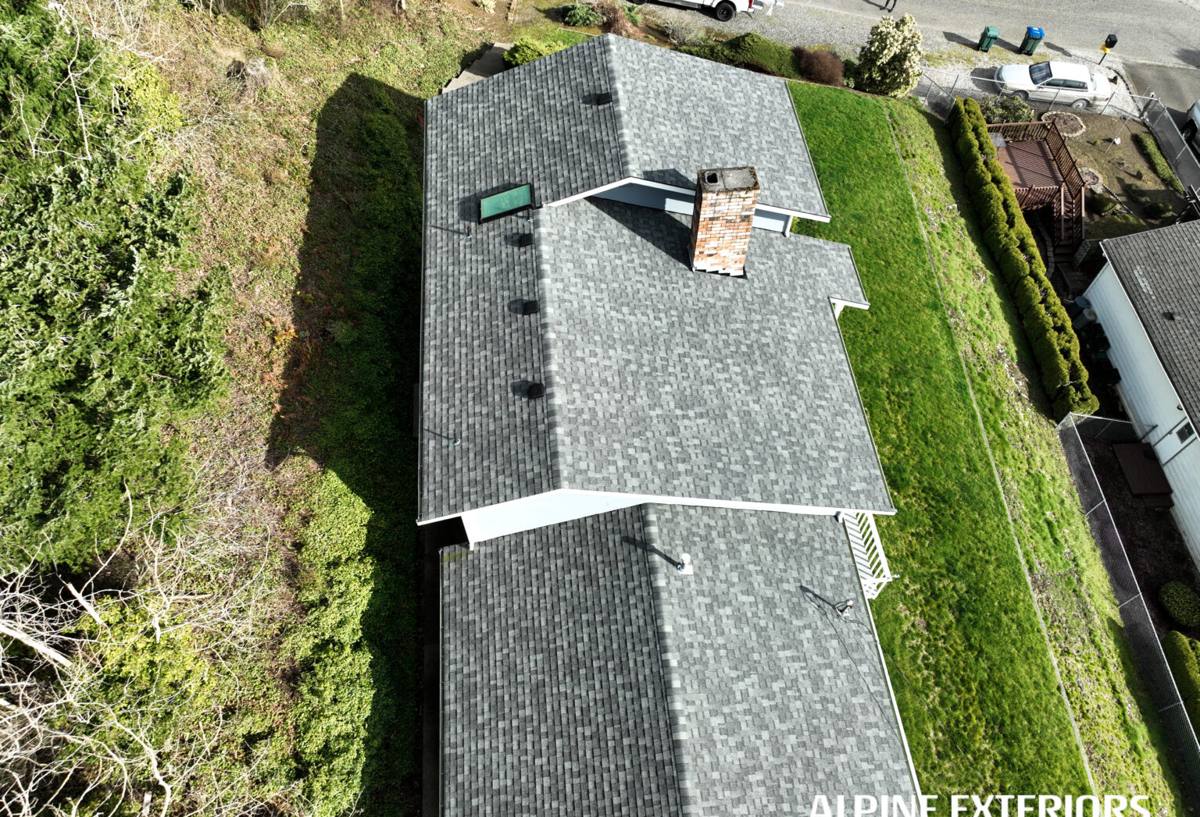
What Actually Counts as Storm Damage
Homeowners often assume "storm damage" means missing shingles or a visible hole. In practice, most of the repair work we do after a Skagit County storm falls into a few categories:
- Wind-lifted or creased shingles, where the seal strip has broken but the shingle is still mostly in place
- Torn or punctured roofing from falling branches, especially common on lake-adjacent lots with tall conifers
- Flashing pulled loose around chimneys, skylights, and roof-to-wall transitions
- Gutter and fascia damage that lets wind-driven rain track back under the roof edge
- Granule loss on older shingles, which accelerates after repeated wind events even without a single obvious failure point
The tricky part is that several of these are invisible from the ground. A homeowner walking the yard after a storm sees no shingles on the lawn and assumes the roof is fine, when a lifted tab or a bent flashing seam is quietly letting water in every time it rains.
The Long Moss Season and Why It Matters After a Storm
Mount Vernon's moss season isn't a minor seasonal nuisance — with our mild, wet winters and shaded lots around Big Lake, moss can be actively growing on north-facing roof slopes for eight or nine months of the year. That matters directly for storm repair because moss changes how a roof fails.
Moss holds moisture against the shingle surface long after a storm passes, which softens the mat and speeds up granule loss in exactly the areas already weakened by wind. It also lifts shingle edges as it grows under the tabs, which gives wind an easier grip during the next storm. When we inspect storm damage on a Big Lake roof, moss coverage is one of the first things we document — not just for cosmetic reasons, but because it tells us whether nearby undamaged-looking shingles are actually still sound or already compromised underneath.
Salt Air's Slower, Quieter Effect
The lake and the broader Skagit valley's proximity to Puget Sound mean roofs here deal with a low level of salt-laden moisture in the air. On its own it's not dramatic, but combined with wind and driving rain it accelerates corrosion on exposed metal — flashing, nail heads, gutter fasteners — which is often the actual point of failure after a storm, not the shingle itself.
How We Approach a Storm Damage Repair
A correct storm repair starts with a full inspection, not a patch job on the one spot the homeowner noticed. Here's the process we follow:
- Ground and roof-level inspection. We walk the roof (weather permitting) and check every slope, not just the side facing the prevailing wind, since gusts around Big Lake's open water can hit a roof from more than one direction during a single storm.
- Interior check. Attic and ceiling inspection for staining, wet insulation, or daylight showing through decking — signs of a leak that hasn't reached the surface yet.
- Damage mapping. We document every lifted shingle, damaged flashing point, and area of granule loss, and separate storm-caused damage from pre-existing wear so the scope of repair is honest and accurate.
- Repair plan. Depending on scope, that's targeted shingle and flashing replacement, a section re-roof, or in some cases a recommendation that the full roof is near the end of its service life and repair would just be a short-term fix.
- Repair execution. Matching materials as closely as possible, re-sealing and re-nailing to current code, and checking flashing and gutter attachment points while we're already up there.
- Final walkthrough. We show you what was found and what was done — no surprises after the fact.
Repair Scope Comparison
Not every storm-damaged roof needs the same level of work. This is a general guide to how scope typically breaks down — actual cost depends on roof pitch, access, material, and how much of the roof is affected.
| Damage Type | Typical Scope | What Drives Cost |
|---|---|---|
| Isolated wind-lifted shingles | Spot repair, re-seal or replace individual shingles | Number of shingles, roof pitch/access |
| Branch strike or puncture | Section replacement including decking check | Decking damage, size of affected area |
| Flashing failure (chimney, skylight, wall) | Flashing replacement and re-seal | Complexity of the transition, material match |
| Widespread granule loss / moss undermining | Full slope or full roof evaluation | Roof age, extent of moss damage, remaining shingle life |
| Gutter/fascia pulled from wind | Re-fasten or replace gutter run and fascia board | Length of run, wood rot behind fascia |
Matching Materials on an Existing Roof
One detail that gets overlooked on storm repairs: matching the replacement shingles or metal to what's already on the roof. Shingle colors fade with UV and moss exposure over time, so a patch using brand-new shingles next to a ten-year-old roof will often look mismatched even when the repair itself is done correctly. We'll tell you upfront when a perfect match isn't realistic, and talk through whether a slightly visible patch, a full slope replacement, or a color blend is the better call for your situation and budget.
We also pay attention to nailing pattern and fastener type on repairs — a shingle re-nailed with the wrong fastener spacing or the wrong nail length is a repair that looks fine for a season and fails in the next windstorm.
Insurance and Documentation
Many storm repairs in this area go through homeowners insurance, particularly after a named windstorm or significant weather event. We document damage with photos and a written scope before any repair work starts, which gives you something concrete to bring to an adjuster. We're not a public adjuster and won't promise a claim outcome, but a clear, honest damage assessment from a local roofer carries weight in that process — and it protects you if there's ever a dispute about what was storm-caused versus pre-existing wear.
What to Do Right After a Storm
If you suspect storm damage on your Big Lake home, a few simple steps in the days after the weather clears can prevent a small problem from becoming a bigger one:
- Check the attic for fresh water stains, damp insulation, or daylight through the roof deck
- Look at ceilings and around chimneys and skylights inside the house for new staining
- From the ground, scan for shingles or granules collected in gutters or on the lawn
- Note any large branches that came down near or on the roofline, even if they didn't visibly hit
- Avoid getting on the roof yourself, especially on wet or mossy slopes — that's when most storm-related falls happen
- Get an inspection scheduled promptly; a lifted shingle left through a second storm often turns a repair into a replacement
Why Local Experience with Big Lake Homes Matters
A roofer who works Big Lake regularly already knows which slopes take the brunt of the wind off the water, how much shade a given lot gets and what that means for moss buildup, and what a typical roof age and construction looks like in this part of Skagit County. That local knowledge shortens the inspection, sharpens the damage assessment, and means fewer surprises once repair work is underway. It also means we're not learning the area's weather patterns on your roof — we already know what a Mount Vernon storm season does to a shingle roof over the years, and we repair accordingly rather than applying a generic fix.
If you've had storm damage — or just want a straight answer on whether that lifted shingle needs attention now or can wait — we'll come take a look and give you a clear, no-pressure estimate. There's no charge for the inspection, and no obligation to move forward with the work.