 Mount Vernon
 Board & Batten Siding Built for Big Lake's Weather
Big Lake sits in a pocket of Skagit County that takes weather from two directions at once. You get the marine push off Puget Sound and the Salish Sea bringing salt-laden air and driving rain, and you get the shaded, moisture-holding conditions around the lake and surrounding tree cover that keep siding damp longer than it would stay in a drier, more exposed part of the county. That combination is hard on any exterior cladding, but it's especially unforgiving on vertical board and batten profiles, where the board-to-batten seams and the long vertical joints give water more opportunities to find a way in if the material or the installation isn't right.
Board and batten remains one of the most requested looks for homes around Big Lake — it reads clean on newer builds, it suits cabin-style and lake-adjacent properties, and it holds up visually against the surrounding evergreens in a way that busier lap-siding patterns sometimes don't. Done correctly, it's also one of the more durable siding profiles available, because the vertical orientation sheds water faster than horizontal laps when the flashing and drainage details are correct. Done incorrectly, it's one of the fastest profiles to fail, because every seam is a potential water entry point and there's less forgiveness in the detailing than homeowners expect.
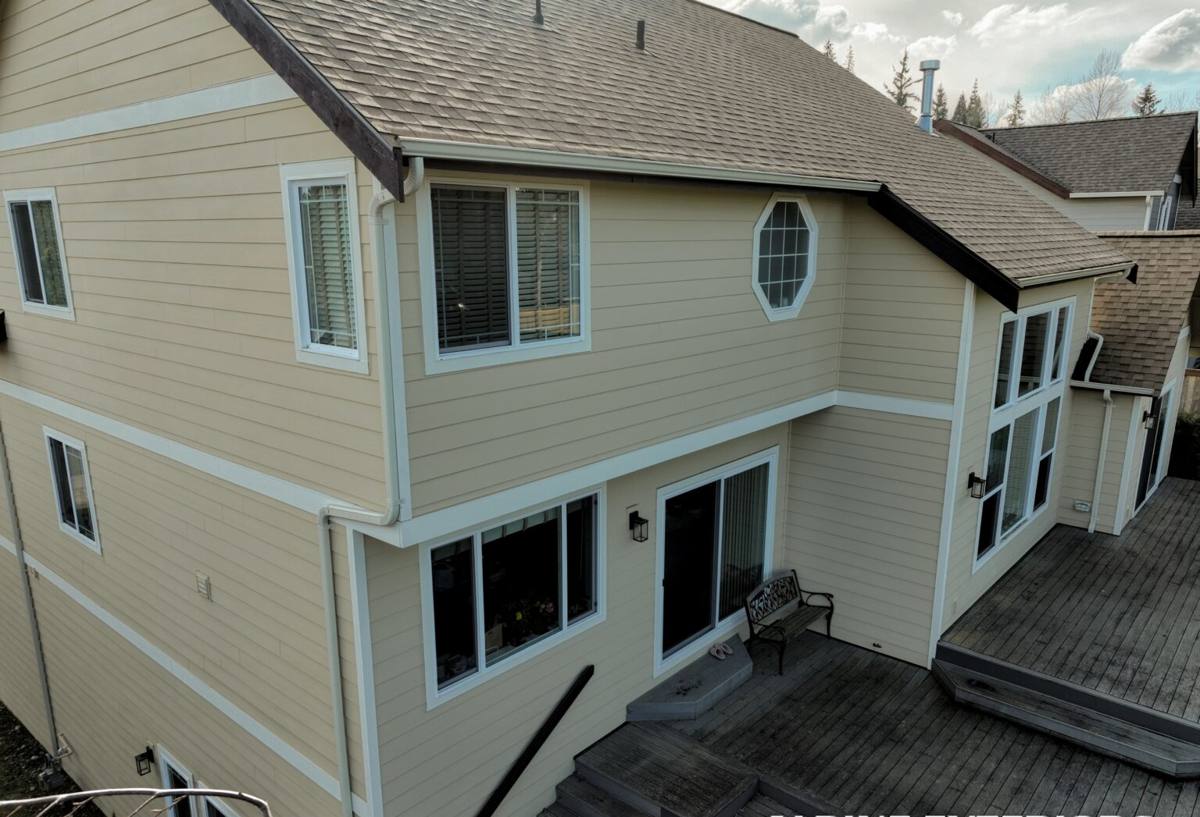
What Big Lake's Climate Actually Does to Siding
Salt Air
Homes closer to the Sound and the lake's open water see airborne salt settle on exterior surfaces. Salt is hygroscopic — it pulls moisture out of the air and holds it against whatever surface it lands on. On siding materials that aren't dimensionally stable or that have exposed, unsealed cut edges, that constant low-grade moisture exposure accelerates swelling, paint failure, and edge deterioration over years, even when the siding never sees a drop of rain.
Driving Rain
Skagit County's rain rarely falls straight down. Wind-driven rain hits vertical siding at an angle, which means it's pushed against and sometimes behind board and batten seams rather than just running down the face. If the battens aren't fastened and flashed to shed that wind-driven water back out rather than trapping it, moisture works its way behind the boards where it can sit against sheathing and framing for weeks at a time in our wet season.
Moss Season
Big Lake's tree cover and lake humidity extend moss season well beyond what you'd see on a more open, sun-exposed lot. Moss and algae hold moisture directly against the siding surface, and on the north and shaded sides of a home that moisture load rarely fully dries out between rain events from fall through spring. Over time this keeps the substrate wetter than the material was ever designed to handle, which is exactly the condition that causes rot, cupping, and coating breakdown in wood-based and engineered wood siding products.
What a Correct Board & Batten Job Actually Involves
Board and batten looks simple from the curb — vertical panels with strips covering the seams — but the parts you can't see are what determine whether it lasts fifteen years or fifty. A correct installation on a Big Lake home involves:
- A drainage plane and weather-resistive barrier behind the siding, installed continuously with no gaps at penetrations
- A rainscreen or furring strategy that lets water that does get behind the cladding drain and dry rather than sit against the sheathing
- Properly lapped and sealed flashing at every window, door, and roofline intersection — the highest-risk water entry points on any vertical siding job
- Fastening patterns that account for panel expansion and contraction rather than pinning the material rigidly
- Batten placement and fastening that covers panel seams fully while still allowing the assembly to shed wind-driven rain
- Factory-sealed or properly field-sealed cut edges, since exposed raw edges are the fastest path for moisture intrusion
Any one of these done wrong won't necessarily show up as a visible problem in year one. It shows up in year five or eight, as staining, soft spots, or paint failure at the seams — right when it's expensive to fix and the damage may already extend to the sheathing underneath.
The Hardie System We Install
We install James Hardie fiber cement exclusively, and for board and batten applications that typically means HardiePanel vertical siding installed with HardieTrim boards as the battens, engineered as a system rather than mixed-and-matched from different manufacturers. That matters for two reasons specific to a place like Big Lake.
First, fiber cement is dimensionally stable in a way wood and wood-composite products aren't. It doesn't swell and shrink with the moisture swings that come with a long, damp moss season followed by drier summer stretches, which means the seams stay tight and the fasteners stay put instead of working loose over repeated wet-dry cycles.
Second, James Hardie engineers its siding lines for specific climate zones — the HZ10 line, used across the Pacific Northwest, is formulated for a wetter, more humid climate profile than the HZ5 line used in drier regions. That's not a marketing detail; it affects how the material handles moisture absorption over its service life, which is the exact stress Big Lake's rain and moss season put on any exterior product.
The factory-applied ColorPlus finish is baked on under controlled conditions rather than field-applied, which gives far more consistent coverage at cut edges and panel faces than a painted-on-site finish can match, and it comes with its own finish warranty separate from the product warranty.
Why We Don't Install the Alternatives for This Application
LP SmartSide and other engineered wood products can look similar to fiber cement board and batten from the curb, and they perform reasonably well in drier climates. But they're wood-based, which means the cut edges and seams — the exact vulnerable points in any board and batten assembly — need to stay sealed and maintained more aggressively in a climate with Big Lake's moisture load, or moisture can reach the wood fiber core. Vinyl board and batten is a lower-maintenance option in some regions, but it's a thinner, more flexible material that shows waviness over time and doesn't hold up as well to the freeze-thaw and moisture cycling this area sees. Primed spruce and cedar board and batten are the traditional look, and cedar in particular has real appeal, but both are organic wood products that require an ongoing paint and sealant maintenance schedule to keep moss, rot, and the region's driving rain from finding an opening — a maintenance burden that's harder to keep up with the closer a property sits to shaded, damp conditions like those around Big Lake. We made the call to standardize on one material system so every board and batten job we do gets the same climate-matched product, the same warranty structure, and the same installation detailing, rather than asking homeowners to choose between trade-offs we'd have to talk them out of six years later.
Our Process for Big Lake Homes
1. On-Site Assessment
We look at your home's specific exposure — how close you are to the lake, how much shade and tree cover the walls see, which elevations take the most wind-driven rain — because that exposure profile changes the drainage and flashing detailing we specify, not just the finish color.
2. Substrate and Moisture Check
Before any new siding goes on, we check the existing sheathing and framing for moisture damage from the old siding, especially on shaded, moss-prone walls where problems are most likely to be hiding behind the surface.
3. Weather Barrier and Drainage Plane
We install a continuous weather-resistive barrier and drainage strategy suited to a rainscreen assembly, which is the single biggest factor in whether wind-driven rain and trapped moisture become a long-term problem.
4. Panel and Batten Installation
HardiePanel and HardieTrim battens go on to Hardie's fastening and spacing specifications, with flashing detailed at every window, door, and roofline transition before the next course goes up.
5. Final Inspection
We walk the finished job checking seams, fastener lines, and flashing details before calling it complete — the same points that, if missed, are what cause callbacks years later.
Cost Factors for Board & Batten Siding
| Factor | Why It Affects Cost |
|---|---|
| Home exposure and elevation count | Walls facing prevailing wind-driven rain need more careful flashing detail, adding labor time |
| Existing substrate condition | Sheathing repair from prior moisture damage is often discovered mid-project on older homes near the lake |
| Panel and trim configuration | Batten spacing and reveal width affect material quantities and installation time |
| Window and door count | Each penetration requires individual flashing work, a major driver of labor hours |
| Access and site conditions | Tree cover, slope, and lakefront lot layouts can affect scaffolding and staging needs |
Maintaining Board & Batten Through Moss Season
- Rinse siding annually, focusing on shaded and north-facing walls where moss and algae take hold first
- Keep gutters clear so overflow doesn't run directly down siding seams during heavy rain events
- Trim back tree and shrub growth that keeps walls shaded and damp longer than necessary
- Inspect caulking at trim and penetrations each year, since even durable sealants need periodic attention
- Address any soft spots or staining promptly rather than waiting for a full season to pass
Fiber cement dramatically reduces this maintenance burden compared to wood-based board and batten, but no siding material is entirely maintenance-free in a climate like this one.
Why a Crew That Works Big Lake Matters
Big Lake isn't identical to siding a home in downtown Mount Vernon or out toward the drier edges of Skagit County. The lake's humidity, the shade patterns from surrounding tree cover, and the specific way wind-driven rain hits lakefront and near-lake properties all change how a board and batten job should be detailed. A crew that already works this specific area knows which elevations on a typical Big Lake lot see the worst moss buildup, understands how close to the water a home needs extra drainage attention, and isn't learning the local exposure conditions on your project. That local pattern recognition is what turns a correct installation on paper into one that actually performs through a Skagit County winter.
If you're weighing board and batten siding for a home in or around Big Lake, we're happy to walk the property, look at your current exposure and existing siding condition, and put together a straightforward, no-pressure estimate — just fill out the form below.