 Mount Vernon
 Anacortes Siding Has to Deal With Water From Three Directions
Anacortes sits right up against Puget Sound and Fidalgo Bay, which means homes here take on weather that inland Mount Vernon properties simply don't see as much of. Salt-laden air off the water works into seams and fastener heads over time. Driving rain off the water pushes horizontally into wall assemblies during winter storms, not just straight down. And the combination of shade, moisture, and mild temperatures gives moss and algae a long growing season on north-facing walls and anything shaded by fir or cedar trees. Any siding installed in Anacortes has to hold up to all three at once, year after year, not just look good on install day.
This is the whole reason we standardized on James Hardie fiber cement and only install James Hardie. It's not the cheapest option on the market, but it's the one that was engineered specifically for climates like this one, and it's the one we're willing to stand behind after watching how different materials actually age on Skagit County homes.
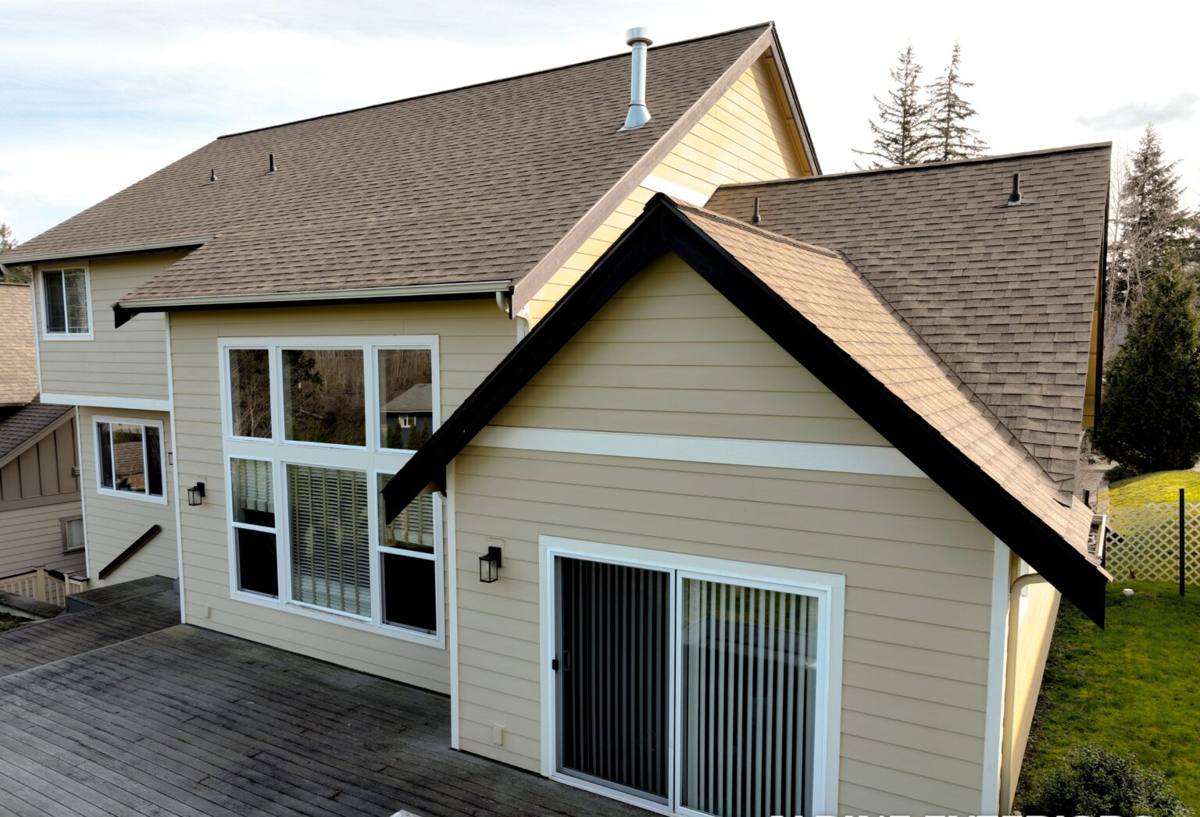
What Salt Air, Rain, and Moss Actually Do to Siding Over Time
Salt Air
Airborne salt is corrosive to exposed metal — fasteners, flashing, trim edges — and it accelerates the breakdown of finishes that aren't formulated to resist it. On lower-quality siding, salt exposure shows up as chalking, fading, and premature caulk failure well before the material itself gives out.
Driving Rain
Wind-driven rain doesn't just hit a wall, it finds its way into any gap, unsealed joint, or poorly lapped panel and pushes moisture behind the cladding. Materials that swell, warp, or wick water when saturated — untreated wood, some composite products — start failing from the inside out long before the surface shows a problem.
Moss and Algae
Shaded, north-facing, and tree-covered walls in Anacortes stay damp longer than walls that get direct sun, especially through fall and winter. Porous or textured surfaces give moss spores something to grab onto, and once established, moss holds moisture against the siding surface, which is bad news for anything underneath a factory finish that isn't fully sealed.
Why James Hardie Fits This Climate
James Hardie siding is fiber cement — a mix of cement, sand, and cellulose fiber — which behaves fundamentally differently from wood, vinyl, or wood-composite products in wet, salty, coastal air.
- It doesn't rot, warp, or delaminate from repeated wetting and drying cycles the way wood-based products can.
- It's non-combustible, which matters given the dry spells Skagit County has seen in recent summers even with our generally wet climate.
- ColorPlus factory finish is baked on in a controlled environment and formulated to resist fading and chalking from UV and salt exposure far better than field-applied paint.
- HZ5 engineered panels are Hardie's product line built specifically for climates with prolonged moisture exposure — which is exactly what Fidalgo Island and the surrounding waterfront areas deliver.
None of that means Hardie siding is maintenance-free or immune to problems. It means the material itself isn't the weak link — the installation is, which is why the details below matter as much as the product choice.
What a Correct Installation Involves in a Coastal Setting
Fiber cement siding is only as good as the assembly behind it. In an area like Anacortes, a handful of details separate a job that lasts decades from one that fails early despite using the right product.
Water Management Behind the Siding
A weather-resistant barrier and properly integrated flashing at every window, door, and penetration matter more here than in drier inland areas, because wind-driven rain will find any shortcut. Flashing has to be lapped correctly — over the barrier at the top, under it at the bottom — so water sheds outward instead of getting trapped.
Fastening and Gaps
Hardie specifies exact nailing patterns, fastener types, and gap tolerances between panels, trim, and adjoining surfaces. Panels installed too tight can buckle with seasonal movement; gaps left too wide invite water intrusion and give moss a foothold. Corrosion-resistant fasteners are non-negotiable this close to saltwater — standard fasteners will rust and stain the face of the siding within a few seasons.
Caulking and Sealant Choices
Not all sealants hold up to salt air and UV exposure equally. The wrong caulk shrinks, cracks, or lets go at the joint within a year or two, creating an entry point for water right where it matters most.
Starter Strips and Clearances
Proper starter strip installation and ground clearance keep the bottom course of siding from sitting in splash-back moisture, which is one of the most common places we see premature wear on homes near the water.
How Our Process Works
- On-site assessment — we look at sun exposure, tree cover, wind direction relative to the water, and the condition of the existing wall assembly before quoting anything.
- Tear-off and inspection — old siding comes off and we check the sheathing and water-resistive barrier underneath for hidden moisture damage before anything new goes up.
- Barrier and flashing correction — any gaps in the moisture barrier or flashing details get fixed as part of the job, not left for the new siding to hide.
- Hardie panel installation to spec — correct fasteners, gaps, and lapping, following James Hardie's published installation requirements for this climate zone.
- Final walk-through — we go over the finished job with you before we consider it done.
Why a Crew That Already Works Anacortes Matters
Anacortes and the surrounding Fidalgo Island area have their own microclimate quirks compared to Mount Vernon proper — more direct salt exposure, more wind off the water, and building conditions that vary block to block depending on proximity to the shoreline. A crew that regularly works this area already knows which walls tend to hold moss, which exposures need extra attention to flashing, and how local wind patterns drive rain into siding assemblies. That's knowledge you don't get from a crew that mostly works inland and treats every job the same regardless of where the house sits relative to the water.
Skagit County permitting and inspection requirements are also something a local, established crew navigates routinely rather than learning on your project.
James Hardie vs. Other Siding Materials in This Climate
| Material | Salt Air Resistance | Moisture Behavior | Long-Term Maintenance |
|---|---|---|---|
| James Hardie Fiber Cement (HZ5) | Strong — non-combustible, factory finish resists chalking | Doesn't swell, warp, or rot when wet | Periodic cleaning and repaint only when ColorPlus finish eventually ages |
| Vinyl Siding | Can become brittle and fade faster under UV/salt combination | Handles surface moisture but seams can allow water behind panels | Low upkeep but limited lifespan in harsh coastal exposure |
| Untreated/Primed Wood or Spruce | Vulnerable — salt accelerates finish breakdown | Absorbs moisture, prone to rot and warping | Frequent repainting and moisture monitoring required |
| LP SmartSide (Wood Strand) | Moderate — finish quality is critical | Engineered wood core is moisture-sensitive if finish fails | Edge sealing and finish maintenance are important ongoing tasks |
This is a general comparison of how these materials tend to behave, not a claim that every product in a category will fail — installation quality and maintenance matter across the board. It's simply why, after years of doing this work along the Skagit County coastline, fiber cement is the only material we're willing to put our name behind.
Living With Hardie Siding in a Moss-Prone Climate
No siding product stops moss and algae from landing on a wall — that's a function of shade, moisture, and airflow around the house, not the cladding material. What Hardie's factory finish does is give you a harder, more consistent surface to clean, and it holds up to gentle rinsing far better than field-painted wood siding does. On heavily shaded walls, we'll sometimes talk through simple things like trimming back branches or improving airflow, since that does more for long-term moss control than any siding choice alone.
Signs Your Current Siding May Be Struggling With This Climate
- Persistent moss or algae staining that comes back within weeks of cleaning
- Soft or spongy spots when you press on the siding, especially near the bottom courses
- Visible gaps, cracked caulking, or separated seams around windows and trim
- Rust streaks running down from fastener heads or metal flashing
- Paint that's peeling or bubbling rather than just fading evenly
- Warping, bowing, or panels that no longer sit flat against the wall
If you're seeing more than one of these, it's worth having someone take a real look before a small water intrusion problem turns into sheathing or framing repair.
What to Ask Before Hiring Anyone for Siding Work Near the Water
Coastal siding jobs punish shortcuts faster than inland jobs do, so it's worth being specific with any contractor you're considering:
- Do they follow James Hardie's published installation specs for gaps, fasteners, and flashing, or their own shortcut version?
- Will they inspect and repair the water-resistive barrier and flashing, or just install over whatever's already there?
- Do they use corrosion-resistant fasteners appropriate for salt air exposure?
- Can they explain how they'll handle your home's specific sun/shade exposure and wind direction relative to the water?
- Are they familiar with Skagit County permitting requirements for exterior work?
If your Anacortes home's siding is showing its age, or you're planning ahead for a replacement, we're happy to walk the property with you and give you a straight, no-pressure assessment and estimate — no obligation, just an honest look at what your home actually needs.