 Mount Vernon
 West Mount Vernon Decks Face a Tough Combination of Weather
Homes on the west side of Mount Vernon sit close enough to the Skagit River delta and the broader Puget Sound air pattern that decks here take a different kind of beating than decks fifty miles inland. It's not one big storm that does the damage — it's the daily grind. Salt-tinged air moving in off the Sound corrodes fasteners and hardware faster than most homeowners expect. Driving rain, often blown sideways by wind off the flats, finds its way under flashing and behind ledger boards that weren't detailed correctly the first time. And Skagit County's long, damp shoulder seasons in fall and spring create months of shade and standing moisture where moss and algae take hold on any surface that doesn't drain and dry quickly.
Put those three things together — corrosion, wind-driven moisture intrusion, and a long moss season — and you get decks that look fine from the yard but are quietly failing where you can't see them: at the ledger connection, inside the joist bays, and around post bases set in ground that rarely fully dries out. Replacing a deck the right way in this neighborhood means designing for all three, not just swapping old boards for new ones.
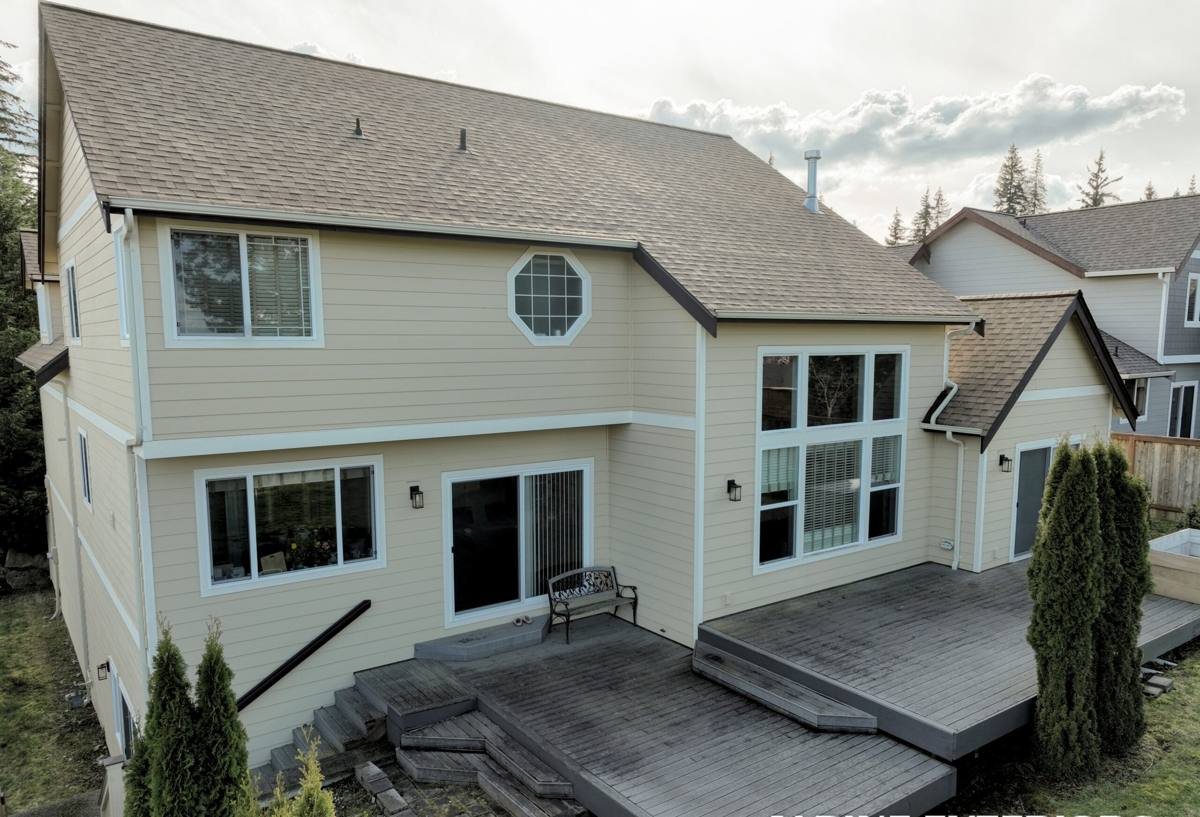
Signs Your Deck Needs Replacement, Not Another Repair
Not every tired deck needs to come out. But there's a point where patching boards is just delaying a bigger problem, and it usually shows up as a combination of the issues below rather than just one.
- Soft, spongy, or bouncy spots in the decking or framing when you walk across it
- Rust streaks or crumbling fasteners at joist hangers, ledger bolts, or post brackets
- Gaps or dark staining where the deck meets the house — a common sign water has been getting behind the ledger board
- Posts that wobble at the base, or visible rot at ground contact points
- Moss or black algae that comes back within weeks of cleaning, even on a dry-looking surface
- A structure that predates current ledger flashing and hardware standards, even if it "looks okay"
If you're seeing two or three of these at once, that's usually a structural conversation, not a cosmetic one. We'll tell you honestly if a repair is enough — replacement isn't the right call for every deck that needs work.
What a Correct Deck Replacement Actually Involves
A deck is only as good as what's underneath it. Most of the failures we get called out for in this part of Mount Vernon trace back to shortcuts in three specific areas.
Framing and Footings
Skagit County soils hold moisture longer than people assume, especially on lots closer to the river or with heavier clay content. Footings need to be sized and set to current code depth, not just matched to whatever was there before. We check drainage around the footing locations and won't reuse old concrete pads that show cracking or heaving — that's a foundation problem waiting to reappear under new decking.
Ledger Board and Flashing
This is the single most common failure point on older decks in wet coastal climates. The ledger board bolts the deck to the house, and if the flashing behind it isn't installed correctly — sealed, layered properly with the house's water-resistive barrier, and free of trapped moisture — water works its way in slowly over years. By the time you see staining on the siding or rim joist, there's often already rot behind it. On every replacement, we pull the old ledger connection apart, inspect the structure behind it, and re-flash it properly rather than caulking over the old setup.
Fasteners and Hardware
Given the salt content in the air here, we spec corrosion-resistant, coated or stainless hardware rated for the fastener's specific use — hangers, structural screws, post bases. Standard mixed-metal hardware corrodes visibly faster in this environment, and corroded hardware is a structural issue, not a cosmetic one.
Choosing the Right Decking Material for This Climate
There's no single "best" decking material — there's a best fit for how much maintenance you want to do and how much shade and moisture your specific deck sits in. Here's how the common options actually perform under Mount Vernon's wet, mossy conditions.
| Material | Moss/Algae Resistance | Maintenance | Notes for This Climate |
|---|---|---|---|
| Pressure-treated wood | Low without upkeep | Annual cleaning and periodic sealing | Lowest upfront cost; needs consistent care in shaded, damp spots or moss takes hold quickly |
| Cedar | Moderate | Regular sealing/staining | Natural look many homeowners want; still needs upkeep in shaded areas to resist graying and moisture uptake |
| Composite decking | Good | Occasional washing | Doesn't absorb water like wood, but can still grow surface algae in fully shaded, low-airflow areas — capped composites resist this better than uncapped |
| PVC decking | Very good | Low | Fully synthetic, doesn't feed rot, best option where a deck sits in near-constant shade or gets little sun to dry out |
We'll walk through this table with you against your actual deck's sun exposure, because a south-facing deck and a north-facing deck tucked under trees can have very different right answers even on the same street.
How Our Deck Replacement Process Works
1. On-Site Assessment
We start under the deck, not on top of it — checking footings, framing, ledger condition, and drainage before we ever talk materials.
2. Permitting
Deck replacement in Mount Vernon typically requires a permit, especially for structural work involving footings or the ledger connection. We handle the permit process as part of the job so you're not left navigating city requirements on your own.
3. Demolition
Old decking, framing, and hardware come out, and we inspect the house's rim joist and sheathing behind the old ledger while it's exposed — this is the one point in the project where hidden moisture damage is fully visible.
4. Rebuild
New footings or reinforced existing ones, corrosion-resistant hardware, properly flashed ledger, and your chosen decking material installed to manufacturer spec — fastener spacing and gapping matter more in a wet climate than people assume, since improper board spacing traps moisture instead of shedding it.
5. Final Walkthrough
We go over the structure with you, explain what maintenance (if any) your material choice needs, and make sure drainage and grading around the deck are directing water away from the house.
What Drives the Cost of a Deck Replacement
Every deck is different, so we don't quote off square footage alone. The estimate is free and specific to your project, but these are the main factors that move the number up or down.
- Size and height: a ground-level deck is simpler than a second-story deck requiring taller posts and additional bracing
- Framing condition: footings and framing that need full replacement versus a structure that's sound enough to reuse in part
- Decking material: pressure-treated wood, cedar, composite, and PVC span a wide cost range, with maintenance savings offsetting upfront cost differently for each
- Railing and stairs: code-compliant railing systems and stair runs add material and labor beyond the deck surface itself
- Ledger and flashing repair scope: if there's hidden rot behind the old ledger, that repair is necessary before rebuilding and affects the total
- Permit and inspection requirements specific to the structure's size and attachment to the house
We'd rather walk your deck in person and give you real numbers than guess over the phone — every one of these factors changes based on what we actually find underneath.
Why Local Experience in This Neighborhood Matters
A deck built to a generic spec sheet doesn't always hold up to Skagit County's specific weather pattern. Crews who work regularly in West Mount Vernon know which fastener grades actually hold up to the salt content in the air here, which lots tend to hold moisture longer at the footing level, and where moss takes hold fastest based on how a deck sits relative to the sun and prevailing wind. That's the kind of judgment that comes from doing this work repeatedly in this specific area, not from a standard checklist. It's also why we don't treat every deck the same — a deck on an open, sunny lot and one tucked in shade a few streets over can call for different material and drainage decisions even though they're both "just a deck replacement."
Keeping Your New Deck Ahead of Moss Season
Even a well-built deck needs some seasonal attention in this climate. A few habits go a long way toward protecting the investment:
- Keep debris and leaves swept off the surface, especially heading into fall — trapped organic matter is what feeds moss and algae growth
- Check that gaps between boards stay clear so water keeps draining through rather than pooling
- Rinse shaded areas periodically through the wet months rather than waiting for visible growth
- Have fastener and railing connections checked every couple of years, since that's where corrosion shows up first
None of this is complicated, but it's the difference between a deck that still looks good in ten years and one that needs premature repairs because moisture and moss got ahead of it.
If your deck in West Mount Vernon is showing its age, or you just want an honest opinion on repair versus replacement, we're happy to take a look and walk you through what we find. Fill out the form below for a free, no-pressure estimate.