 Mount Vernon
 Why Siding Damage in Sedro-Woolley Looks Different
Sedro-Woolley sits back from the open water of Skagit Bay, but that doesn't mean the siding on local homes gets an easy ride. The town is ringed by trees, tucked into the Skagit River valley, and shaded by the kind of mature tree canopy that keeps yards cool in July and keeps siding damp for days after every storm. Add in the driving rain that rolls through this part of Skagit County most of the fall and winter, plus a moss season that can run six or seven months on a shaded north wall, and you get a specific pattern of siding failure that's different from what we see on a wide-open lot outside town.
We're not describing a disaster scenario. Most of what we repair in Sedro-Woolley is slow, quiet moisture damage that built up over a few seasons because nobody was looking at the parts of the house that don't get looked at — behind shrubs, under eaves that don't get direct sun, around trim that was caulked once and never touched again. Catching it early is the difference between a repair that costs a few hundred dollars and one that turns into a full wall replacement.
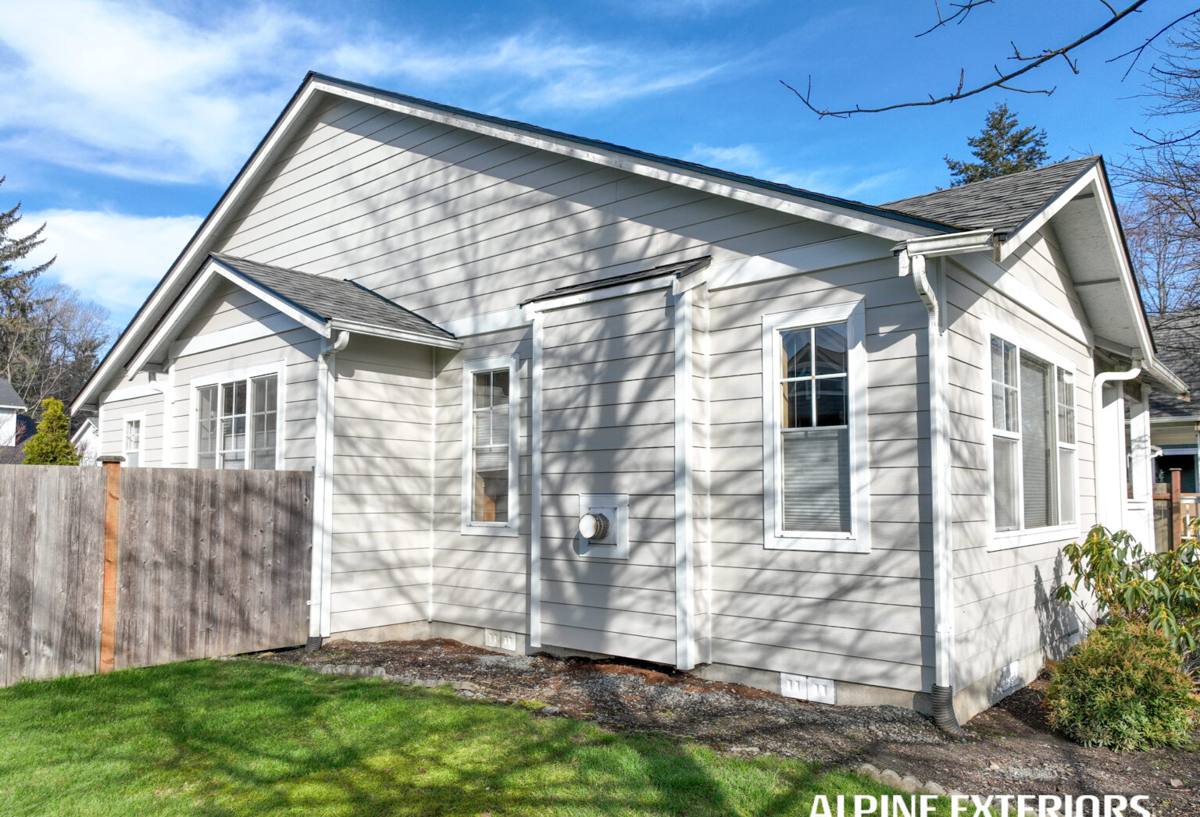
What Actually Causes Siding Failure Here
Shade and Moss
Moss itself doesn't eat siding, but it holds water against the surface long after the rest of the house has dried out. On wood-based products — cedar, primed spruce, or engineered wood siding like LP SmartSide — that constant dampness is exactly the condition that leads to swelling, delamination at panel edges, and eventually soft, punky wood. On older or poorly maintained fiber cement, moss buildup at butt joints and around fasteners can trap moisture at the exact points where water intrusion does the most damage.
Driving Rain and Wind-Driven Wet
Skagit County storms don't just fall straight down — wind pushes rain sideways into wall assemblies, especially on west- and southwest-facing elevations. Siding that was installed with tight or nonexistent gaps at butt joints, undersized flashing, or caulk used in place of proper flashing will eventually let that wind-driven rain past the surface. Once water gets behind the cladding, it doesn't matter how good the siding material is — the sheathing and framing underneath start absorbing it.
Freeze-Thaw and Seasonal Movement
Sedro-Woolley doesn't see the hard winters that crack siding open in colder climates, but the valley does get enough freeze-thaw cycling in a typical winter to widen small cracks that started as caulk failure or minor impact damage. A hairline crack that was cosmetic in October can be a water entry point by February.
Signs Local Homeowners Should Watch For
- Dark green or black staining that keeps coming back within weeks of being cleaned
- Soft or spongy spots when you press on the siding, especially near the bottom courses or under windows
- Paint or ColorPlus finish that's bubbling, peeling, or flaking in one localized area rather than uniformly across the wall
- Visible gaps or separation at butt joints and corner boards
- Warping, bowing, or panels that no longer sit flat against the wall
- Interior signs — a musty smell, discoloration on interior drywall, or trim that feels damp — near an exterior wall
- Fastener heads that are rusting, popping out, or leaving streaks below them
Any one of these on its own might be minor. Two or three showing up in the same area of the house is usually a sign that water has been getting behind the siding for a while.
What a Correct Repair Actually Involves
A repair that only addresses what's visible from the ground is a repair that fails again. Here's what we actually do differently:
Diagnose Before Cutting
Before we replace a single board, we find out why that section failed. If the cause was a missing kick-out flashing, a failed window sealant, or grading that pushes water back toward the foundation wall, replacing the siding without fixing the cause just buys a few years before the same spot fails again.
Check What's Behind the Siding
Once damaged boards come off, we look at the water-resistive barrier, the sheathing, and the flashing underneath. Sometimes the siding is the only thing that needs attention. Sometimes we find soft sheathing that needs to be cut out and replaced before new siding goes back on — skipping that step means covering up a problem instead of fixing it.
Match the Material and the Finish
Patching in a mismatched product, or a board with a visibly different profile or finish sheen, is the most common reason a repair looks like a repair for years afterward. We match the existing James Hardie plank profile, exposure, and ColorPlus finish so the repaired section blends into the wall instead of standing out.
Rebuild the Details, Not Just the Panel
Proper repair means correct flashing at any disturbed joints, factory-recommended fastening, and gaps at butt joints and trim per Hardie's install specifications — not caulk used as a substitute for flashing, which is a common shortcut that causes the same failure to come back.
Repair or Replace: How We Help You Decide
| Situation | Usually Repair | Usually Replace |
|---|---|---|
| Damage limited to one or two isolated areas | Yes | |
| Underlying sheathing and framing still sound | Yes | |
| Damage traced to a single fixable cause (flashing, sealant, grading) | Yes | |
| Moisture damage found in multiple, unrelated wall sections | Yes | |
| Existing siding is a non-Hardie product we can't match or don't install | Yes | |
| Siding is original and near or past its practical service life | Yes |
We'll always give you the honest version of this table for your specific house rather than defaulting to the bigger job. A lot of the siding repair calls we get in Sedro-Woolley turn out to be legitimate, contained repairs — not the start of a full re-side.
Why We Repair Into James Hardie, Not Other Products
We install and repair with James Hardie fiber cement exclusively. That matters for repair work specifically because of what happens when a wall is already mixed materials or when a homeowner asks us to patch into an existing vinyl or engineered wood system. Fiber cement doesn't share the same moisture behavior, expansion rate, or fastening requirements as vinyl or wood-based siding, so a true match — one that performs the same way under the same weather, not just looks similar on install day — isn't something we can honestly deliver by mixing products. When we repair a Hardie wall, we're matching a product engineered for this climate with more of the same product, installed to the same spec, backed by the same warranty structure. That's a repair we can stand behind years later, not just a patch that looks fine until the next wet winter.
Our Process for Sedro-Woolley Repair Calls
- Inspection: We walk the full exterior, not just the spot you called about — damage in one area often has a twin starting somewhere less visible.
- Diagnosis: We identify the actual water source, not just the symptom.
- Written scope: You get a clear explanation of what's being repaired, what's being replaced, and why — no vague line items.
- Repair: Damaged material and, if needed, damaged sheathing come out; flashing and water-resistive barrier get corrected; matching Hardie material and finish go back in to spec.
- Final check: We confirm the repaired area sheds water correctly before we call the job done.
Why Local Experience Matters for This Kind of Work
A crew that already works Sedro-Woolley regularly knows which parts of town sit in more shade and hold moisture longer, which older neighborhoods are more likely to have a mix of siding generations on the same house, and what Skagit County permitting looks like when a repair crosses over into larger structural work. That local knowledge shortens the diagnosis step and avoids surprises mid-job — things an out-of-area crew learns on your house instead of before they show up.
Cost Factors for Siding Repair
| Factor | Why It Affects Cost |
|---|---|
| Size and number of damaged areas | More linear feet and more separate repair locations mean more labor and material |
| Condition of sheathing behind the siding | Rotted sheathing has to be cut out and replaced before new siding goes back on |
| Height and accessibility | Second-story or steep-roofline repairs require staging or lift access |
| Color and profile matching | Discontinued or custom colors may need repainting a larger section to blend properly |
| Root cause repair | Fixing the flashing, sealant, or grading issue that caused the damage adds a step but prevents a repeat call |
We give straightforward, written estimates before any work starts — no surprise add-ons once the wall is opened up, unless we find something during that step that genuinely changes the scope, in which case we stop and talk to you before proceeding.
If you're seeing staining, soft spots, or moss buildup on your Sedro-Woolley home, it's worth having someone look at it before another wet season adds to the damage. We offer free, no-pressure estimates — use the form below to get a local crew out to take a look.