 Mount Vernon
 Why Sedro-Woolley Roofs Take More Punishment Than People Expect
Sedro-Woolley sits back from Puget Sound but not far enough to escape it. Moist, salt-tinged marine air still pushes up the Skagit Valley on a regular basis, and it mixes with the heavy tree cover and river-bottom humidity that define this part of Skagit County. The result is a roof climate that's tougher than the sunny-Cascades postcard suggests: long stretches of driving rain in the fall and winter, a shoulder season where everything stays damp for days at a time, and a moss season that, depending on the year, can run eight months or more under shaded, north-facing roof planes.
None of that is a reason to panic about your roof. It's a reason to be specific about what goes on it and how it's installed. A roofing system that performs fine in a dry inland climate can underperform here — not because the material is bad, but because the details that matter in a wet, mossy, salt-touched environment weren't accounted for.
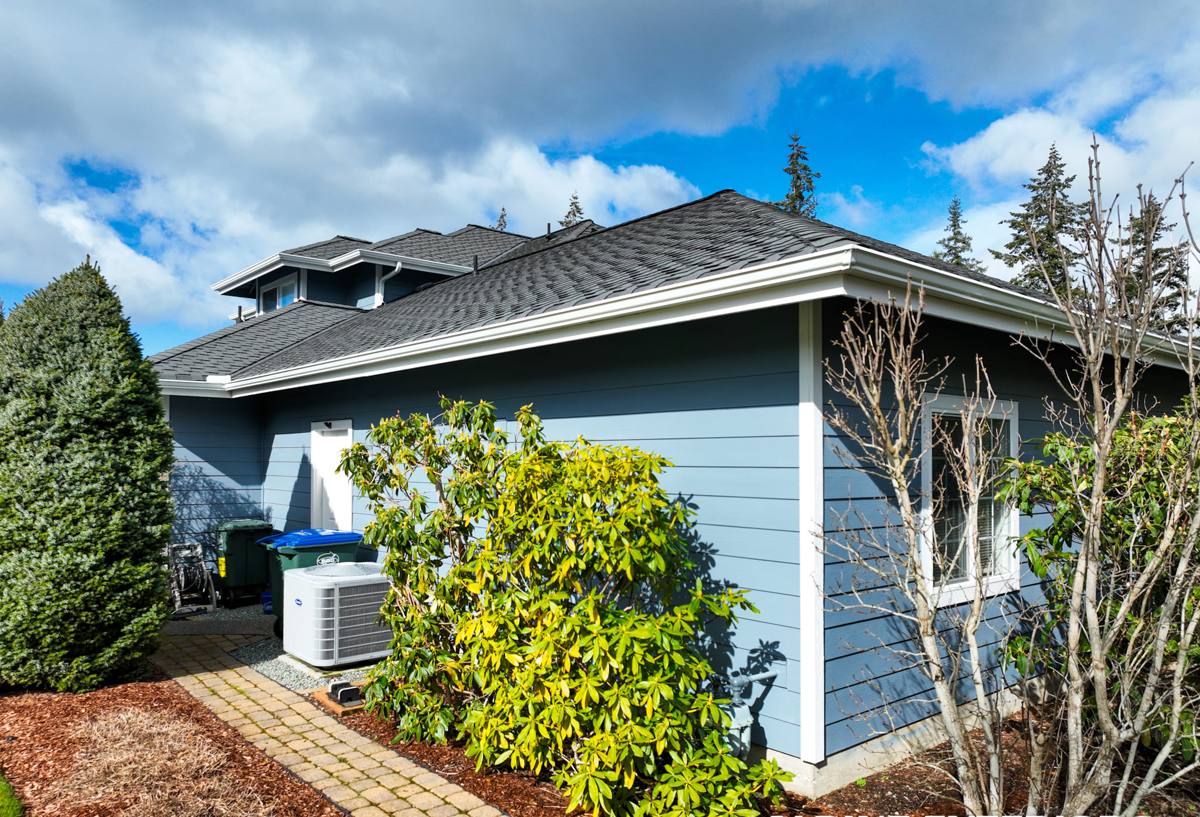
What Metal Roofing Needs to Do in This Climate
Metal roofing is a strong fit for Sedro-Woolley homes when it's specified and installed correctly, because it addresses the exact problems this climate creates:
- Sheds water fast — steep-pitched metal panels move rain off the roof before it has time to sit, pond, or work its way under shingles.
- Doesn't hold moisture against itself — unlike a shingle mat, a properly installed metal panel doesn't absorb water, which matters when a roof stays wet for days between storms.
- Gives moss less to grip — moss and algae need a porous surface and standing organic debris to establish. A smooth, properly sloped metal panel with clean water flow is far less hospitable to it than a shingle roof shaded by fir and cedar canopy.
- Resists the coastal-adjacent air — with the right fastener and panel metallurgy, a metal roof holds up to the intermittent salt exposure this part of the county gets without the fastener corrosion that undermines cheaper systems.
The catch is that every one of those advantages depends on installation quality. A metal roof installed like a shingle roof — wrong fasteners, wrong underlayment, sloppy valley and flashing work — will fail early and expensively. This is a trade where the difference between a 40-plus-year roof and a 10-year roof is almost entirely in the details, not the panel itself.
Underlayment: The Part You Never See but Always Pay For
In a marine climate like this, we don't treat underlayment as an afterthought. Metal roofs move with temperature swings, and any condensation that forms on the underside of the panel needs somewhere to go besides your sheathing. On Sedro-Woolley homes we typically spec a high-temp synthetic or self-adhered underlayment at eaves, valleys, and penetrations — the areas where wind-driven rain and ice-adjacent moisture are most likely to find a way in — rather than relying on felt alone.
Fasteners and Flashing: Where Corrosion Actually Starts
Most premature metal roof failures we see traced back to one thing: mismatched or undersized fasteners and flashing that wasn't properly lapped. If a fastener's coating doesn't match the panel's metallurgy, you get galvanic corrosion right at the penetration point — exactly where you can least afford a leak. Valleys, chimney flashing, and wall-to-roof transitions get the same scrutiny, because these are the points where a driving Skagit County rainstorm finds any gap in the work.
Choosing a Metal Roofing System for a Sedro-Woolley Home
Not every metal roofing system is the right call for every house. Roof pitch, tree cover, and how long you plan to own the home all factor in. Here's how the common options compare for this area:
| System | Best For | Trade-Offs Here |
|---|---|---|
| Standing seam (concealed fastener) | Steep or moderate pitches, long-term ownership, heavy tree/moss exposure | Highest material and labor cost, but no exposed fasteners to fail over time — the strongest option for our wet climate |
| Exposed-fastener panel | Outbuildings, budget-conscious re-roofs, simpler rooflines | Lower upfront cost, but fastener gaskets age and need periodic inspection — more maintenance in a climate this wet |
| Metal shingle / shake profile | Homes wanting a traditional look with metal's durability | More seams than standing seam, so installation precision around laps matters even more under heavy rain |
For most full re-roofs in this area, we lean toward standing seam because it removes the recurring maintenance item — fastener gaskets — that's most likely to cause a slow leak ten or fifteen years down the road. Where budget or roofline complexity points elsewhere, exposed-fastener systems can still be the right call; we just make sure the homeowner understands the maintenance difference going in.
Moss and Debris: What Actually Prevents It Long-Term
Metal roofing resists moss far better than shingles, but "resists" isn't "immune." Under heavy fir and cedar canopy — common on Sedro-Woolley lots — organic debris can still collect in valleys and against any obstruction, and wherever debris sits wet long enough, moss and algae will eventually try to take hold. A few things make the real difference:
- Proper panel slope and overlap so water — and the debris riding on it — keeps moving instead of pooling
- Valley design that doesn't create a flat catch-point for needles and leaves
- Keeping overhanging limbs trimmed back so less debris lands on the roof in the first place
- An annual or twice-yearly rinse-off before the wet season settles in, especially on north-facing or heavily shaded planes
- Avoiding pressure-washing techniques that can lift panel coatings or force water under laps — a soft rinse and brush is the safer approach
Cost Factors for a Sedro-Woolley Metal Roof
Every roof is different, but the variables that move the price on a metal roofing project here are consistent. This isn't a quote — it's what to expect a contractor to weigh when pricing your job:
| Factor | Pushes Cost Up | Pushes Cost Down |
|---|---|---|
| Roof system | Standing seam, custom panel lengths | Exposed-fastener panels |
| Roof complexity | Multiple valleys, dormers, steep pitch, tree-shaded planes needing extra flashing detail | Simple gable or hip roofline |
| Tear-off scope | Multiple existing layers, damaged sheathing found underneath | Single-layer tear-off with sound decking |
| Access | Steep pitch, limited driveway or yard access for material staging | Easy ground-level access |
| Accessories | Snow guards, custom trim, gutter/leaf-guard upgrades | Standard trim package |
Sedro-Woolley's tree-heavy lots tend to push toward the "more valleys, more flashing detail" end of that table more often than open, treeless sites elsewhere in the county — which is one more reason a generic bid from a crew unfamiliar with local rooflines can miss the mark.
How We Approach a Metal Roofing Project
- On-site evaluation — we walk the roof (or inspect via drone/ladder where pitch requires it), check the decking condition, note valley and penetration points, and look at tree exposure and drainage patterns specific to your lot.
- System recommendation — we tell you which panel system fits your roof and budget, and why, including the honest trade-offs of each option covered above.
- Written estimate — scope, materials, underlayment spec, and timeline in writing before any work starts.
- Tear-off and deck inspection — old roofing comes off, sheathing gets checked for rot or soft spots (common on older Sedro-Woolley homes with a history of moss and moisture), and anything compromised gets addressed before a single panel goes down.
- Underlayment and flashing first — the water-management layer goes in correctly before panels are installed, not around them.
- Panel installation — fasteners and panel metallurgy matched to avoid galvanic corrosion, seams and laps run to spec.
- Final walkthrough — we go over the finished roof with you, including basic maintenance expectations for this climate.
Why Local Experience on This Roof Type Matters
Metal roofing rewards a crew that's done it enough times on this specific terrain to know where the water actually goes. A contractor who mostly installs shingles and occasionally does metal will get the panel on the roof, but the difference shows up at the valleys, the transitions, and the fastener choices — exactly the points that determine whether the roof is still watertight in year fifteen. A crew that regularly works Sedro-Woolley roofs already knows which rooflines collect debris under the tree cover common here, how far up the valley the marine air's salt exposure realistically reaches, and which older homes in this area tend to have decking issues worth checking before panels go on.
That local pattern-recognition doesn't show up on a spec sheet, but it's a large part of what separates a metal roof that performs for decades from one that needs early repairs.
Questions Worth Asking Any Metal Roofing Contractor
- What underlayment do you spec for this climate, and where do you upgrade it (valleys, eaves, penetrations)?
- How do you match fasteners to panel metallurgy to avoid galvanic corrosion?
- Will you inspect and document deck condition before installing, not just assume it's sound?
- What's your plan for valleys and transitions on a roof with heavy tree exposure?
- What does your workmanship warranty actually cover, separate from the manufacturer's material warranty?
Maintenance After Installation
A correctly installed metal roof is low-maintenance, not no-maintenance. In this climate, we recommend:
- A visual check each fall before the heavy rains set in — look for debris buildup in valleys and around penetrations
- Clearing overhanging branches that drop needles or leaves directly onto the roof
- A gentle rinse of shaded, moss-prone areas once or twice a year rather than waiting for visible growth
- Prompt attention to any fastener that shows early rust streaking, rather than waiting for it to become a leak
If you're weighing a metal roof for your Sedro-Woolley home, we're happy to take a look and walk you through what your specific roof needs — no pressure, no obligation. Fill out the form below for a free estimate.