 Mount Vernon
 Riverside's Climate Puts Real Demands on Siding
Homes in the Riverside area of Mount Vernon deal with a specific combination of stresses that a lot of siding products simply aren't built to handle over the long term. Skagit County sits close enough to Puget Sound and the surrounding wetlands that salt-tinged air is a constant presence, not an occasional event. Add in the region's long stretch of driving rain each fall and winter, plus the shaded, damp conditions that let moss and algae colonize north-facing walls and anything under tree cover, and you've got an environment that will find every weakness in a siding system within a few years.
This isn't a hypothetical. We see it on real houses: caulk joints that failed early, trim that soaked up water at the bottom edge and started to swell, and siding faces that stay perpetually green or black in the shaded sections of a wall. None of that is really about "bad luck" — it's about a material or an installation detail that wasn't matched to what this climate actually does to a house, year after year.
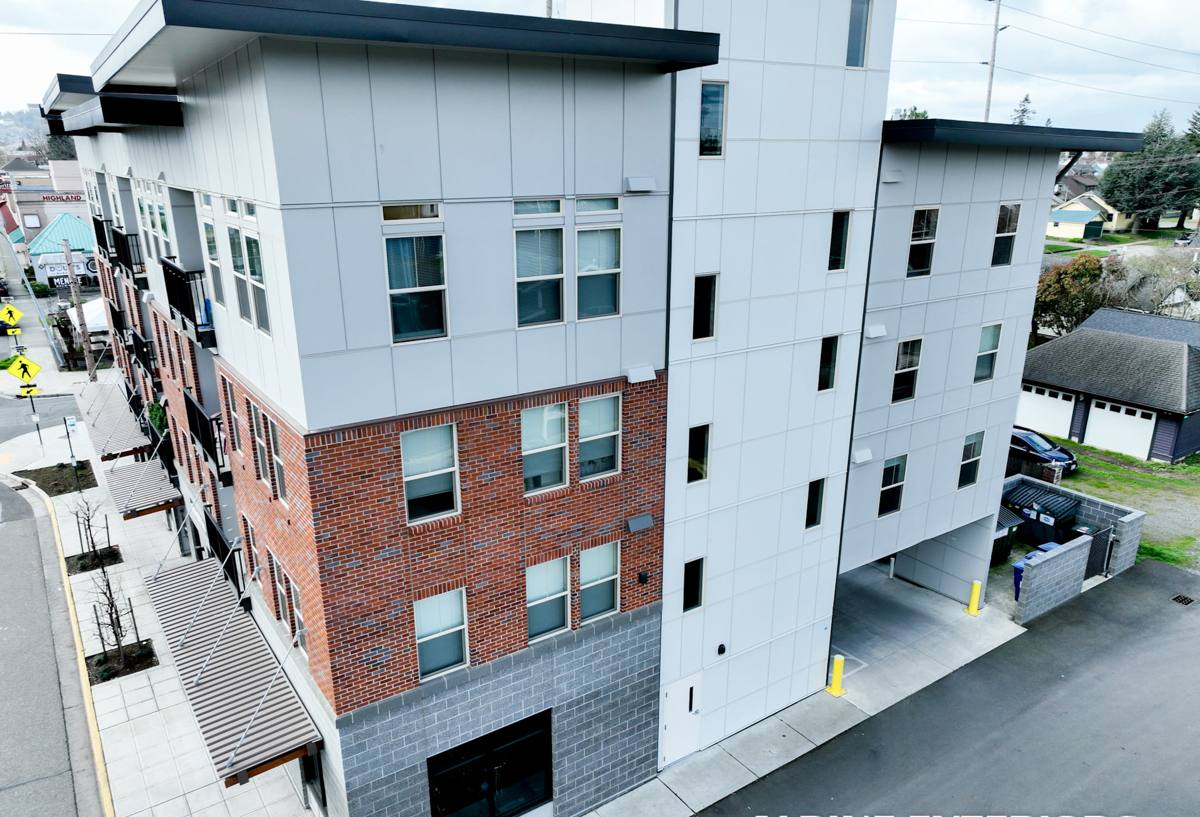
Why We Only Install James Hardie in This Area
We install James Hardie fiber cement exclusively — not vinyl, not LP SmartSide, not cedar, not any of the other fiber cement brands. That's not a marketing position, it's a standard we hold because of what we've seen happen to other products in exactly this kind of coastal, wet, moss-prone climate.
Fiber cement itself is the right category of material for Riverside: it's non-combustible, dimensionally stable, and doesn't rot the way wood-based products can when moisture gets behind them. James Hardie specifically engineers its siding by climate zone — homes here fall into the HZ5 product line, formulated for regions that see sustained moisture and freeze-thaw cycling rather than the drier or hotter conditions HZ10 products are built for. That distinction matters more in Skagit County than it would somewhere arid, because the siding is genuinely working against the weather here most months of the year.
James Hardie's ColorPlus factory finish is the other piece of this. It's baked on in a controlled environment rather than field-applied, which means the color coat is more consistent and more resistant to fading and moisture intrusion at the surface than a job-site paint job. Combined with a strong, transferable warranty backing both the substrate and the finish, it gives homeowners a siding system that's actually engineered for what Riverside throws at it, not just marketed for it.
What Salt Air Does to Ordinary Siding
Salt-laden air accelerates corrosion of exposed metal fasteners, trim flashing, and hardware. On vinyl siding, salt air combined with UV exposure speeds up brittleness and fading. On wood-based products, it accelerates the breakdown of any exposed edge where moisture can wick in. Fiber cement resists this kind of degradation far better because it isn't relying on a thin surface layer or a petroleum-based material to hold up over decades.
What Constant Moss and Algae Exposure Does
Moss doesn't just sit on top of siding — it holds moisture against the surface, and that trapped moisture is what actually causes damage over time, especially at seams, laps, and anywhere caulk has started to separate. Products that absorb even small amounts of moisture at cut edges or fastener holes will degrade faster under a moss mat than they would in full sun and open air. Correct detailing — not just the base material — is what keeps that from becoming a structural problem.
What a Correct Hardie Installation Actually Involves
The material is only half the equation. A huge percentage of the siding failures we get called out to inspect in this area trace back to installation shortcuts, not the product itself. For Riverside homes specifically, we pay close attention to a handful of details that matter more here than in drier climates:
- Proper weather-resistive barrier and correct lapping direction behind every course, so water is always shed downward and outward
- Flashing at every horizontal trim transition, window head, and roof-to-wall intersection — this is where the majority of moisture intrusion actually starts
- Correct fastener type, spacing, and depth per James Hardie's published installation specs, not generic fastener schedules
- Minimum clearance between the bottom of the siding and grade, decks, patios, or roofing — a gap that's too tight traps moisture and invites the moss and rot cycle
- Factory-cut and factory-primed edges kept intact wherever possible, with any field cuts properly sealed
- Caulk only at the joints James Hardie specifies — not as a substitute for correct flashing
Skip any one of these and you can end up with a wall that looks fine for two or three years and then starts showing problems that are expensive to trace back and fix, because by the time they're visible, water has usually already gotten behind the cladding.
Common Problems We Find on Older or Poorly Installed Siding in This Area
| Symptom | Likely Cause | Why It Happens Here Specifically |
|---|---|---|
| Soft or swelling trim at the base | Missing kickout flashing or insufficient grade clearance | Prolonged rain exposure gives water more chances to find any unprotected entry point |
| Persistent green or black staining | Poor airflow, heavy shade, or dense moss growth | Skagit County's damp, shaded microclimates support moss growth nearly year-round |
| Cracked or separated caulk joints | Caulk used in place of proper flashing, or wrong joint design | Constant moisture cycling stresses caulk joints faster than in drier regions |
| Corroded or streaking fasteners | Wrong fastener material or exposed fastener heads | Salt air accelerates corrosion of standard fasteners |
| Warped or delaminating panels (non-Hardie products) | Moisture absorption into the substrate | Sustained wet conditions expose weaknesses in wood-based or lower-grade materials |
Our Process for a Riverside Hardie Installation
1. On-Site Assessment
We look at the whole envelope, not just the siding — soffits, trim, window flashing, deck ledgers, and grade clearance. A lot of what determines whether new siding lasts is what's happening underneath and around it, not just the panels themselves.
2. Tear-Off and Substrate Check
Once old siding comes off, we inspect the sheathing for any existing moisture damage before anything new goes up. This is the point where hidden problems — the kind that caused the original siding to fail — actually get found and corrected, rather than covered over.
3. Weather Barrier and Flashing
We install or verify the weather-resistive barrier and get flashing right at every penetration and transition before the first piece of Hardie board goes on. This step is the difference between siding that performs for decades and siding that fails from behind within a few years.
4. Installation to James Hardie Spec
Panels, fasteners, and trim go in per James Hardie's published fastening and clearance requirements — the specifics that keep the manufacturer's warranty intact and that actually match how this climate behaves.
5. Final Inspection
We walk the finished job checking caulk lines, fastener patterns, clearances, and trim details before calling it complete.
Cost Factors for a Riverside Home
Every home is different, but the factors that typically move a James Hardie project up or down in price are consistent:
| Factor | Effect on Project |
|---|---|
| Home size and wall complexity | More corners, gables, and dormers mean more cutting, trim, and labor time |
| Existing siding condition | Rotted sheathing or hidden moisture damage found at tear-off adds repair scope |
| Siding profile chosen | Lap width, shingle-style panels, and trim details vary in material and labor cost |
| Access and site conditions | Multi-story sections, tight lot lines, or landscaping obstacles affect labor and staging |
| Trim and accessory scope | Fascia, soffit, and trim replacement alongside siding adds to the total but avoids mismatched materials later |
We don't quote off square footage alone — an accurate number comes from actually walking the house and accounting for what's found once old siding starts coming off.
What to Ask Any Contractor Before You Sign
- Are you a certified or trained James Hardie installer, and can you explain their published fastening and clearance specs?
- Will you inspect and repair sheathing issues found during tear-off, or just cover over what's there?
- How will flashing be handled at windows, trim, and roof intersections?
- What does the warranty actually cover, and is it transferable if you sell the home?
- Have you worked on homes in this specific area, and do you understand the moisture and moss conditions here?
Why Local Experience in Riverside Matters
A crew that's worked on homes throughout the Mount Vernon area already knows which wall orientations hold moss longest, which detailing choices actually hold up through a Skagit County winter, and where past installations in this area tend to fail. That's not something you get from a general contractor working from a manufacturer's install manual for the first time — it comes from having done the work here, seen what breaks, and adjusted accordingly. For a material like James Hardie, where the manufacturer's warranty depends on correct installation, that local track record is part of what protects your investment.
If you're planning a siding project in Riverside or elsewhere in Mount Vernon, we're happy to take a look at your home and put together a straightforward, no-pressure estimate — just fill out the form below.