 Mount Vernon
 Kulshan Ridge Weather Isn't Generic Pacific Northwest Weather
Every siding company will tell you it "understands Northwest weather." In Kulshan Ridge, that phrase needs to mean something specific. This part of Mount Vernon sits close enough to Skagit Bay and the broader Puget Sound air mass to pick up salt-laden moisture on top of the standard Skagit County rain load, and the tree cover and shaded exposures common on ridge lots mean siding surfaces often stay damp long after a storm has passed. That combination — salt air, driving rain that hits siding at an angle instead of straight down, and a moss season that can run from late fall into spring — is what actually determines whether a siding job holds up here or starts failing at year six instead of year thirty.
None of that is exotic. It's just cumulative. A siding product or installation detail that would be perfectly fine in a drier inland climate gets tested every single week in Kulshan Ridge, and small mistakes compound fast when the house rarely gets a long dry stretch to recover.
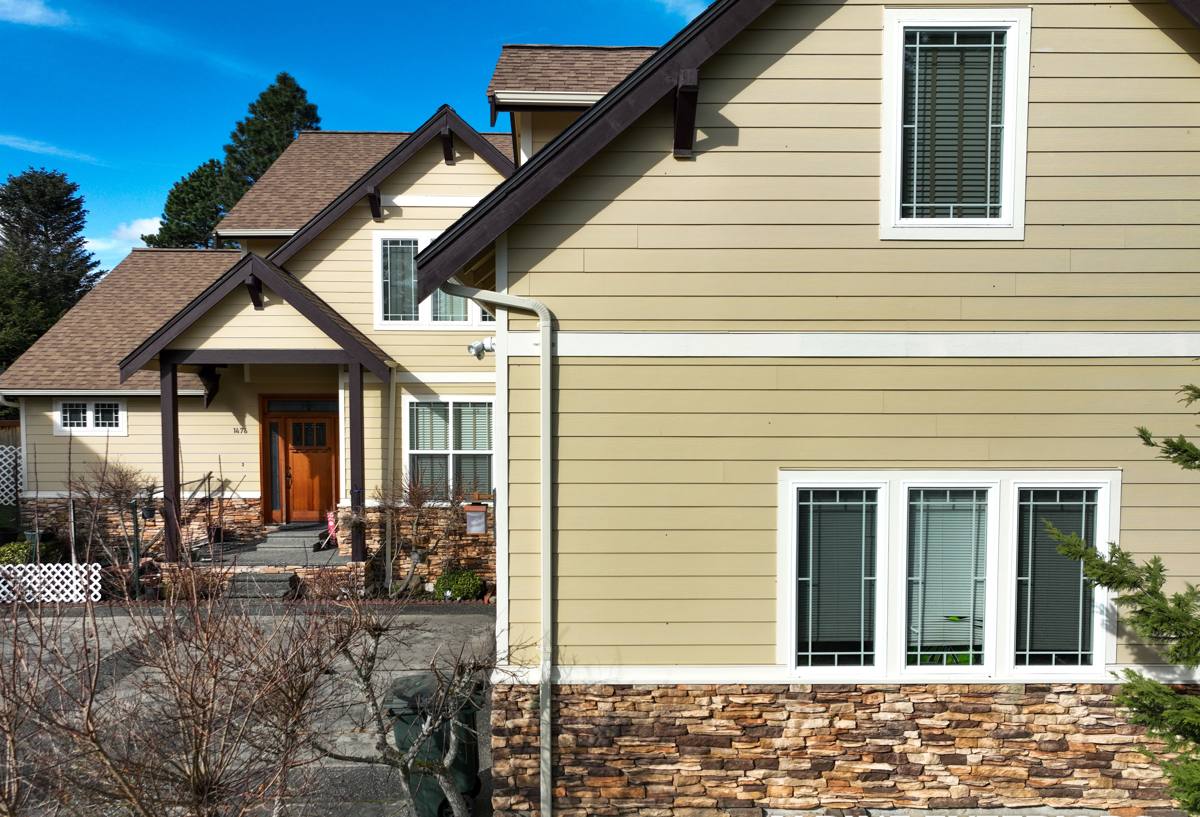
What Local Homes Actually Need From Their Siding
Moisture Management, Not Just Moisture Resistance
The material itself matters less than what happens behind it. A siding system in this climate needs a drainage plane that lets incidental water out instead of trapping it against the sheathing, correctly lapped house wrap, and flashing details at every window, door, and roof intersection that assume water will get behind the cladding at some point — because in a wet climate, it eventually does. Siding that looks fine from the street can be hiding rot at the bottom courses or around penetrations if these details were rushed.
Salt-Air Tolerance
Homes with any exposure toward the water deal with airborne salt that accelerates corrosion on fasteners, trim accessories, and paint films. Fastener choice and finish quality stop being cosmetic decisions and become durability decisions.
Moss and Algae Resistance
Shaded, north-facing, and tree-lined walls — common throughout Kulshan Ridge — stay damp longer and grow moss and algae faster than open, sun-exposed walls. Siding with a factory-baked finish resists staining and holds up to the occasional gentle wash far better than field-painted or bare wood surfaces, which absorb moisture into the finish itself and feed the growth instead of shedding it.
Why We Only Install James Hardie Fiber Cement
We don't install vinyl, LP SmartSide, cedar, or the other fiber cement brands, and Kulshan Ridge is exactly the kind of neighborhood that explains why. Vinyl expands and contracts more than fiber cement and can distort or loosen over the freeze-thaw and moisture cycles this area sees. Cedar looks great going up but requires ongoing sealing, staining, and vigilance against exactly the moss and moisture problems described above — it's a real product with real appeal, but it's a maintenance commitment, not a one-time install. Engineered wood products like LP SmartSide use a wood-strand substrate that, while treated, is still wood at its core; any breach in the coating or caulking gives moisture a path into a material that can swell or degrade if it stays wet.
James Hardie fiber cement is non-combustible, dimensionally stable in wet climates, and available in HZ5 formulation, which is engineered specifically for the wet, humid conditions found across the Pacific Northwest. Its ColorPlus factory finish is baked on under controlled conditions, which gives it far better fade and moisture resistance than field-applied paint — a meaningful difference on a wall that's damp more often than it's dry. We standardized on one manufacturer because it lets us guarantee installation quality against a single, well-documented spec instead of juggling different moisture and fastening requirements across several product lines.
Siding Options Compared for This Climate
| Material | Moisture behavior in wet/salt climates | Maintenance | Typical lifespan here |
|---|---|---|---|
| James Hardie fiber cement (HZ5) | Dimensionally stable, factory-sealed finish resists moisture and salt | Occasional gentle wash | 30+ years with correct install |
| Vinyl | Won't rot, but can warp/loosen with temperature swings | Low, but panels can crack or fade | 15-25 years |
| Cedar | Natural but absorbs moisture; prone to moss/mildew without upkeep | Recurring stain/seal cycle | Varies widely with maintenance |
| Engineered wood (LP SmartSide, etc.) | Treated wood substrate; vulnerable if coating or caulk fails | Moderate, coating inspection needed | 20-30 years if maintained |
What a Correct Fiber Cement Job Involves
Fiber cement is only as good as the details underneath it. A correct installation in this climate includes:
- A continuous, properly lapped weather-resistant barrier behind the siding
- Rainscreen or drainage gap where the wall assembly calls for it, so incidental moisture can drain and the wall can dry
- Flashing integrated at every window, door, deck ledger, and roof-to-wall intersection — installed shingle-style so water sheds down and out
- Correct fastener spacing, type, and penetration depth per the manufacturer's specification, using fasteners rated for coastal/salt-air exposure
- Proper clearance between the bottom of the siding and grade, decks, and roof lines to keep splashback and standing moisture away from the material
- Factory-primed cut edges and joints sealed per spec, not just caulked over as an afterthought
Skip any one of these and the siding can still look right for a few years before problems show up as staining, soft spots, or paint failure at the seams — usually right around the time the workmanship warranty would have covered it.
Our Process on a Kulshan Ridge Project
1. On-Site Assessment
We walk the exterior, check the existing siding and sheathing condition, look at drainage around the foundation, and note shaded or moss-prone walls that need extra attention to flashing and drainage detail.
2. Removal and Substrate Check
Old siding comes off in sections so we can inspect the sheathing underneath for hidden moisture damage before it gets covered up again — a step that matters more here than in drier climates, since trapped moisture problems are common on older homes that were never built with a drainage gap.
3. Weather Barrier and Flashing
We install or correct the water-resistive barrier and flashing at every penetration and transition before a single piece of Hardie board goes up. This is the step that determines whether the siding lasts one decade or three.
4. Hardie Installation to Spec
Panels or lap siding are installed per James Hardie's published fastening and clearance requirements, with joints and seams sealed correctly for this climate.
5. Final Walkthrough
We review the completed exterior with the homeowner, cover basic care, and go over warranty coverage before calling the job done.
Maintenance in a Salt-Air, High-Moss Climate
Fiber cement is low-maintenance, not no-maintenance. A short annual routine keeps it performing the way it's designed to:
- Rinse siding gently once or twice a year, focusing on shaded and north-facing walls where moss and algae build up fastest
- Keep gutters clear so overflow doesn't run down the siding face repeatedly
- Trim back vegetation and tree limbs that keep a wall section shaded and damp
- Inspect caulking at trim, windows, and joints annually and touch up before gaps open up
- Watch for any soft spots, staining, or paint lifting near the bottom courses, which can signal a drainage or flashing issue worth checking early
Why Hiring a Crew That Already Works Kulshan Ridge Matters
Siding installation isn't one-size-fits-all across Skagit County. A crew that already works Kulshan Ridge and the surrounding Mount Vernon area knows which wall orientations on local lots tend to run damp longer, understands the local permitting and inspection expectations, and has already worked through the flashing and drainage details that matter for this specific mix of rain, salt air, and shade. That local repetition is what separates a siding job that looks good at handoff from one that's still performing correctly ten and twenty years later. It also means faster response if a warranty question or minor issue comes up down the road — you're not waiting on a crew that has to drive in from outside the area or relearn the local conditions each time.
Cost Factors for a Kulshan Ridge Fiber Cement Project
| Factor | Why it affects cost |
|---|---|
| Home size and wall complexity | More corners, dormers, and trim details mean more cutting, flashing, and labor time |
| Existing siding removal and substrate repair | Hidden moisture damage found during tear-off adds repair work before new siding goes up |
| Product line and profile | Lap siding, panel systems, and trim/accessory choices carry different material costs |
| Color and finish | ColorPlus factory finishes vs. field painting affect both cost and long-term durability |
| Access and site conditions | Sloped lots, tree cover, and tight setbacks common on ridge properties can affect staging and labor |
Exact numbers depend on the specifics of your home, which is why we walk the property in person rather than quoting off a phone call.
If you're weighing a re-side or new siding install in Kulshan Ridge, we're happy to come take a look, walk you through what your home's exposure actually needs, and put together a straightforward, no-pressure estimate using the form below.