 Mount Vernon
 Siding That Has to Work Harder in Blanchard
Blanchard sits in that stretch of northern Skagit County where the landscape does a lot of the talking — low hills running down toward the water, timber close on every side, and weather that rolls in off the Salish Sea with very little to slow it down. Homes here don't face the same conditions as a house a few miles inland in Mount Vernon proper. Blanchard gets more salt-laden air, more wind-driven rain off the water, and more shade from surrounding trees, which adds up to a longer moss and mildew season than most of the county sees.
That combination is hard on exterior materials. Salt air accelerates corrosion on fasteners and trim. Wind-driven rain finds every gap in flashing and caulking. Shade and moisture together mean algae and moss get a foothold on siding faster than they would on a sun-exposed wall in a more open part of the valley. A siding product and installation that would hold up fine in a drier part of Skagit County can fall short here. We install fiber cement siding in Blanchard because it's the material built to take that kind of punishment — but the product is only half the equation. How it's installed matters just as much.
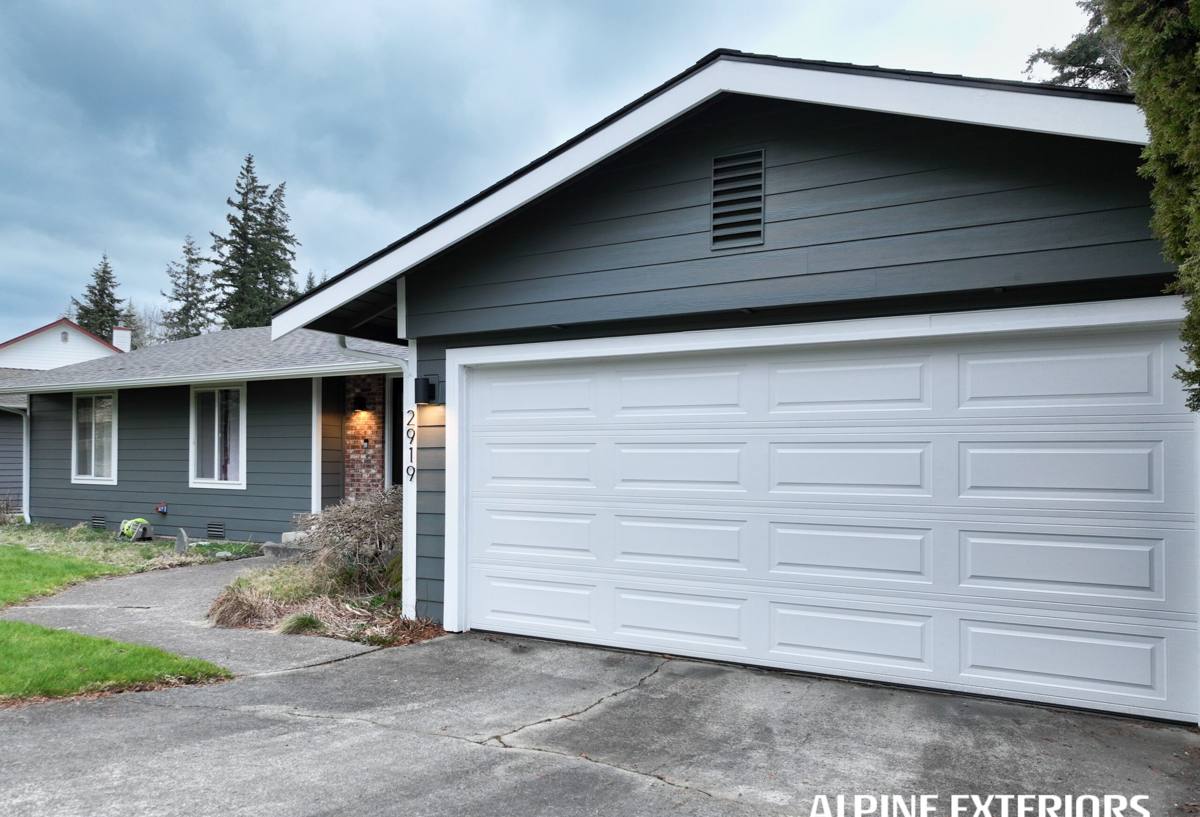
What Blanchard's Climate Actually Does to a House
Salt Air and Moisture
Proximity to saltwater means airborne salt settles on exterior surfaces and accelerates the breakdown of unprotected wood, cheap fasteners, and painted finishes that aren't built for a marine-influenced environment. Over years, that shows up as premature paint failure, rust bleed at nail heads, and soft spots where moisture has worked its way behind trim.
Driving Rain
Storms coming off the water don't just fall straight down — they push rain sideways into walls, especially at corners, around windows, and along roof-to-wall transitions. Any siding system with weak flashing details or gaps in the water-resistive barrier is going to take on moisture in conditions like that, regardless of what the siding itself is made of.
Extended Moss and Algae Season
Tree cover and persistent damp conditions in and around Blanchard mean north-facing and shaded walls stay wet longer after a storm than they would in open sun. That extended dampness is exactly what moss, lichen, and algae need to establish themselves on a wall surface. Once established, they hold moisture against the siding and finish, which compounds the problem over time.
Why We Only Install James Hardie Fiber Cement
We've made a deliberate choice to install James Hardie fiber cement exclusively — not vinyl, not LP SmartSide, not Cemplank, not Allura, not primed wood species like spruce or cedar. That's not a marketing position, it's a standard we hold ourselves to because of what we've seen these products do (and not do) over time in climates like ours.
- Non-combustible core: Hardie's fiber cement composition doesn't feed a fire the way wood-based products can, which matters increasingly in Washington's wildfire-exposed seasons.
- Engineered for the Pacific Northwest: Hardie's HZ5 product line is specifically formulated for wetter, cooler climates — a meaningful difference from a one-size-fits-all siding spec.
- Factory-applied ColorPlus finish: The finish is baked on at the factory under controlled conditions, which gives more consistent, longer-lasting color performance than field-applied paint over wood or composite substrates.
- Dimensional stability: Fiber cement doesn't swell, warp, or rot the way engineered wood products can when they take on moisture — a real concern given how much rain Blanchard sees.
- Warranty structure: Hardie backs its products with a strong, transferable limited warranty, which also supports resale value when a home eventually changes hands.
None of this means other products don't have a place somewhere. LP SmartSide is engineered wood with a wood-based core that depends heavily on maintaining an intact factory coating — any breach at a cut edge or fastener hole becomes a moisture entry point, and that's a harder risk to manage in a climate that stays wet as long as Blanchard's does. Vinyl is lightweight and inexpensive but it's a thin plastic skin that can warp in heat, crack in cold, and offers little in the way of impact resistance or a factory finish that holds up to UV over decades. Cemplank and Allura are also fiber cement, and reasonable products in their own right, but we've standardized on one system, one set of installation details, and one warranty structure so every job we do gets the same level of expertise behind it — rather than spreading our crews thin across multiple product lines with different quirks.
What Correct Fiber Cement Installation Actually Involves
Fiber cement siding is only as good as the installation behind it. A huge share of the siding problems we see on older Skagit County homes aren't material failures — they're installation shortcuts that let water in behind a perfectly good product. For a Blanchard home, we pay particular attention to:
| Detail | Why It Matters Here |
|---|---|
| Weather-resistive barrier (WRB) | A continuous, properly lapped barrier is the last line of defense if wind-driven rain gets past the siding — critical given Blanchard's exposure to water-driven storms. |
| Flashing at windows, doors, and roof lines | These are the highest-risk points for water intrusion during sideways rain; correct step flashing and head flashing keep water moving out, not in. |
| Proper fastener placement and type | Hardie specifies fastener type, spacing, and blind- vs. face-nailing by product and climate zone; salt air makes corrosion-resistant fasteners non-negotiable. |
| Clearance and gapping | Manufacturer-specified gaps at trim, butt joints, and ground clearance allow the assembly to manage moisture rather than trap it. |
| Caulking and sealant selection | Using the right sealant at the right joints — and not over-caulking areas designed to drain — prevents trapped moisture behind the panel. |
Every one of these details is spelled out in James Hardie's installation guidelines, and every one of them is a place where a rushed or unfamiliar crew can quietly create a moisture problem that won't show up for a year or two — right about the time it's expensive to fix.
Our Process for a Blanchard Siding Project
1. On-Site Assessment
We start by walking the exterior with you, looking at current siding condition, trim and flashing details, areas showing moss or algae growth, and any spots where past moisture intrusion is visible. Shaded, tree-covered walls get particular attention since they're the most exposed to Blanchard's extended damp season.
2. Substrate and Moisture Check
Before any new siding goes up, we check the sheathing and framing underneath the existing siding for rot or moisture damage. Installing new fiber cement over a compromised substrate just hides a problem instead of solving it.
3. Product and Color Selection
We walk through Hardie's plank profiles, panel styles, and ColorPlus palette so you can choose a look that fits the home and the surrounding landscape, with input on which finishes tend to perform best against algae and moss buildup in shaded, damp settings.
4. Installation to Manufacturer Spec
Our crews install to James Hardie's published specifications — correct fasteners, correct clearances, correct flashing sequencing — because that's what preserves both the performance of the siding and the validity of the manufacturer's warranty.
5. Final Walkthrough
We go over the finished work with you, point out maintenance basics specific to your home's exposure, and make sure everything meets the standard we'd want on our own house.
Maintenance Realities for a Damp, Shaded Property
Even the best siding and installation still benefit from basic upkeep, especially on a property with Blanchard's mix of tree cover and coastal moisture. A few things worth building into a yearly routine:
- Rinse siding surfaces periodically, especially shaded north- and east-facing walls where moss and algae take hold first.
- Keep vegetation and tree limbs trimmed back from exterior walls to improve airflow and sun exposure.
- Inspect caulking around windows, doors, and trim annually, and have any cracked or failing sealant replaced promptly.
- Clear debris from gutters and downspouts so water isn't sheeting down the siding face during storms.
- Watch for early moss growth and address it before it spreads across a wider surface area.
None of this is heavy maintenance — fiber cement is far more forgiving than wood or engineered wood products in this regard — but a little attention goes a long way in a climate that stays damp as long as Blanchard's does.
Why Local Experience in Blanchard Matters
A crew that's worked Blanchard and the surrounding Skagit County waterfront knows what to expect before the first panel goes up — where wind-driven rain hits hardest, which wall orientations need extra attention to flashing, and how much shade a given lot is likely to hold onto through the wet months. That's not something you get from a general installation manual. It comes from having done the work here, on homes dealing with the same salt air, the same rain patterns, and the same moss pressure your home is dealing with.
It also matters for timing and sequencing. Coastal-influenced weather in this part of Skagit County can change plans quickly, and a crew familiar with the area builds installation schedules that account for that rather than getting caught mid-project by a system rolling in off the water.
Cost Factors for a Blanchard Fiber Cement Project
Every home is different, but a few factors consistently move the price of a fiber cement siding project up or down. We'll walk through all of these specific to your home during a free estimate rather than quoting broad numbers that don't reflect your actual project.
| Factor | How It Affects Scope |
|---|---|
| Home size and wall complexity | More square footage, corners, and roof transitions mean more material and more flashing detail work. |
| Substrate condition | Rot or moisture damage found during removal adds repair work before new siding can go up. |
| Existing siding removal | Full tear-off versus siding over an existing layer (when feasible) affects labor and disposal costs. |
| Product selection | Plank profile, panel style, and ColorPlus finish choice all carry different material costs. |
| Trim and accessory work | Window and door trim, corner boards, and fascia detailing add scope beyond flat wall siding. |
| Site access | Tree cover, slope, and driveway access in a property like a Blanchard lot can affect staging and labor time. |
Get a Straight Answer for Your Home
If your Blanchard home's siding is showing moss, fading, soft spots, or you're just planning ahead before the next wet season sets in, we're happy to take a look and give you an honest read on what it needs. We'll walk the exterior with you, point out anything we see, and explain your options clearly — no pressure, no upsell. Fill out the form below for a free estimate.