 Mount Vernon
 Decking in a Wet, Mossy Corner of Skagit County
Downtown Mount Vernon sits in a part of Skagit County where moisture is a year-round fact of life, not a seasonal inconvenience. Between the marine air that moves up the valley, long stretches of driving rain, and a moss season that can run from fall through spring, an outdoor deck here gets tested constantly. Composite decking has become a popular answer for homeowners in this neighborhood because it doesn't rot, splinter, or need refinishing the way wood does — but "composite" isn't a single product, and a composite deck is only as good as the framing, drainage, and fastening underneath it.
This page covers what a composite deck actually needs to hold up in Downtown Mount Vernon conditions, what a correct installation looks like, and why local experience matters more than most homeowners expect.
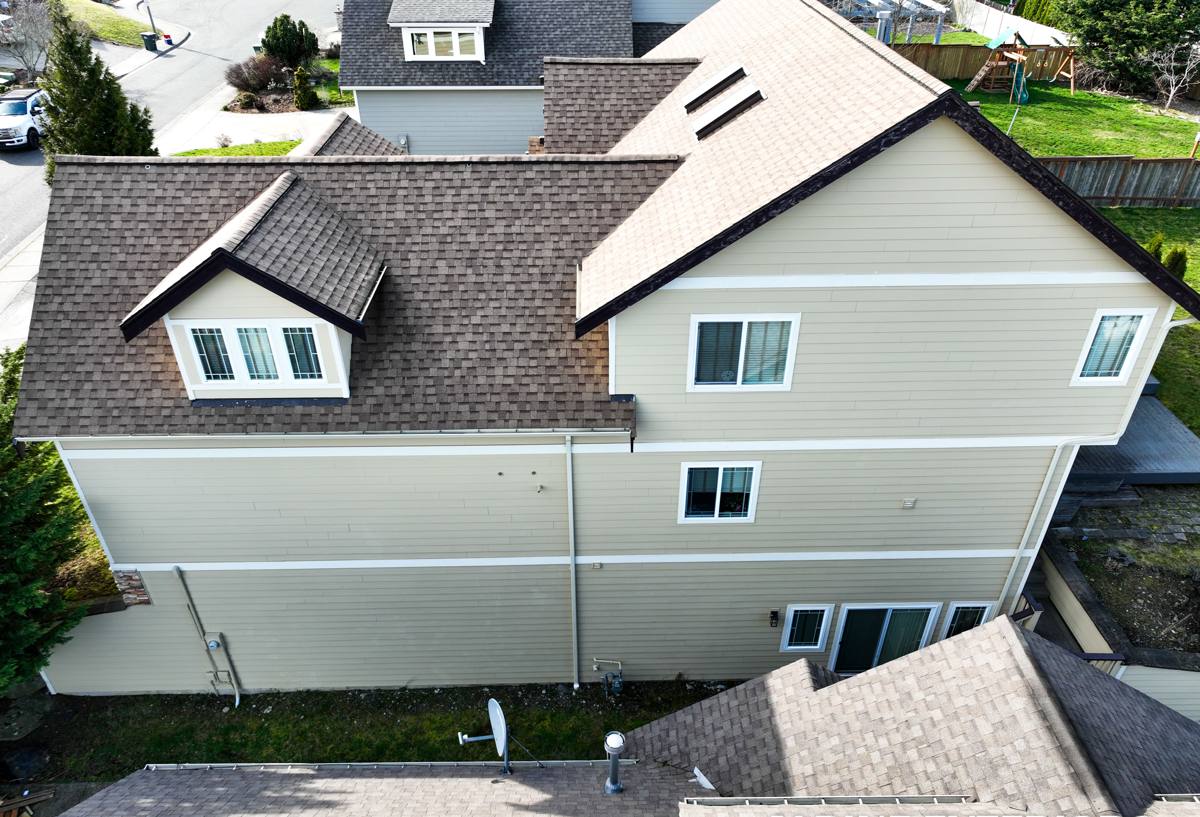
What Local Conditions Do to a Deck
Constant Moisture Load
Composite boards themselves resist water absorption far better than wood, but water still has to go somewhere. In a climate with frequent rain and heavy morning dew, any deck that traps moisture underneath — against joists, around posts, or in tight fastener gaps — creates a damp environment where mold, mildew, and moss can take hold, even on boards that are technically "moisture resistant."
Moss and Algae Growth
Skagit County's long moss season isn't just a roofing problem. Shaded decks, north-facing decks, and decks under mature trees near Downtown Mount Vernon homes accumulate the same organic buildup on horizontal surfaces. Composite boards vary a lot in how much surface texture they have and how easily that texture holds onto spores and grime versus letting rain rinse it clean.
Driving Rain and Wind-Driven Water
Rain in this area doesn't always fall straight down. Wind-driven rain gets pushed sideways into ledger connections, stair stringers, and the gap between decking and siding — the exact spots where a sloppy installation lets water into structural wood that composite boards are supposed to be protecting.
What a Correct Composite Deck Installation Involves
The composite boards are the visible part of the job, but most of what determines whether a deck lasts happens underneath and around them.
- Ledger flashing: Where the deck attaches to the house, proper flashing (not just caulk) keeps wind-driven rain from tracking behind the siding and into the wall framing.
- Joist protection: Framing lumber underneath composite decking still needs to be protected — typically with joist tape or a comparable barrier — because composite boards don't stop moisture from reaching the wood structure below.
- Proper spacing and ventilation: Composite boards expand and contract with temperature and moisture. Gaps between boards, and airflow underneath the deck, need to be sized correctly so the deck can dry out between rain events instead of staying saturated.
- Hidden or manufacturer-approved fastening: Fastener choice affects both appearance and how water sheds off the board surface. Using the wrong screws or clips can void product warranties and create spots where water pools.
- Post and footing work: Posts need proper base isolation from standing water, and footings need to meet local frost and load requirements even though hard freezes are uncommon in this part of the valley.
Comparing Decking Materials for This Climate
Homeowners in Downtown Mount Vernon usually narrow their choice down to composite, pressure-treated wood, or cedar. Each has real trade-offs — none is objectively "bad," but each behaves differently in a wet, mossy climate.
| Factor | Composite | Pressure-Treated Wood | Cedar |
|---|---|---|---|
| Moisture resistance | High — won't rot or absorb water into the board itself | Moderate — treated but still wood; needs sealing to stay protected | Naturally decay-resistant but still absorbs moisture over time |
| Moss/algae resistance | Varies by product texture; capped boards shed grime better | Low — porous surface holds moisture and organic growth | Low to moderate |
| Maintenance | Occasional washing; no staining or sealing | Annual sealing/staining recommended | Sealing every 1–3 years to maintain color and protection |
| Upfront cost | Higher material cost | Lowest material cost | Mid to high material cost |
| Long-term cost | Lower over time — less upkeep labor | Higher over time — recurring maintenance | Higher over time — recurring maintenance |
| Lifespan expectation | Long, backed by manufacturer warranty on the boards | Moderate, dependent on maintenance | Moderate to long, dependent on maintenance |
Composite generally makes the most sense for homeowners who want to spend less time maintaining the deck year to year, especially given how much upkeep this climate demands from any exposed wood surface. That said, it's a bigger upfront investment, and the quality gap between composite product lines is real — a poorly capped or low-density board can still stain, fade unevenly, or hold onto moss in shaded areas.
Board Selection: What Actually Matters
Not all composite decking is built the same, and the differences matter more in a wet climate than in a dry one.
Capped vs. Uncapped Composite
Capped composite boards have a protective shell around the wood-plastic core, which limits water absorption and staining. Uncapped or lower-grade composite can absorb more moisture at the edges and cut ends over time, which becomes a real issue on a deck that's rarely fully dry.
Surface Texture
A heavily embossed wood-grain texture can look great, but deep grooves also hold onto pollen, dirt, and moss spores longer than a smoother finish. For shaded decks or north-facing exposures common on Downtown Mount Vernon lots, a lower-texture board is often easier to keep clean.
Color Considerations
Darker composite boards absorb more heat, which helps them dry faster after rain — a modest but real advantage in a climate where boards spend a lot of time wet. Lighter boards stay cooler underfoot in summer but can take longer to dry between storms.
How We Approach a Composite Deck Project
- On-site assessment: We evaluate existing framing (if replacing an old deck), grading and drainage around the foundation, sun/shade exposure, and how the deck ties into the house.
- Material selection: We walk through composite options with honest trade-offs — texture, color, warranty terms, and cost — based on how the deck will actually be used and exposed.
- Structural prep: Ledger flashing, joist protection, and footing work are done to hold up under sustained rain exposure, not just pass a one-time inspection.
- Installation: Boards are fastened per manufacturer specification with correct spacing for expansion and drainage.
- Final walkthrough: We review drainage, gaps, and any transitions (stairs, railings, house connections) with the homeowner before calling the job complete.
Permits and Local Requirements
Deck projects in Mount Vernon typically require a building permit, particularly for anything attached to the house or elevated above a certain height, and inspections generally cover footings, ledger attachment, and railing/guard requirements. Requirements can vary by lot and by whether the deck is a replacement versus new construction, so this is confirmed on a case-by-case basis rather than assumed. Getting this step right up front avoids problems at resale and keeps the ledger connection — the single most common source of water damage on attached decks — built to code.
Maintaining a Composite Deck in This Climate
Composite decking cuts maintenance significantly compared to wood, but "low maintenance" doesn't mean "no maintenance" in a climate with this much moisture and moss pressure. A simple seasonal routine keeps a composite deck looking and performing the way it should:
- Sweep off leaves, needles, and debris regularly, especially in fall — trapped organic matter holds moisture against the board surface.
- Wash the deck surface once or twice a year with a mild soap and water solution or a manufacturer-approved cleaner; avoid pressure washing at close range, which can damage the cap layer.
- Check and clear the gaps between boards periodically so water and debris can drain instead of pooling.
- Inspect railings, stair connections, and the ledger area annually for any signs of movement or water intrusion.
- Address moss or algae spotting early with a gentle scrub — letting it establish makes it harder to remove without damaging the board finish.
Why Local Installation Experience Matters
A crew that regularly works in Downtown Mount Vernon has already seen how the neighborhood's mix of older and newer homes, mature tree cover, and lot layouts affect deck performance. That means knowing which orientations tend to hold moss longest, how existing framing on older homes typically needs to be handled during a tear-off, and what the local permitting process actually requires before work starts. It also means being available for the seasonal maintenance check-ins or warranty questions that come up after the install — not just showing up for the build and disappearing.
If you're weighing a composite deck for a home in Downtown Mount Vernon, we're happy to take a look at your space and talk through honest options — no pressure, no hard sell. Fill out the form below to request a free estimate.