 Mount Vernon
 Composite Decking Built for Bow's Coastal Edge
Bow sits close enough to Samish Bay and the open water of Skagit County that homes here deal with a mix most inland Mount Vernon properties don't: salt-laden air, wind-driven rain coming off the water, and a moss season that can run half the year in shaded, damp yards. A deck built for a dry inland lot doesn't always hold up the same way out here. If you're planning a new deck or replacing tired wood boards in Bow, composite decking is worth a serious look — but only if it's specified and installed with this specific climate in mind.
This page covers what we've learned installing composite decking for homeowners in and around Bow: what the material needs to do here, what a correct installation actually involves, and how our process works from first call to final walkthrough.
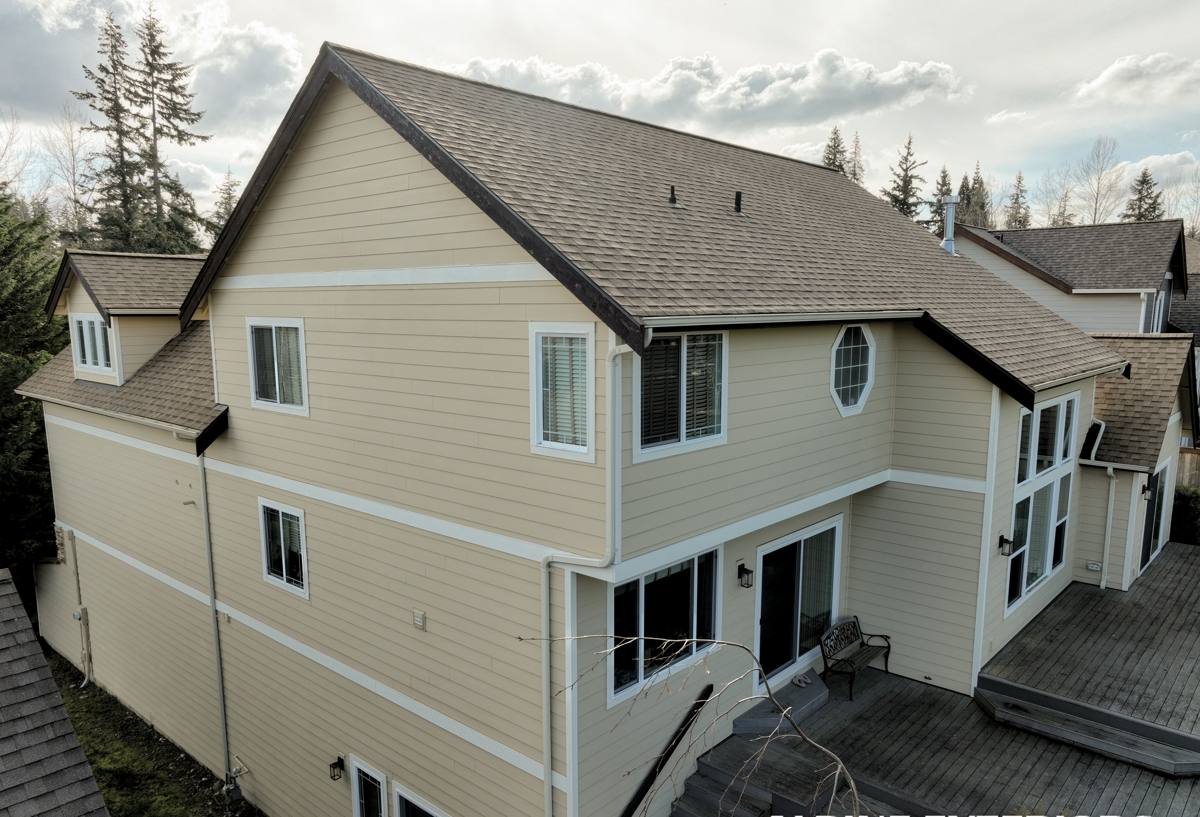
Why Bow's Climate Changes the Decking Conversation
Salt Air
Properties near Samish Bay and the surrounding tidal flats get a steady dose of salt in the air, especially with onshore wind. Salt accelerates corrosion in fasteners, brackets, and any exposed metal hardware. It also settles into porous surfaces over time. This doesn't rule out any particular decking material, but it does mean fastener selection and hardware coatings matter more here than they would twenty miles inland.
Driving Rain
Storms coming off the water tend to arrive with wind behind them, which pushes rain sideways into ledger connections, stair stringers, and any spot where a deck meets the house. Standing water and repeated wetting are the two things that shorten the life of any deck, wood or composite. Framing, flashing, and drainage details carry more weight in a wind-driven-rain area than they do in a sheltered yard.
Moss Season
Shaded lots, tree cover, and the region's long wet stretch from fall through spring give moss and algae plenty of time to establish on horizontal surfaces. Moss holds moisture against a deck board, and on wood that moisture leads to soft spots and rot. On composite, moss is mostly a surface and slip-hazard issue rather than a structural one — but board selection still affects how easily it grows and how easily it comes off.
What "Correct" Composite Decking Looks Like Here
Composite decking is popular because it doesn't need staining, doesn't splinter, and resists rot the way wood eventually can't. But composite isn't maintenance-free, and it isn't immune to a bad installation. A few things we treat as non-negotiable on Bow jobs:
- Proper ventilation underneath. Composite boards need airflow beneath the deck surface to shed the moisture that collects in our wet months. Low clearance or blocked airflow traps damp air against the joists.
- Corrosion-resistant fasteners and hardware. Given the salt exposure this close to the bay, we use fasteners and structural hardware rated for coastal or marine-adjacent conditions, not generic exterior-grade hardware.
- Correct board spacing. Composite expands and contracts with temperature more than most homeowners expect. Gaps that are too tight can cause buckling; gaps that are too wide collect debris and moss. We follow manufacturer spacing specs adjusted for our seasonal temperature swing.
- Grooved-edge boards with hidden fastener systems where the design allows, which reduce the number of exposed fastener heads that can corrode or streak the board surface over time.
- Slip-resistant surface texture on boards, since moss and algae plus a smooth surface is a real fall hazard on shaded decks through the wet season.
Choosing a Composite Product for a Bow Property
Not every composite board is built the same way, and the differences matter more in a damp, salt-adjacent climate than they would in a dry one. We walk homeowners through the trade-offs honestly rather than pushing whatever's cheapest or has the highest margin.
| Factor | What to look for | Why it matters in Bow |
|---|---|---|
| Capping | Fully capped (all four sides) vs. partially capped | Full capping resists moisture intrusion better in a wet climate; uncapped edges are the first place rot-prone cores fail |
| Core material | Wood-plastic composite vs. mineral-based / PVC composite | Mineral and PVC-based cores handle sustained moisture exposure with less risk of swelling than older wood-plastic blends |
| Surface texture | Textured or brushed finish vs. smooth | Textured surfaces stay safer underfoot when moss and algae form during wet months |
| Color | Lighter and mid-tone colors vs. very dark colors | Darker boards run hotter in direct sun, which affects comfort and can slightly increase expansion movement |
| Warranty structure | Fade/stain warranty terms and what voids them | Salt air and biological growth are exactly the conditions some warranties carve out exceptions for — worth reading before you buy |
We don't install every composite brand on the market. Our standard is boards with full capping, a documented warranty against moisture and fade, and a track record in Pacific Northwest coastal conditions — not just desert or inland testing. If a product doesn't meet that bar, we'll say so and explain why, rather than installing something we don't trust to hold up in this specific climate.
Framing and Drainage: The Part That Actually Fails First
Most deck problems we get called out to fix aren't failures of the decking material — they're failures underneath it. In a wind-driven-rain area like Bow, this is where we spend the extra attention:
Ledger Board Flashing
Where the deck attaches to the house is the single most common source of hidden water damage. Wind-driven rain finds gaps that a calm-weather installation might get away with elsewhere. We flash this connection to shed water away from the house structure, not just seal it.
Joist Protection
Even with composite decking on top, the substructure is typically still wood. We use joist tape or an equivalent barrier on top of joists to keep standing water from sitting against exposed wood and starting rot that you won't see until it's advanced.
Grading and Runoff
On sloped or low-lying Bow lots, we check where water goes after it leaves the deck. A deck that dumps runoff back against the foundation or into a low spot that doesn't drain creates problems well beyond the decking itself.
Our Process for a Bow Composite Deck
- On-site assessment. We look at sun and shade exposure, wind direction relative to the water, existing drainage, and the condition of any structure being replaced.
- Product walkthrough. We show you actual board samples and go through the capping, core, and warranty differences that matter for your specific lot — not a generic brochure pitch.
- Written estimate. Materials, labor, hardware, and any framing repair or upgrade are itemized so you know what you're paying for and why.
- Demo and framing check. If replacing an existing deck, we inspect the substructure before covering it with new decking. Rotted or undersized framing gets flagged and addressed, not built over.
- Installation. Corrosion-resistant fasteners, correct spacing, proper ventilation clearance, and flashing details as described above.
- Final walkthrough. We check the deck with you, cover basic care (seasonal cleaning to keep moss from establishing, what to avoid using on the surface), and make sure you know the warranty terms you're covered under.
Living With a Composite Deck in This Climate
Composite decking cuts down on maintenance compared to wood, but "low-maintenance" isn't "no-maintenance," especially with our moss season. A few habits keep a Bow deck looking and performing well for years:
- Rinse or sweep debris and organic buildup off the surface a few times a year, more often in shaded areas prone to moss.
- Use a soft-bristle brush and a manufacturer-approved cleaner for moss or algae — pressure washers on the wrong setting can damage the cap surface.
- Keep gutters and downspouts near the deck clear so runoff isn't concentrated onto one section of boards.
- Check under-deck ventilation isn't blocked by stored items, plants, or added skirting that seals off airflow.
- Inspect fastener heads and hardware annually near the coast — catching early corrosion is easier than replacing a bracket after it fails.
Why Local Installation Experience Matters
A lot of decking problems we're asked to repair trace back to an installer who did solid work for a drier or more inland climate but didn't account for what Bow's salt air, driving rain, and moss actually do to a deck over several seasons. Hardware that's fine forty miles from the water corrodes faster here. Ventilation gaps that are adequate in a dry yard aren't enough under a mossy tree canopy. These aren't exotic problems — they're just specific to this stretch of Skagit County, and they're avoidable with the right approach from day one.
We work on homes throughout Mount Vernon and the surrounding Skagit County communities, including Bow, and we bring the same climate-specific standards to every composite deck we build here, whether it's a small platform off a kitchen door or a full multi-level outdoor living space.
Get a Free, No-Pressure Estimate
If you're weighing composite decking for a home in Bow, we're glad to come take a look, talk through product options honestly, and give you a written estimate with no obligation. Use the form below to get started.