 Mount Vernon
 Why Blanchard Siding Wears Differently Than Siding Inland
Blanchard sits close enough to the salt water and the hillside timber that homes here take a different kind of beating than a house a few miles inland in downtown Mount Vernon. You've got salt-laden air moving in off the bay, driving rain that comes sideways during winter fronts, and a lot of shade and tree cover that keeps moisture sitting on north- and west-facing walls far longer than the sun ever gets a chance to dry it out. Add in a long moss and algae season that runs from fall through spring, and you've got a climate that's genuinely harder on exterior materials than what siding manufacturers test for in a lab.
This isn't unique to any one house in Blanchard — it's the whole area. Homes tucked against the hillside or under a tree canopy tend to fight moss and mildew year-round. Homes more exposed to the water side deal with salt exposure that accelerates corrosion on fasteners and finish. Either way, siding here has to do more than look good on installation day. It has to hold up to a climate that never really gives it a break.
Signs a Blanchard Home Needs Siding Replaced, Not Patched
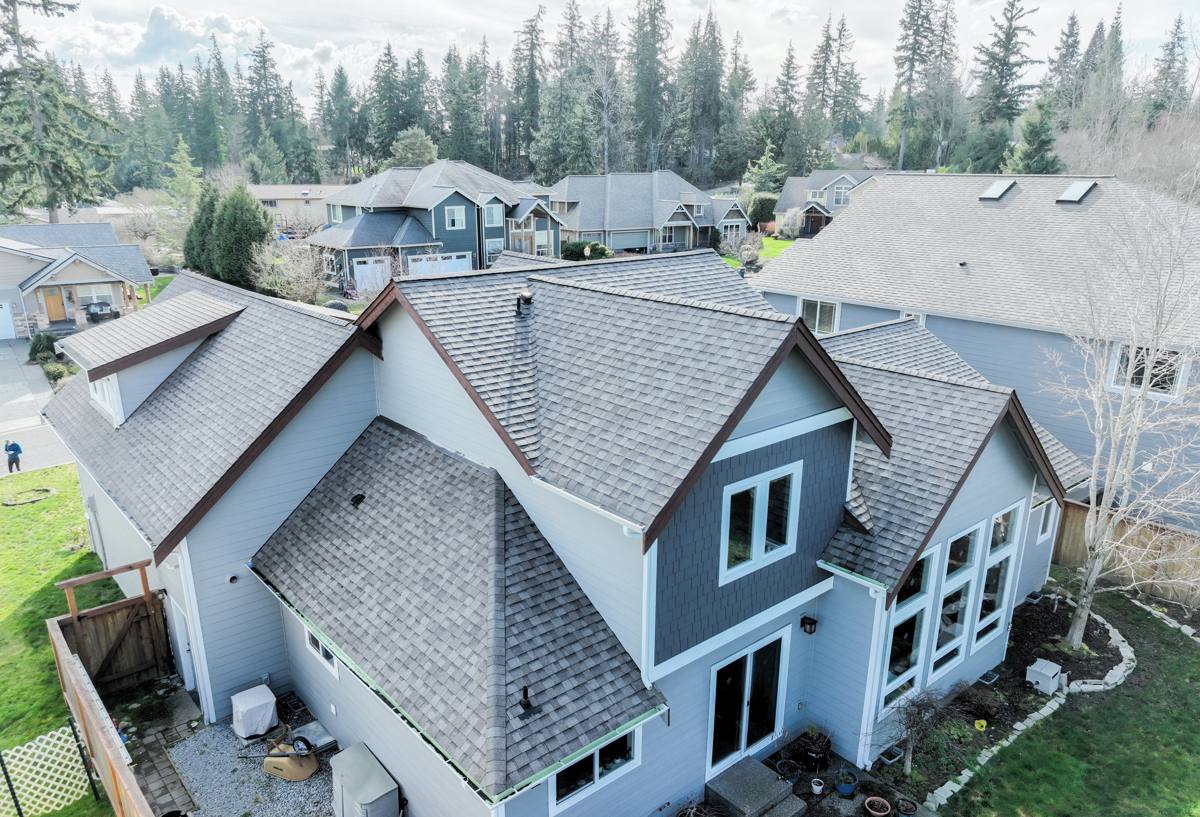
A lot of siding problems in this area get treated as cosmetic — a little discoloration, a soft spot near a downspout — when they're actually early signs of moisture getting behind the material. Because Blanchard's rain comes with wind, water gets driven into seams, laps, and trim joints that would stay dry in a calmer climate. Once that happens repeatedly over a few seasons, patching stops being a real fix.
- Boards that feel soft, spongy, or crumble at the edges when pressed
- Persistent black or green staining that comes back within weeks of cleaning
- Paint that's bubbling, peeling, or failing faster than a normal repaint cycle
- Visible cupping, warping, or gaps opening up between boards
- Musty smell or moisture staining on interior walls that back up to exterior siding
- Nail heads popping or corroding through the surface
Any one of these can sometimes be spot-repaired. Several of them together, especially on a wall that gets heavy weather exposure or shade, usually means the siding system itself has reached the end of its useful life and a full replacement is the honest recommendation.
What a Correct Siding Replacement Actually Involves
Siding replacement isn't just stripping old boards and nailing up new ones. In a climate like Blanchard's, what's underneath the siding matters as much as the siding itself.
Tear-Off and Inspection
Removing the old siding is also the only real chance to see what's happened to the wall behind it — sheathing, framing, and any water damage that's been hidden for years. A crew that rushes past this step is gambling with your wall assembly.
Water-Resistive Barrier and Flashing
Given how much wind-driven rain this area sees, the housewrap and flashing details around windows, doors, and penetrations are arguably more important than the siding product itself. Proper lapping, taped seams, and correctly integrated flashing are what keep water from ever reaching the sheathing in the first place.
Rainscreen or Drainage Gap
On shaded or moisture-heavy walls, a small air gap behind the siding lets any water that does get past the surface drain and dry out instead of sitting against the wall. This is one of the details that separates a siding job built for the Pacific Northwest from one built for a drier climate.
Correct Fastening and Clearances
Fastener spacing, siding-to-grade clearance, and caulking at joints all affect how well the system sheds water over the next 20-30 years, not just how it looks in year one.
Why We Install Only James Hardie Fiber Cement
We get asked why we don't offer vinyl, LP SmartSide, or other engineered wood options. The honest answer is that in a climate like Skagit County's — and especially in a moisture-heavy, shaded spot like Blanchard — the trade-offs on those products aren't ones we're willing to put our name behind.
Vinyl is affordable and low-maintenance in dry climates, but it expands and contracts with temperature swings, can crack in impacts, and doesn't hold up structurally the way fiber cement does over decades of wet-dry cycling. Engineered wood products like LP SmartSide perform well when installed and maintained precisely to spec, but they're wood-based, which means they're inherently more vulnerable to the kind of sustained moisture exposure that shaded, coastal-adjacent homes see here — caulking, paint, and flashing details all have to be maintained on schedule or the wood substrate is at risk.
James Hardie fiber cement is non-combustible, dimensionally stable, and engineered specifically for wet climates through its HZ10 product line, which is built for the kind of moisture and temperature swings the Pacific Northwest delivers. The factory-applied ColorPlus finish is baked on under controlled conditions, which gives it better fade and moisture resistance than field-applied paint, and it comes with a strong transferable warranty. It costs more up front than vinyl and is heavier and more labor-intensive to install correctly, but for a climate that punishes shortcuts, it's the product we're comfortable standing behind on a Blanchard roofline for the next 30 years.
| Factor | What It Means for a Blanchard Home |
|---|---|
| Salt air exposure | Favors non-combustible, corrosion-resistant fastening and factory-cured finishes over field-painted surfaces |
| Shade and tree cover | Increases importance of drainage gap, breathable assembly, and moss-resistant finish |
| Wind-driven rain | Makes flashing and water-resistive barrier detailing as critical as the siding product itself |
| Long wet season | Rewards materials that don't swell, warp, or rot when saturated repeatedly over months |
| Home wall exposure (sun vs. shade side) | May justify different maintenance schedules even on the same house |
Our Process for a Blanchard Siding Replacement
We approach every Blanchard job with the site's specific exposure in mind rather than a one-size-fits-all install.
- On-site assessment — we walk the exterior, note which walls carry the heaviest moss, staining, or moisture exposure, and check for any signs of hidden water damage.
- Written estimate — a clear scope covering tear-off, water-resistive barrier, flashing, siding product and color, and any drainage or ventilation details specific to your walls.
- Tear-off and structural check — old siding comes off, and we inspect sheathing and framing before anything new goes up.
- Barrier, flashing, and drainage detailing — this is where most long-term failures are prevented, and it's not a step we compress to save time.
- Hardie installation — installed to manufacturer spec for fastening, clearances, and joint treatment, since deviating from spec can affect warranty coverage.
- Final walkthrough — we go over the finished work with you before calling the job done.
Why a Crew That Already Works Blanchard Matters
A contractor who's worked this part of Skagit County knows which walls on a given lot orientation tend to hold moisture longest, how much of a drainage gap actually makes sense on a heavily shaded elevation, and what kind of flashing detail holds up against the wind-driven rain that comes through here in the fall and winter. That's not something you get from a crew that mostly works drier inland neighborhoods and treats every job the same. Local experience shows up in the small decisions — where extra flashing gets added, which walls get prioritized first, how the job gets sequenced around the weather — and those decisions are what determine whether a siding job still looks and performs well in year 15, not just year one.
Questions Worth Asking Any Siding Contractor Before You Hire
- Are you a certified or preferred installer for the siding product you're proposing?
- Will you show me the water-resistive barrier and flashing plan before installation starts, not just the finished siding?
- How do you handle a drainage gap or rainscreen on shaded or moisture-prone walls?
- What does the manufacturer's warranty actually require in terms of installation method?
- Can I see the written scope of work, including tear-off and disposal, before I sign anything?
- How do you sequence the job around wet weather so materials and the open wall aren't exposed longer than necessary?
If your Blanchard home is showing signs of siding failure, or you're just planning ahead before the next wet season sets in, we're happy to come take a look. Reach out for a free, no-pressure estimate — we'll walk the exterior with you, point out what we're actually seeing, and give you a straight answer on whether it's time to replace.