 Mount Vernon
 Avon's Climate and What It Does to Siding
Avon sits in the Skagit River valley just north of Mount Vernon, in a stretch of Skagit County where moisture is a year-round fact of life, not an occasional inconvenience. Air moving inland off Puget Sound and the Salish Sea carries salt and humidity up the valley, and it combines with driving rain that comes in sideways during fall and winter storms. Add the river's own low-lying dampness and the tree cover common on rural and semi-rural lots in the area, and you get long stretches of the year where siding simply doesn't get a chance to fully dry out.
That combination is exactly what wears down the wrong siding material. Wood-based products absorb moisture at the edges and behind poorly caulked joints, and once trapped moisture sets in, rot follows even if the surface paint still looks fine. Vinyl doesn't rot, but it moves with temperature swings and can crack or warp at fastener points over the years, and it does nothing to slow the moss and algae growth that this climate practically guarantees on north-facing and shaded walls. Homes in Avon need siding that resists moisture intrusion at the material level, not just at the paint layer, and that holds a factory finish long enough to make the area's long moss season a maintenance issue rather than a structural one.
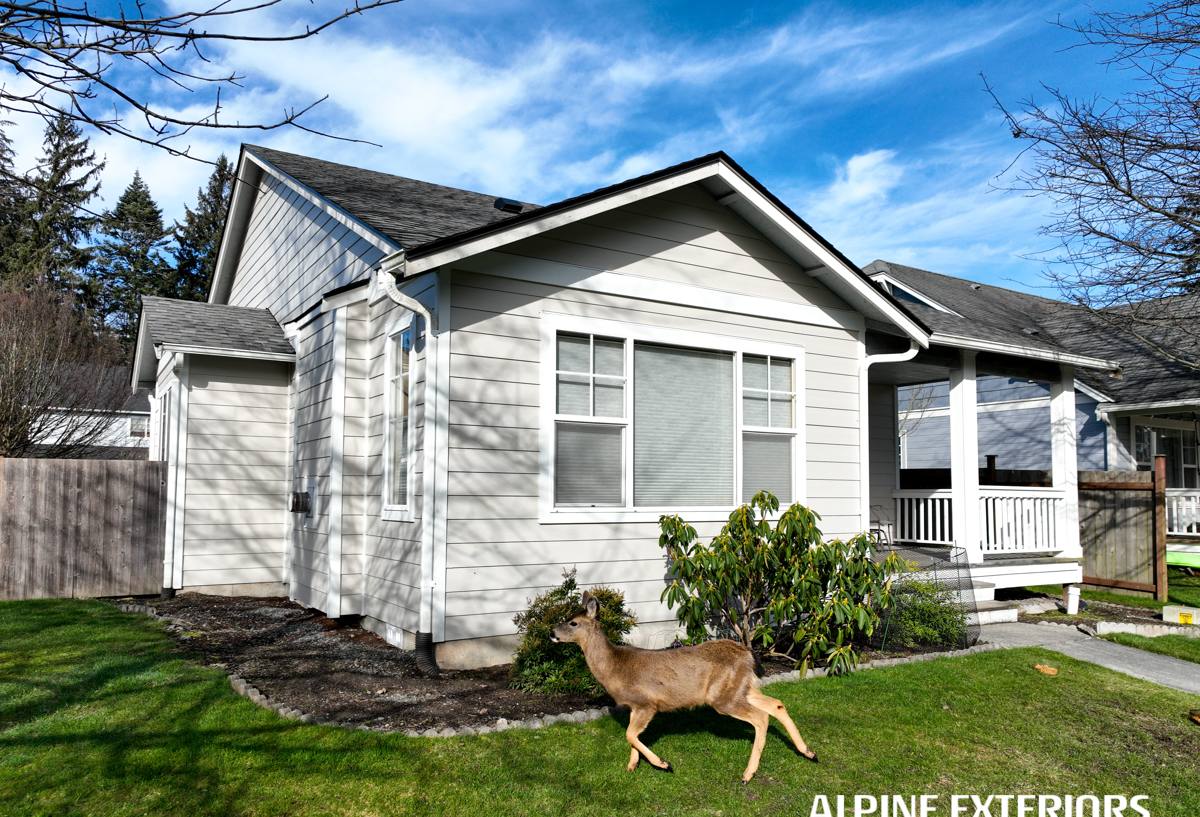
Why Fiber Cement Fits Skagit County Homes
Fiber cement is a mix of sand, cement, and cellulose fiber, pressed and cured into planks that don't absorb water the way wood does and don't expand and contract the way vinyl does. That stability matters in a valley climate that swings between saturated winters and warm, dry summers. A wall that doesn't move much with the seasons is a wall where caulk joints last longer, paint lines stay tight, and moisture doesn't find new gaps to exploit year after year.
We install James Hardie fiber cement exclusively — not LP SmartSide, not vinyl, not Cemplank, Allura, or primed spruce and cedar. That's a standard we hold across every job we take in Skagit County, including here in Avon. Hardie's HZ5 product line is engineered specifically for the cold, wet weather patterns found in the Pacific Northwest, and its ColorPlus factory finish is baked on under controlled conditions rather than field-applied, which gives it far more consistent resistance to moisture, UV fading, and the kind of surface staining that moss and mildew leave behind. We think that combination is worth standardizing on, and we explain our reasoning to every homeowner who asks why we don't offer alternatives.
What Fiber Cement Does Well Here Specifically
- Resists moisture absorption at the plank level, reducing swelling and soft spots behind trim and at butt joints
- Holds paint and factory color far longer than wood, cutting down on repaint cycles in a climate that's hard on exterior coatings
- Doesn't feed mold, moss, or insects the way cellulose-based or untreated wood products can
- Stands up to wind-driven rain without the seam and caulk failures common on lower-grade composite sidings
- Non-combustible, which matters for wildfire-adjacent insurance considerations even in a historically wetter region
What a Correct Fiber Cement Installation Actually Involves
Fiber cement is only as good as the installation behind it. This is where a lot of siding jobs in wet climates go wrong — not because the material failed, but because the crew treated it like any other siding and skipped the details that keep water out of the wall assembly.
The Non-Negotiables
- A proper weather-resistive barrier (housewrap) installed with correct overlaps and taped seams before any siding goes up
- Rainscreen or furring strips where conditions call for it, creating a drainage gap behind the siding so incidental moisture can escape instead of sitting against the wall
- Correct fastener type, spacing, and placement per James Hardie's published installation instructions — under- or over-driven nails are one of the most common causes of early siding failure
- Proper clearance at the ground, roofline, and any horizontal trim, so water sheds away from the wall instead of wicking up into the bottom edge of the planks
- Factory-cut and factory-primed edges kept intact wherever possible, with field cuts sealed per manufacturer spec
- Flashing integrated correctly at every window, door, and penetration — this is where the majority of hidden leaks originate on any home, regardless of siding brand
Skip any one of these steps and you can end up with moisture trapped behind a material that's otherwise excellent at keeping it out. That's why installation quality matters as much as the product choice itself, especially on a home exposed to the kind of driving rain Avon sees.
James Hardie Compared to Other Siding Options
| Factor | James Hardie Fiber Cement | Vinyl | Wood / Primed Spruce or Cedar |
|---|---|---|---|
| Moisture resistance | High — engineered cement composite, minimal absorption | Doesn't absorb, but seams and J-channels can trap water | Prone to swelling and rot without diligent maintenance |
| Finish longevity | Factory ColorPlus finish, long fade resistance | Color molded in, but can chalk and fade over time | Field-applied paint, shorter repaint cycles in this climate |
| Moss and algae resistance | Smooth, dense surface resists buildup better than porous materials | Textured surfaces can hold moisture and organic growth | Porous surface is a common host for moss and mildew |
| Dimensional stability | Minimal expansion/contraction with temperature swings | Expands and contracts noticeably, can warp | Moves with humidity; prone to cupping and cracking |
| Fire rating | Non-combustible | Combustible | Combustible |
| Typical lifespan when correctly installed | Multiple decades with periodic recoating | Decades, but brittle failures increase with age | Highly dependent on maintenance diligence |
Our Process, Start to Finish
For an Avon project, our process looks the same whether the home is on a farm lot or in a more built-up part of the neighborhood:
- On-site assessment — we walk the exterior, check for existing moisture damage, note trim and flashing conditions, and measure for material takeoff.
- Written estimate — a clear scope covering removal (if needed), weather barrier, rainscreen approach, Hardie product line and color, trim, and fastening schedule.
- Tear-off and inspection — once old siding comes off, we inspect sheathing for rot or soft spots before anything new goes up. Any repairs get addressed and documented before covering the wall.
- Weather barrier and drainage plane — housewrap, flashing, and rainscreen installed to manufacturer spec, since this layer does most of the real work keeping water out long-term.
- Siding installation — Hardie planks or panels installed per fastening schedule, with careful attention to butt joints, corners, and clearances.
- Trim, caulking, and final detail — window and door trim, touch-up at factory-cut edges, and a final walkthrough with the homeowner.
Cost Factors for an Avon Fiber Cement Project
Every home is different, so we don't quote a number without seeing the site, but the main variables that move the price are consistent from job to job:
| Factor | Why It Matters |
|---|---|
| Existing siding removal | Tear-off, disposal, and any sheathing repair add labor and material costs |
| Home size and wall complexity | More corners, dormers, and trim details mean more cutting, fitting, and time |
| Hardie product line and profile | Lap siding, board-and-batten, and shingle-style panels carry different material costs |
| Rainscreen system | Adding a drainage gap improves long-term performance but adds labor and material |
| Access and site conditions | Rural lots, landscaping, or limited access can affect staging and scaffolding needs |
Maintaining Fiber Cement Through Skagit County's Wet Season
Fiber cement is low-maintenance compared to wood, but "low" isn't "none," especially with the moss and moisture Avon sees for a good part of the year.
- Rinse siding annually with a garden hose to clear pollen, dust, and early moss growth before it takes hold
- Keep gutters clean and downspouts directed away from the foundation so runoff doesn't sheet down the siding face
- Trim back vegetation and tree limbs that keep walls shaded and damp longer than necessary
- Re-caulk trim joints if you notice gaps or cracking, rather than waiting for water intrusion to show up inside
- Watch for chalking or fading on south- and west-facing walls as an early signal it's time for a maintenance coat
Why It Matters That We Already Work in Avon
A lot of siding problems in this region trace back to installers who treat every job the same, regardless of climate. A crew used to drier markets may not think twice about skipping a rainscreen or cutting corners on flashing details, because in their home climate those shortcuts don't get punished the way they do here. Working Avon and the rest of Skagit County regularly means we've seen how driving rain and long wet seasons actually test a wall assembly over time, and we build every job to hold up to that, not just to pass a walkthrough on a dry day.
It also means shorter travel time for site visits, warranty follow-ups, and any adjustments during the project — practical advantages when you're trying to get a job done right and don't want to wait weeks between steps.
If you're planning a siding project in Avon and want to talk through what James Hardie fiber cement would look like on your home, we're happy to walk the property with you and put together a straightforward, no-pressure estimate.