 Mount Vernon
 Anacortes Decks Live in a Different Climate Than the Rest of Skagit County
Anacortes sits out on the water, and that changes what a deck has to survive. You're not just dealing with the same rain that falls on Mount Vernon or Burlington — you're dealing with salt-laden air off the Sound, wind-driven rain that gets pushed sideways under railings and against ledger boards, and a moss season that runs longer than it does further inland because the humidity rarely lets up. A deck built to a generic spec, without accounting for that, tends to show its age fast: fastener corrosion, green film on the boards by late fall, and moisture finding its way into framing that wasn't detailed for it.
Composite decking has become the go-to material for homeowners here precisely because it handles those conditions better than wood when it's installed correctly. The word "correctly" is doing a lot of work in that sentence, and it's the reason this page exists — composite is forgiving compared to cedar or pressure-treated lumber, but it's not maintenance-free or install-proof, especially this close to salt water.
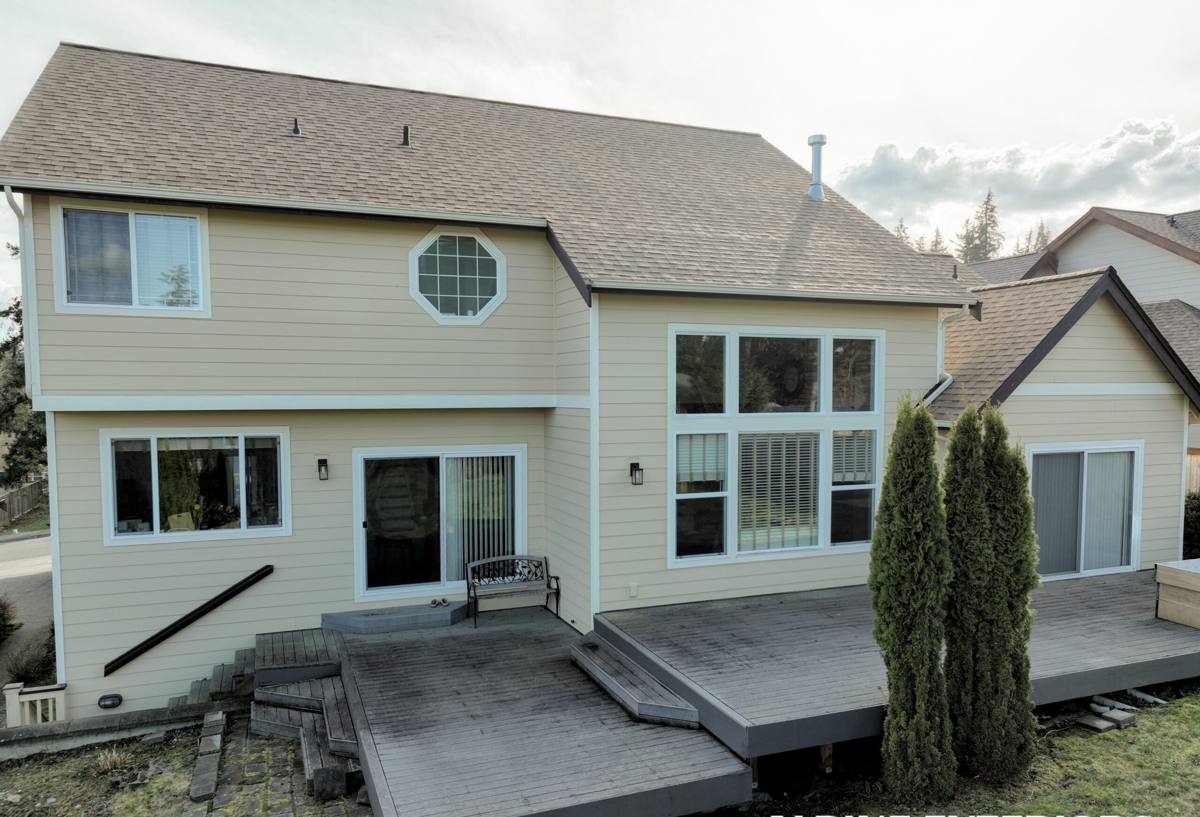
What Salt Air, Rain, and Moss Actually Do to a Deck
Salt Air
Airborne salt accelerates corrosion on anything metal — screws, joist hangers, ledger flashing, railing hardware. On a standard wood deck, this often shows up first as rust streaks bleeding down the boards from fastener heads. On composite, the boards themselves shrug off salt exposure, but the fasteners and structural hardware underneath still need to be rated for it, or you're just delaying the same problem by a few years.
Driving Rain
Anacortes gets weather that comes in sideways off the water more often than the sheltered inland parts of the county. That means water gets driven up under rail posts, into end-grain cuts, and behind ledger boards where they meet the house. A deck that only handles rain falling straight down is going to leak at the house connection within a few wet seasons.
Moss and Algae
Composite decking resists rot, but it doesn't resist organic growth sitting on its surface. Boards that stay damp in shaded, low-airflow spots — under trees, on the north side of a house, or wherever snow and leaf litter collect — will grow moss and algae just like anything else outdoors here. The difference is that composite won't rot from it the way wood eventually will; the growth is a surface and slip-hazard issue, not a structural one, as long as the deck was built with airflow underneath.
Why Composite Makes Sense for This Location
We're not going to tell you composite is the only right answer — it isn't for every budget or every homeowner's taste. But for a deck that has to deal with salt air and a long wet season without constant upkeep, here's what it gets you over the alternatives:
- No annual staining, sealing, or sanding to keep water out of the wood fibers
- Won't splinter, cup, or check the way lumber does when it cycles between soaked and dry
- Color and cap-stock formulations hold up to UV and salt exposure without graying or fading the way untreated wood does
- Consistent board dimensions make for tighter, more predictable installs — fewer gaps for debris and moss to collect in
What a Correct Composite Install Looks Like Here
The board itself is only part of the job. Most composite deck problems we get called out to fix aren't the composite failing — they're the framing, flashing, or fastening underneath that wasn't detailed for this climate. A correct install for an Anacortes property includes:
Ledger and House Connection
Proper flashing where the deck ties into the house, sealed and lapped so wind-driven rain can't track behind it. This is the single most common failure point we see on decks that weren't built by a crew used to coastal exposure.
Framing and Fasteners
Structural framing rated for exterior exposure, with hardware and fasteners specified for coastal/salt-air environments rather than standard galvanized. It costs a little more up front and saves you a re-deck a decade sooner.
Ventilation and Drainage Underneath
Composite decking needs airflow beneath the boards to shed moisture and discourage the mold and mildew that thrive in damp, still air. Joist spacing, board gapping, and any skirting need to account for that — skirting that's sealed up tight looks nice but traps exactly the moisture you don't want.
Hidden Fastening Systems
Most composite lines now use hidden clip systems rather than face-screwing. Done right, this keeps water out of fastener penetrations in the board face — one less entry point for moisture, and a cleaner look besides.
Composite vs. the Alternatives
| Material | Salt Air / Moisture Behavior | Maintenance | Typical Lifespan Locally |
|---|---|---|---|
| Composite decking | Resists rot and moisture absorption; hardware needs to be corrosion-rated | Periodic washing; no staining or sealing | 25-30+ years with correct install |
| Pressure-treated lumber | Absorbs moisture, prone to cupping and checking in wet/dry cycles | Annual cleaning and re-staining/sealing | 10-15 years before major repair |
| Cedar | Naturally rot-resistant but still absorbs moisture; grays quickly in salt air without upkeep | Regular oiling or sealing to preserve color and moisture resistance | 15-20 years with consistent upkeep |
| PVC / cellular decking | Fully moisture-resistant, doesn't absorb water | Low; occasional washing | Comparable to or longer than composite, at a higher material cost |
We install composite for most Anacortes clients because it lands in the sweet spot between upfront cost and long-term performance in this climate. PVC has its place for homeowners who want the lowest possible maintenance and are comfortable with the added cost. Wood still has fans for its look and lower material price, but we're honest with clients that it asks for a real annual maintenance commitment out here — skip a season of sealing near the water and you'll feel it in the boards.
Our Process
- On-site assessment. We look at sun and wind exposure, drainage, existing framing condition (if this is a re-deck), and how the new deck ties into the house.
- Framing and structural plan. Any rot, undersized joists, or missing flashing from the old structure gets addressed before a single composite board goes down — building on a bad frame is how good decking fails early.
- Material selection. We walk through board profiles, color/cap-stock options, and railing systems based on your budget and how exposed the deck is to weather.
- Installation. Corrosion-rated fasteners, proper board gapping for expansion and drainage, hidden-fastener systems where specified, and flashing detail at every house connection.
- Final walkthrough. We cover basic care — cleaning, what to watch for near planters or shaded corners — so the deck stays low-maintenance the way it's supposed to.
Keeping a Composite Deck Ahead of Moss and Salt Film
Composite is low-maintenance, not no-maintenance, especially this close to the water. A simple seasonal routine keeps it looking and performing the way it should:
- Rinse or sweep off salt film and debris after wind events off the water
- Wash the deck surface with soap and water (or a composite-safe cleaner) a couple times a year, more often in shaded or north-facing areas prone to moss
- Keep gutters and downspouts near the deck clear so runoff isn't pooling on or under it
- Trim back overhanging branches to cut down on shade, leaf litter, and the standing moisture that feeds moss
- Check railing posts and any exposed hardware annually for corrosion, especially on decks facing open water or prevailing wind
What Drives the Cost of a Composite Deck Here
| Factor | Why It Matters in Anacortes |
|---|---|
| Deck size and shape | More linear footage of board and railing; complex angles add labor |
| Board tier/brand | Entry-level to premium cap-stock composite varies in price and UV/stain resistance |
| Framing condition | Re-decks on older homes near the water often need joist or ledger repair before install |
| Fastener and hardware spec | Corrosion-rated hardware for salt exposure costs more than standard galvanized but pays off in longevity |
| Railing system | Composite, aluminum, or cable rail each carry different material and install costs |
| Site access | Waterfront and hillside lots common around Anacortes can add labor for material staging and equipment |
We won't quote a number without seeing the site, but most composite deck projects in this area land in a broad mid-to-upper range compared to a basic pressure-treated rebuild, with the difference paid back over time in maintenance you're not doing every year.
Why It Matters That We Already Work in Anacortes
A crew that mostly builds decks in drier, inland parts of Skagit County can still do fine work — but they're not necessarily thinking about corrosion-rated fasteners, ledger flashing detail for driving rain, or airflow underneath the boards to fight moss, because those aren't daily concerns where they usually work. Building decks around Anacortes regularly means we've seen what wind-driven rain and salt air actually do to a deck over five or ten years, not just what the manufacturer's install guide assumes for a generic climate. That's the difference between a deck that needs attention in year three and one that's still tight and clean well past year ten.
Get a Free Estimate
If you're planning a new composite deck or replacing one that hasn't held up to the weather out here, we're happy to come take a look and walk you through what it would take — no pressure, no obligation. Fill out the form below to get a free estimate.