 Mount Vernon
 Alger's Climate Puts Real Stress on Exterior Siding
Alger sits in that stretch of Skagit County where the marine influence off the Salish Sea meets the damp, timbered lowlands running along the I-5 corridor. Homes here don't just get "Pacific Northwest weather" in the abstract — they get a specific combination of salt-tinged air moving in off the water, long stretches of driving rain that comes in sideways more often than straight down, and a moss and mildew season that can run eight or nine months out of the year in shaded, north-facing exposures. That combination is harder on exterior cladding than most homeowners realize until they're dealing with the results.
We install fiber cement siding for homes in and around Alger specifically because it holds up to this pattern of weather better than the alternatives. This page isn't a generic rundown of fiber cement — it's about what siding actually needs to do on an Alger property, how a correct installation addresses that, and why we do it the way we do.
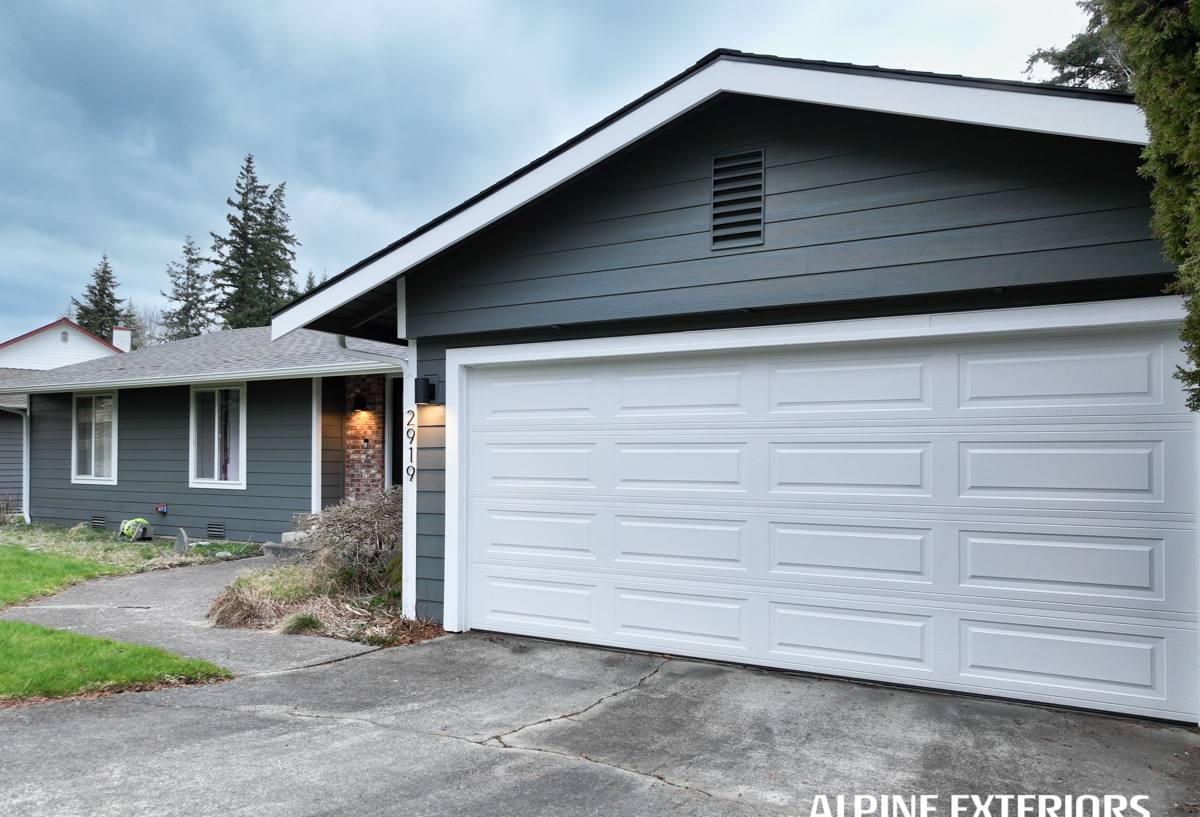
What Salt Air, Rain, and Moss Actually Do to a House
Salt-Influenced Air
Homes closer to the water pick up airborne salt that settles on exterior surfaces. Over years, that salt content accelerates corrosion of exposed metal fasteners and trim, and it can degrade certain paint and coating systems faster than manufacturers' standard weathering tests anticipate. Siding materials and finishes that aren't rated for coastal-adjacent exposure tend to chalk, fade, or lose adhesion sooner in these conditions.
Driving, Wind-Driven Rain
Skagit County's rain doesn't always fall straight down. Wind pushes it sideways and up under laps, trim, and penetrations — windows, hose bibs, light fixtures, deck ledgers. Any siding system with weak lap geometry, poor flashing details, or joints that trap water instead of shedding it will eventually let moisture behind the cladding. Once moisture gets behind siding and can't dry out, it doesn't matter how good the face material is — the wall assembly underneath starts to suffer.
Moss, Algae, and Prolonged Dampness
Shaded elevations, tree-lined lots, and north-facing walls in this area stay damp for extended stretches. That's ideal growing conditions for moss and algae, which hold moisture against the siding surface even longer than the rain itself does. Porous or organic-based siding materials are more vulnerable to this cycle — moisture gets absorbed, freeze-thaw and swelling follow, and the surface breaks down faster than it would in a drier climate.
Why Fiber Cement Is the Right Call for This Address
Fiber cement is a cement, sand, and cellulose fiber composite. It doesn't absorb water the way wood-based products do, it doesn't rot, and it isn't a food source for the fungi and algae that thrive in constant Northwest dampness. It also doesn't warp or swell with repeated wet-dry cycles the way engineered wood products can. For a property in Alger dealing with salt-tinged air, sideways rain, and long moss seasons, that combination of moisture resistance and dimensional stability is exactly what the wall needs.
It's also worth being direct about why we don't offer alternatives to fiber cement. We install James Hardie fiber cement exclusively — we don't install vinyl, LP SmartSide, cedar, primed spruce, Cemplank, or Allura. Each of those products has legitimate uses and each has honest trade-offs: vinyl can warp and fade and doesn't hold paint; wood-based and engineered-wood sidings depend heavily on maintained caulking and paint film to keep moisture out, which is a tough standard to sustain year after year in this climate; cedar is a beautiful, real material but it's a maintenance commitment most homeowners underestimate. We made a standard, not a sales pitch, and it's fiber cement.
The James Hardie System We Install
Not all fiber cement is engineered the same way, and Hardie builds its products in climate-specific formulations called HZ zones. Alger falls into a wetter, more humidity-exposed HZ classification, and the boards, engineered for that zone, are formulated to resist moisture-related damage better than a one-size-fits-all fiber cement product would.
ColorPlus Factory Finish
Most of what we install carries Hardie's ColorPlus finish — a coating baked on at the factory under controlled conditions, rather than field-applied paint. That matters in a place like Alger because factory-cured finishes adhere more consistently and resist fading and chipping better than site-applied paint, which is exactly the kind of finish that struggles under salt air and constant damp cycling.
Product Lines We Work With
Depending on the home and the look the owner wants, that typically means HardiePlank lap siding for the main field, HardieShingle for accent gables or dormers, and HardieTrim for corners, fascia, and window surrounds. All three are designed to work together as one system rather than mixed materials with different expansion rates and moisture behavior.
What a Correct Installation Actually Involves
Fiber cement is only as good as the installation behind it. This is where a lot of the real protection against Alger's weather either gets built in or gets skipped, and it's usually invisible once the job is finished — which is exactly why it matters who's doing the work.
- Proper starter strip and lap alignment so water sheds outward at every course rather than tracking sideways or pooling
- Correct minimum overlap between courses — a shortcut that's tempting to skip on a tight schedule but critical for wind-driven rain
- Weather-resistant barrier installed and lapped correctly behind the siding, with flashing integrated at every window, door, and penetration
- Fastener placement and spacing that meets Hardie's specification, with corrosion-resistant fasteners appropriate for this region's salt exposure
- Field-cut edges sealed or primed per manufacturer instruction, since raw cut edges are the most vulnerable point on any fiber cement board
- Proper clearance between siding and grade, decks, roofing, and other transitions so the board isn't sitting in standing water or constant splash-back
- Caulking limited to the joints Hardie specifies — not used as a substitute for correct flashing and lap technique
Every one of those details affects how the wall performs during an Alger winter. Skip the flashing integration and you can have the best siding material available and still get moisture intrusion behind it.
Our Process, Start to Finish
We keep the sequence straightforward and we walk the homeowner through it before the crew shows up, not after.
- On-site assessment — we look at existing siding condition, water damage or rot at penetrations, current flashing details, and the specific exposures on your lot (tree cover, prevailing wind side, proximity to standing moisture).
- Scope and estimate — a written breakdown of product line, color, trim details, and what tear-off or repair work is involved before new siding goes on.
- Substrate prep — addressing any sheathing damage or moisture issues found once old siding comes off, before anything new gets installed over it.
- Weather barrier and flashing — installed and integrated at every opening and penetration before a single course of siding goes up.
- Siding installation — installed to Hardie's fastening and clearance specification, not a generalized "close enough" standard.
- Trim, caulking, and final detail — corners, window and door surrounds, and the specified joints sealed correctly.
- Walkthrough and cleanup — site cleaned, debris hauled, and a final walkthrough with the homeowner before we consider the job done.
What Drives Cost on an Alger Siding Job
Every home is different, but the same handful of factors drive most of the cost variation we see on jobs in this area.
| Factor | Why It Matters Here |
|---|---|
| Tear-off vs. new construction | Removing and disposing of existing siding, and repairing any rot found underneath, adds labor and material cost |
| Home size and wall complexity | Dormers, gables, and multiple stories increase both material use and the labor needed for correct cuts and flashing |
| Trim and accent choices | Shingle accents, wide trim boards, and custom color combinations add cost over a straightforward lap-and-trim approach |
| Substrate condition | Moisture-damaged sheathing found during tear-off, common on shaded or long-neglected walls, needs repair before new siding goes on |
| Access and site conditions | Tree cover, tight lot lines, and sloped ground affect staging and can add time to the job |
We give a firm, itemized estimate before work starts — no surprise change orders for things we could have identified during the initial walk-through.
Keeping Fiber Cement Siding Performing Long-Term
Fiber cement is low-maintenance compared to wood or engineered-wood siding, but "low-maintenance" isn't "no-maintenance," especially in a climate that grows moss on everything left alone long enough.
- Rinse siding periodically to remove built-up pollen, dust, and organic growth before it establishes — a garden hose is usually enough; avoid high-pressure washing directly at joints and edges
- Keep gutters clear and functioning so runoff isn't sheeting down the siding face at concentrated points
- Trim back vegetation and tree limbs that keep a wall section shaded and damp longer than the rest of the house
- Inspect caulking at trim joints and penetrations every year or two and have any failed caulk replaced before water gets behind it
- Watch for moss or algae establishing in shaded corners and address it early rather than letting it hold moisture against the surface for months
Why a Crew That Already Works This Area Matters
Alger isn't a place where generic siding knowledge translates perfectly. A crew that already works homes in this part of Skagit County knows which elevations take the worst of the wind-driven rain, how much moss pressure a north-facing wall under tree cover is actually going to see, and where salt-influenced air makes fastener choice and finish durability non-negotiable rather than optional upgrades. That local pattern recognition shows up in the details — flashing at the right penetrations, fastener spec that accounts for the air quality here, clearance decisions that anticipate how wet this ground actually gets in January. It's the difference between siding installed to a manufacturer's minimum spec and siding installed for the specific conditions of this address.
If you're considering new siding or replacing failing siding on a home in Alger, we're glad to walk the property, look at what your current exterior is dealing with, and put together a straightforward, no-pressure estimate using the form below.