 Mount Vernon
 Siding Installation in Clear Lake
Clear Lake sits in that stretch of Skagit County where the weather doesn't do anything in half measures. You get long stretches of wet, wind-driven rain off the Sound, salt air that travels further inland than most homeowners expect, and a moss season that seems to start earlier and end later every year. Siding here isn't just cosmetic — it's the one layer standing between a wood-framed house and a climate that actively works against it for eight or nine months a year. When we install siding in Clear Lake, we're building for that reality, not for a showroom photo.
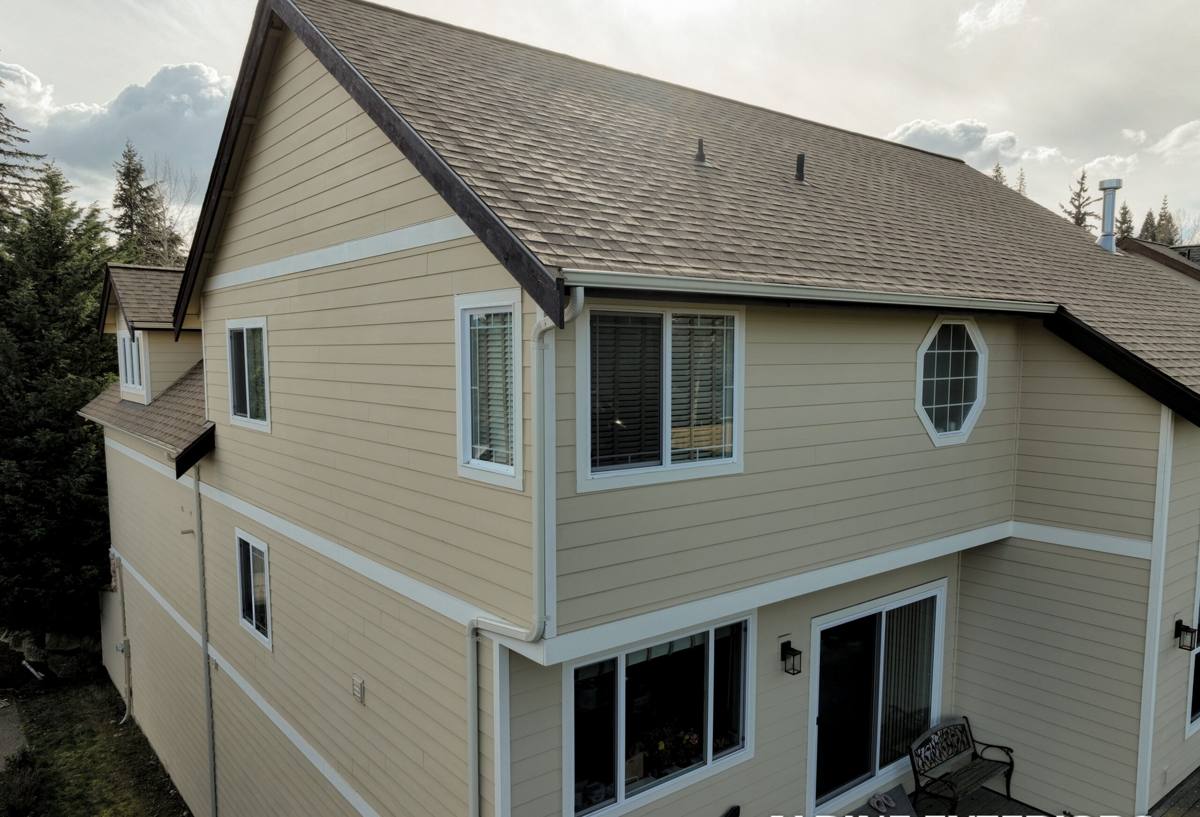
What Clear Lake Homes Actually Need From Their Siding
Every siding job we do here has to answer three questions before color or trim style ever comes up: how does this material handle sustained moisture exposure, how does it hold up under repeated wet-dry cycling, and how much maintenance will the homeowner actually be willing to do year after year. Clear Lake's mix of tree cover, standing moisture, and salt-tinged air makes all three questions harder than they'd be in a drier inland climate.
Moisture That Doesn't Let Up
Driving rain off the water pushes moisture into seams, laps, and fastener points that a lighter drizzle would never reach. Siding that relies on paint film or a surface coating to keep water out is fighting a losing battle here — eventually the film cracks, water gets behind it, and the substrate underneath starts to swell, rot, or delaminate. We look for a product and installation detail that keeps water out mechanically, not just chemically.
The Moss and Algae Problem
Shade, moisture, and cool temperatures are exactly what moss and algae need to take hold, and Clear Lake's tree-lined lots supply all three for a good chunk of the year. Wood-based siding products give organic growth something to feed on. Fiber cement doesn't — it's an inorganic material, so moss and algae can grow on the surface but they aren't consuming the substrate the way they will on wood or wood-composite siding.
Salt Air, Further Inland Than You'd Think
Clear Lake isn't oceanfront, but this part of Skagit County still gets enough salt-laden air moving through on a windy day to accelerate corrosion on fasteners and wear down cheaper coatings faster than manufacturers' glossy literature suggests. That's a fastener and finish question as much as a siding-material question, and it's one we account for in every install.
Why We Install Only James Hardie Fiber Cement
We standardized on James Hardie fiber cement siding for every project we take on, including here in Clear Lake, and we don't install vinyl, LP SmartSide, Cemplank, Allura, primed spruce, or cedar. That's not a marketing position — it's the product that holds up best against the specific conditions this area throws at a house.
Fiber cement is non-combustible, which matters given how many Clear Lake properties sit adjacent to trees and brush. It doesn't rot, and it doesn't feed moss and mildew the way wood-based products can. James Hardie's ColorPlus factory finish is baked on under controlled conditions, which gives it better adhesion and UV resistance than a field-applied paint job, and it's backed by a real transferable warranty rather than a shorter, more conditional one. James Hardie also engineers specific product lines (their HZ5 line, for instance) around regional moisture and freeze-thaw conditions, which is directly relevant to a climate like ours.
We're not going to tell you every other siding product is worthless — some of them have real strengths. But we've made a professional decision that for the climate we work in, the trade-offs of those other products (moisture sensitivity, shorter effective lifespan, more demanding maintenance schedules, weaker factory finishes) aren't ones we're willing to put our name behind. Hardie is what goes on the houses we install.
What a Correct Installation Actually Involves
Siding is only as good as the water management system behind it. A beautiful lap job over poor flashing and house wrap will fail years before the siding itself would have worn out. Here's what we treat as non-negotiable on every Clear Lake project:
- Proper weather-resistive barrier installed and lapped correctly, shingle-style, so water sheds down and out rather than behind the barrier
- Correct flashing at every window, door, and roof-wall intersection — the single most common failure point we find on older homes
- Rainscreen or drainage gap where conditions call for it, giving any moisture that does get behind the siding a path to drain and dry
- James Hardie's specified fastener patterns and clearances — over-driven or under-driven nails are one of the top causes of premature siding problems
- Correct minimum clearance from grade, decks, and roof lines, so splashback and standing moisture don't sit against the bottom course
- Factory-cut and factory-primed edges used wherever possible, with any field cuts properly sealed per manufacturer spec
- Caulking and sealant only at the joints Hardie's install guide actually calls for — over-caulking traps moisture rather than keeping it out
Skip any one of these and you can still end up with a house that looks right for a few years before problems start showing up from the inside out.
Our Process for a Clear Lake Siding Installation
1. On-Site Assessment
We walk the exterior, check the current siding and water management layer where accessible, look at grading and drainage around the foundation, and note tree cover and moss/algae patterns specific to the lot. Every property in Clear Lake has its own exposure — a lot backed by trees behaves differently than one with more open wind exposure.
2. Scope and Estimate
We put together a detailed scope covering siding, trim, flashing, and any sheathing or wrap repair the assessment turned up, so there are no surprises once the crew is on site.
3. Tear-Off and Substrate Check
Old siding comes off and we inspect the sheathing underneath for rot or moisture damage before anything new goes up. This is the point where hidden problems — often years in the making — get found and fixed rather than sealed over.
4. Water Management Installation
New house wrap, flashing, and drainage detailing go in to current best practice, not just to whatever code minimum requires.
5. James Hardie Installation
Siding, trim, and accessories go up per manufacturer specification, with attention to fastener placement, clearances, and joint treatment.
6. Final Walkthrough
We walk the finished job with the homeowner, cover basic care and what to expect from the ColorPlus finish over time, and answer questions before we consider the job done.
Cost Factors for a Clear Lake Siding Job
Every home is different, but these are the variables that most often move the price on a fiber cement installation in this area:
| Factor | Why It Matters |
|---|---|
| Home size and wall complexity | More corners, gables, and cutouts mean more cutting, fitting, and labor time |
| Condition of existing sheathing | Rot or moisture damage found during tear-off requires repair before new siding goes up |
| Siding profile chosen | Lap width, shingle-style panels, and board-and-batten all install differently and price differently |
| Trim and accessory scope | Corner boards, fascia, soffit, and frieze work add material and labor beyond the field siding |
| Access and site conditions | Tree cover, tight lot lines, and multi-story sections affect staging and crew time |
| Existing moss/algae remediation | Heavier growth on the old siding or nearby surfaces can add prep work |
Why Local Experience with Clear Lake Conditions Matters
A crew that's only ever installed siding in a drier climate will make different — and sometimes wrong — assumptions about flashing details, drainage gaps, and fastener choices. We work throughout Mount Vernon and greater Skagit County, and Clear Lake's particular mix of tree cover, moisture, and salt-tinged air is something we plan for specifically, not something we discover partway through a job. That familiarity shows up in the small decisions: where we add extra flashing attention, how we detail a drainage plane, and which fastener spacing we won't compromise on regardless of how the schedule is running.
It also means we're a known quantity if something needs a look years down the road. A local contractor with a track record in this specific area has a reason to get the water management details right the first time, because we're not leaving town after the invoice clears.
A Straightforward Recommendation
If you're planning a siding project in Clear Lake, the honest starting point is an on-site look at your home's current condition and exposure. There's no substitute for seeing the actual walls, the actual grading, and the actual tree cover before recommending a scope. We're happy to walk your property, point out what we see, and give you a straight answer about what your home needs — no pressure, no upsell script. Reach out for a free estimate and we'll get you a clear picture of the work and the cost.