 Mount Vernon
 Riverside's Climate Is Harder on Siding Than It Looks
Riverside sits close enough to the Skagit River and the tidal influence around Mount Vernon that homes here deal with a specific combination of punishment: damp air carrying salt, long stretches of driving rain off the water, and a moss season that can run from October well into spring. None of that is dramatic on its own. It's the combination, applied year after year, that wears out siding that wasn't built or installed for it.
Salt-laden moisture works differently than plain rainwater. It gets into seams, fastener heads, and paint film faster, and it holds moisture against the wall longer before it evaporates. Combine that with wind-driven rain hitting a wall at an angle instead of just running down it, and you get water finding its way into joints, corners, and butt seams that would stay dry on a more sheltered lot. Add moss and algae that thrive in the shade and damp of mature trees and river-bottom humidity, and you have a siding material's three biggest enemies working at once.
This is why we tell Riverside homeowners the same thing every time: the siding material matters, but so does understanding exactly how water and moss behave on this stretch of property before you pick a product or a crew.
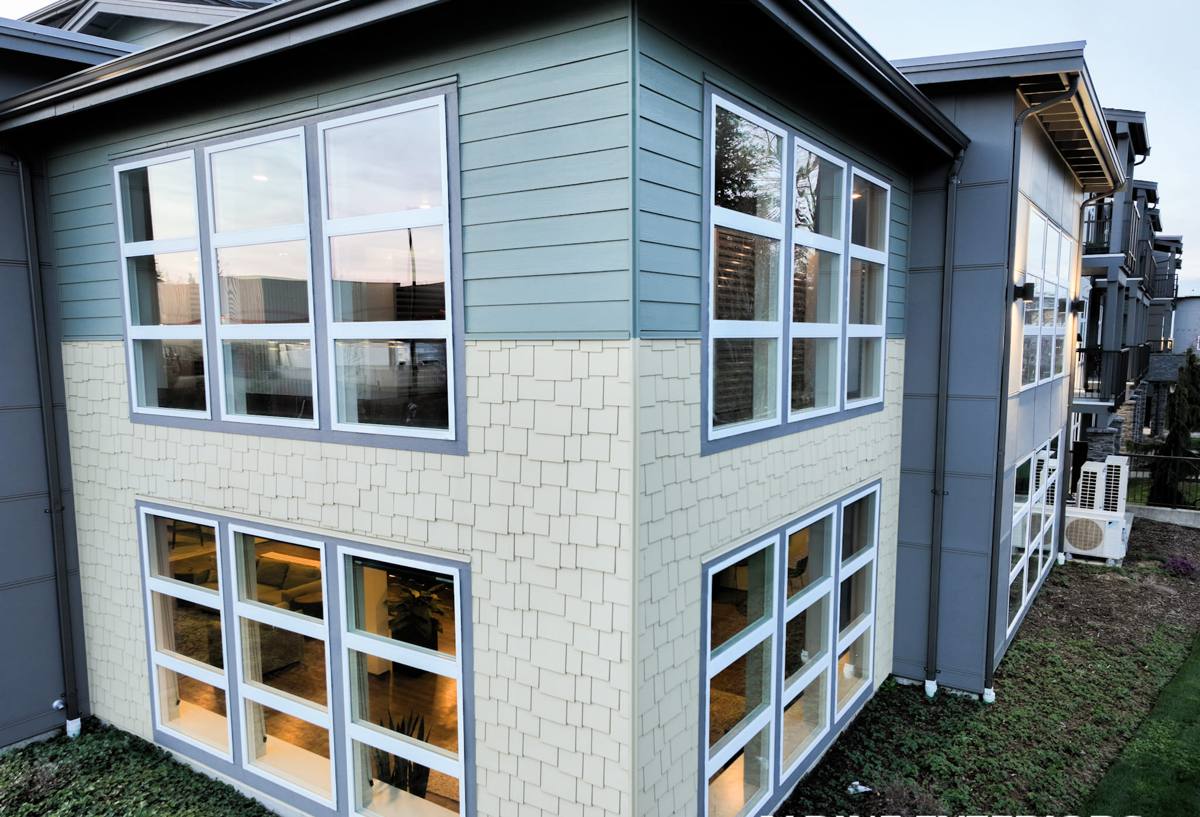
Why Fiber Cement Fits Riverside Specifically
Fiber cement siding is cement, sand, and cellulose fiber pressed and cured into a dense, stable board. It doesn't absorb water the way wood-based products do, it doesn't expand and contract with humidity swings the way vinyl does, and it holds paint and factory finish far longer than either. For a property dealing with river humidity and salt air, that stability is the whole point.
- Won't rot from trapped moisture — no organic wood fiber core to break down when water sits against it during a wet Skagit winter.
- Handles salt exposure better than raw wood or thin vinyl — the cement-based composition doesn't corrode or pit the way some materials degrade under coastal-adjacent conditions.
- Resists moss and algae staining — a properly finished fiber cement surface sheds spores better and cleans up easier than porous wood siding.
- Stays dimensionally stable — it doesn't swell, cup, or warp with the seasonal humidity swings common along the river.
We install James Hardie fiber cement exclusively — not because it's the only fiber cement product on the market, but because it's the one we're willing to put our name behind after years of comparing how different products hold up in this exact climate. Hardie engineers specific product lines for regional moisture and climate conditions, backs the finish with a real factory warranty, and has a long enough track record in the Pacific Northwest that we can speak to how it performs, not just how it's marketed.
Where Generic Fiber Cement Claims Fall Short
Not all fiber cement is equal, and "fiber cement" on a spec sheet doesn't tell you much by itself. Board density, the quality of the factory finish, and how the manufacturer engineers the product for wet climates all vary. A board that's fine in a dry inland market can perform noticeably worse on a property that sees Riverside's rain totals and salt exposure. This is part of why we standardized on one manufacturer rather than installing whatever a supplier has in stock.
What a Correct Fiber Cement Install Actually Involves
Fiber cement's durability depends almost entirely on installation quality. A great board installed wrong will fail early in exactly the ways people wrongly blame on the material. Here's what we consider non-negotiable on every Riverside job:
Water Management Before the Siding Goes On
- A drainable weather-resistant barrier behind the siding, not stapled flat against the sheathing — this gives incidental moisture a path down and out instead of a place to sit.
- Proper flashing at every window, door, and roof-to-wall intersection, lapped correctly so water sheds outward at each layer.
- Rainscreen gap or furring where the wall assembly calls for it, so the back side of the siding can dry instead of staying damp against the sheathing.
Fastening and Joints
- Correct nail type, spacing, and depth — overdriven or underdriven fasteners are one of the most common causes of early failure on fiber cement.
- Butt joints sealed and, where possible, backed with flashing rather than caulk alone.
- Manufacturer-specified clearances at the ground, roofline, and any hardscaping, so the board never wicks standing moisture.
Finish and Long-Term Protection
- Factory-applied ColorPlus finish wherever possible, since it's cured and baked at the plant rather than applied on-site, giving far better color retention and moss/mildew resistance over time.
- Touch-up paint matched to the ColorPlus system used only at cut edges and any field-painted trim, per Hardie's specifications.
Skip any one of these steps and you can end up with siding that looks fine for a year or two, then starts showing staining, swelling at joints, or paint failure — problems homeowners often blame on the siding brand when the real cause was how it was put on the wall.
Our Process for a Riverside Fiber Cement Project
- On-site assessment. We walk the property, check the current siding and water management (or lack of it), look at sun/shade exposure that drives moss growth, and note any framing or moisture issues under the existing siding.
- Written scope and product selection. We spec the correct Hardie line and plank profile for the home, plan flashing details at every penetration, and give you a clear written estimate — no vague allowances.
- Tear-off and substrate check. Old siding comes off, sheathing is inspected for hidden rot or moisture damage, and any needed repairs happen before a single new board goes up.
- Weather barrier and flashing installation. This is the step that determines how the siding performs in 10 years, not just how it looks in month one.
- Siding installation to manufacturer spec. Correct fastening, joint treatment, and clearances throughout.
- Final walkthrough. We go over the finished work with you, including basic care and what to watch for seasonally.
Why Hiring a Crew That Already Works Riverside Matters
Riverside isn't a generic Skagit County lot on paper. Crews who haven't worked this specific area sometimes underestimate how much wind-driven rain a wall actually sees, or how aggressive moss growth gets under mature tree cover near the river. That shows up later as under-flashed penetrations, missing rainscreen gaps, or standard clearances that don't account for local drainage patterns.
A crew that has already put Hardie siding on homes in this neighborhood knows which details to be stricter about here than they might be on a drier, more sheltered job elsewhere in the county. That's not a marketing point — it's the difference between a siding job that looks right at handoff and one that actually holds up through a decade of Skagit winters.
Cost Factors for a Riverside Fiber Cement Project
Every home is different, but the line items that move the price on a Riverside job tend to be the same ones every time:
| Factor | Why It Matters Here |
|---|---|
| Existing wall condition | Hidden moisture damage from years of rain exposure sometimes means sheathing repair before siding can go on |
| Home size and complexity | More corners, dormers, and window/door penetrations mean more flashing detail work |
| Product line and profile | Hardie offers multiple plank styles and textures; some cost more per square foot than others |
| ColorPlus vs. field paint | Factory finish costs more upfront but holds color and resists moss staining longer in this climate |
| Rainscreen/furring requirements | Homes with heavier moisture exposure may need this added drainage layer, which adds labor |
| Access and site conditions | Mature landscaping, sloped lots, or tight setbacks near the river can add time and equipment needs |
We give a firm, written number after the on-site assessment — not a phone estimate — because these factors genuinely vary house to house even within the same neighborhood.
Signs Riverside Homeowners Should Watch For
- Dark streaking or green/black staining that keeps returning within a season or two of cleaning — a sign moss and algae have a foothold the current siding can't shed.
- Soft spots, bubbling paint, or visible swelling at board seams — often a sign of trapped moisture behind the siding, not just a surface issue.
- Gaps opening up at caulked joints or trim — caulk is a maintenance item, not a permanent water barrier, and it fails faster in this climate than in drier regions.
- Visible fastener rust or popped nail heads — a sign of incorrect fastening that will only get worse.
Any of these are worth a look before they turn into sheathing or framing repairs, which cost far more than the siding itself.
If you're seeing any of these signs on a Riverside home, or you're just planning ahead for a siding replacement, we're happy to come take a look and walk you through what your home actually needs. The estimate is free, there's no pressure, and you'll get a straight answer about what's going on with your walls — use the form below to get started.