 Mount Vernon
 Why Decks in Avon Wear Out Faster Than Homeowners Expect
Avon sits in the low, flat river-bottom country just west of Mount Vernon, and that geography shapes what a deck has to survive out here. The ground stays damp longer into the season than it does up on higher ground, morning fog off the river and nearby water lingers under tree cover, and a long moss season means anything horizontal — decking boards, stair treads, railing caps — collects a film of green growth for months at a stretch if it isn't detailed to shed water and dry out. Add in driving rain that comes sideways during fall and winter storms, plus the salt-laden air that reaches inland across Skagit County from Puget Sound and Padilla Bay, and you have a combination that's genuinely harder on a deck than what homes see in drier parts of the state.
None of that means a deck in Avon is doomed to fail early. It means the framing, fasteners, and decking material all have to be chosen and installed with that climate in mind, not just built to a generic spec. A deck that was built correctly for this environment should last decades. One that was built with the wrong hardware or no ledger flashing usually shows soft spots, rust streaks, and rot at the house connection well before it should.
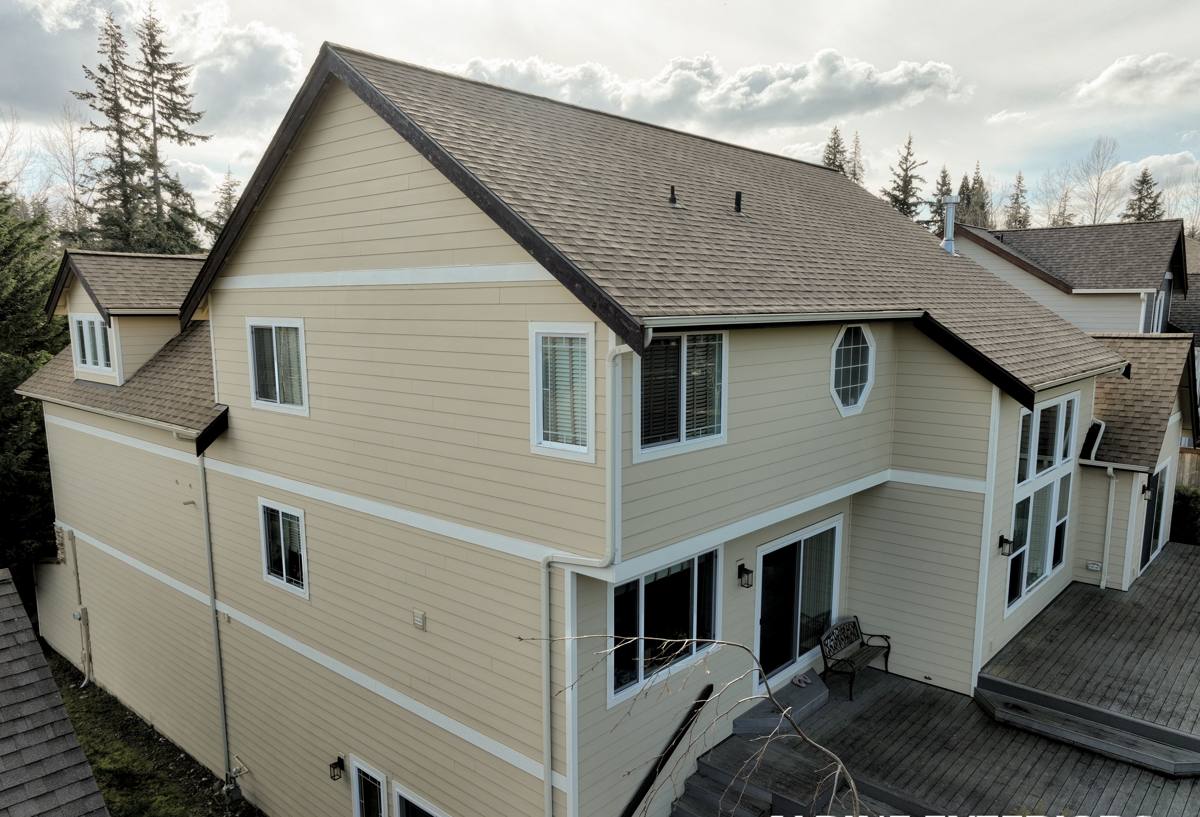
What a Correct Deck Replacement Involves Here
The Ledger Connection
The single most common failure point on any deck attached to a house is the ledger board — the framing member bolted to the rim joist of the house. If it wasn't flashed properly when the deck was originally built, water gets behind it every time it rains and works its way into the house framing. In a climate with as much driving rain as Avon gets, an unflashed or poorly flashed ledger is a matter of when, not if, it starts causing rot. Every deck we replace gets a proper ledger flashing detail — metal flashing that directs water out and away from the house, with a gap or drainage plane so trapped moisture has somewhere to go.
Framing and Fasteners
Standard galvanized deck screws and joist hangers are fine in a dry climate. In an area that gets salt-tinged air and stays damp for long stretches, we spec hot-dip galvanized or stainless steel hardware for structural connections, and post bases that hold the wood posts up off the concrete footing rather than letting them sit directly in standing water after a storm. Cheaper coated fasteners can start showing rust bleed within a couple of years out here — that's a maintenance and appearance problem now, and a structural one later.
Footings
Frost depth isn't the concern it is elsewhere in the country — Skagit Valley winters are mild. The real issue with footings in low-lying areas like Avon is soil that stays saturated for much of the year. Footings need to be sized and set correctly for load-bearing capacity in soil that doesn't always drain quickly, and we check existing footings during replacement rather than assuming the old ones are adequate for a new deck's load and layout.
Choosing the Right Decking Material for This Climate
There's no single "best" decking material — there's a best fit for your budget, your maintenance appetite, and how much sun versus shade your deck gets. Here's how the common options actually perform in a wet, moss-prone, moderately salty climate like Skagit County's:
| Material | Upfront Cost | Maintenance | How It Handles This Climate |
|---|---|---|---|
| Pressure-treated lumber | Lowest | Annual cleaning, re-sealing every 1-2 years | Rot-resistant when sealed and maintained; moss and mildew show quickly if neglected |
| Cedar | Moderate | Regular sealing/staining to keep look and resist moisture | Naturally moisture-resistant and handsome, but needs upkeep or it grays and softens faster in constant damp |
| Composite decking | Higher | Occasional washing, no sealing/staining | Doesn't rot or splinter; textured boards resist algae film better than smooth ones, but low-airflow areas still need cleaning |
| PVC/capped polymer | Highest | Lowest — soap and water | Fully moisture-immune surface; best choice for shaded, damp, low-clearance decks that never fully dry out |
We won't push a homeowner toward the most expensive option if a well-maintained cedar or treated-wood deck fits their budget and they're willing to keep up with sealing. Our job is to lay out the real maintenance trade-off honestly so you're picking based on how much upkeep you actually want to do, not a sales pitch.
Substructure and Drainage Details That Actually Matter
A lot of what determines whether a deck stays moss-free and structurally sound for 20+ years happens where you can't see it once the project is done:
- Joist tape over the tops of framing lumber to keep water from soaking into end grain and fastener holes
- Board spacing sized correctly for the decking material so water sheds instead of pooling in the gaps
- Adequate clearance and airflow underneath the deck so the underside can dry out between rain events instead of staying damp all season
- Grading and drainage away from footings so water doesn't pond under the structure after a storm
- Stair stringers and ledger areas checked for the same rot risk as the main frame — these get missed in a lot of older builds
Low-clearance decks — common on homes built close to grade, which is typical in the flatter parts of Avon — are the ones most prone to moss and mildew because there's less airflow underneath. On those, we sometimes recommend a slightly different board profile or added ventilation gaps specifically to fight that.
Permits and Local Code Considerations
Deck replacements in unincorporated Skagit County areas like Avon go through the county's permitting process rather than the City of Mount Vernon's, and the requirements can differ depending on your exact parcel — including whether it falls within a floodplain overlay, which is a real consideration given how close much of this area sits to the river system. Guardrail height, baluster spacing, stair geometry, and footing depth all have to meet current code even if the deck you're replacing was built under an older standard. We handle the permit application and inspection scheduling as part of the job so you're not the one tracking down county requirements.
Signs Your Deck Needs Replacing, Not Just Repairing
Not every tired-looking deck needs a full tear-off. Here's a rough guide to when repair stops making sense:
- Soft or spongy spots in decking boards, especially near the house or stairs
- Rust streaking from fasteners or visibly corroded joist hangers
- A ledger board with no visible flashing, or gaps where water clearly tracks behind it
- Posts that have shifted, or a frame that feels bouncy or unlevel underfoot
- Persistent moss or black staining that comes right back within weeks of cleaning
- Structural members you can probe with a screwdriver and feel give
If it's mostly surface graying or a few loose boards on an otherwise sound frame, repair or resurfacing can be the right call. If the framing or ledger connection is compromised, replacement is the honest answer — patching around rotten structure just delays the real cost and adds risk.
Our Process, Start to Finish
- On-site assessment: We inspect the existing deck's framing, ledger connection, footings, and decking to see what's actually failing versus what's cosmetic.
- Written estimate: A clear scope and price before any work starts, including material options at different price points.
- Permitting: We pull the required permit and schedule inspections so the job meets current Skagit County code.
- Demo and structural check: Old decking and framing come off; we check the rim joist and house connection for hidden rot before rebuilding.
- Rebuild: New framing with corrosion-resistant hardware, proper ledger flashing, and drainage detailing, followed by decking and railings.
- Final walkthrough: We go over the finished deck with you and cover basic care for whatever material you chose.
Why Hire a Crew That Already Works in Avon
A contractor who mostly works drier inland areas or hasn't dealt with Skagit County's floodplain and permitting quirks will often build to a generic spec — and a generic spec isn't enough for a deck that has to shed driving rain, resist a long moss season, and hold up to salt-tinged air year after year. Knowing which fastener grade actually holds up here, which decking profile fights algae film best in a low-clearance, shaded yard, and how the county's permitting works for this specific area saves you from paying twice — once for a deck that looks fine at handoff, and again a few years later when the framing you couldn't see starts to go.
If your deck in Avon is showing its age — or you're just ready to stop maintaining a high-upkeep material — we're happy to take a look and give you a straight assessment. Reach out for a free, no-pressure estimate using the form below.