 Mount Vernon
 Clear Lake homeowners looking into new siding usually start with a simple question: what actually holds up out here? The honest answer depends less on brand names and more on how a product handles sustained moisture, because that's what this stretch of Skagit County delivers most of the year. This page covers James Hardie fiber cement siding specifically for Clear Lake properties — what the local climate demands from it, what a correct installation actually looks like, and how our process works from the first site visit to the final walkthrough. We only install James Hardie, so everything below reflects what we've learned putting this one product on homes in this one climate, not a generalist's take on siding in general.
What Clear Lake's Climate Actually Does to Siding
Clear Lake sits inland from the water, but it doesn't sit outside the weather pattern that defines Skagit County. Salt air off the broader Puget Sound region carries further inland than most homeowners expect, especially during winter storms, and it contributes to corrosion on fasteners, flashing, and other exposed metal even on homes with no water view at all. Layer in driving rain — wind-pushed moisture that hits siding at an angle instead of straight down — and you get water finding its way into laps, seams, and fastener holes that would stay dry in a calmer climate. Add a moss season that stretches across most of the year on shaded, tree-lined lots common around the lake, and you have three separate stresses working on the same wall at the same time.
None of that makes Clear Lake an unusually hard place to keep a house dry. It does mean the siding and the work behind it have to be built for sustained exposure rather than occasional weather. A product that performs fine in a drier climate on a marginal install can still look fine here for a few years — the problems just take longer to surface, and by the time they do, they're usually behind the siding rather than on top of it.
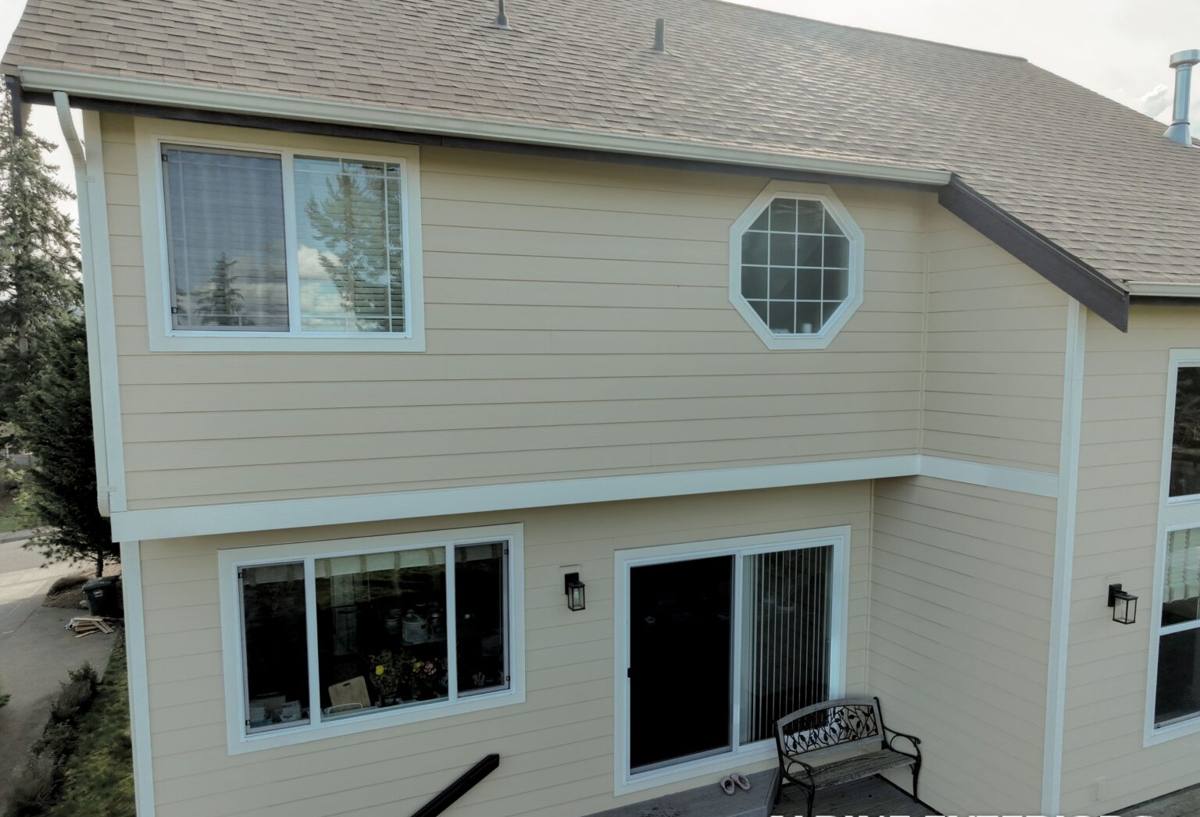
Why We Install Only James Hardie Here
We install James Hardie fiber cement exclusively — no vinyl, no LP SmartSide, no primed wood, no cedar. That's a deliberate standard, not a sales preference, and it comes from watching what each of those materials does over time in this specific climate.
Where the Other Options Fall Short in This Climate
Vinyl depends entirely on the weather barrier behind it staying intact, since the panels themselves are not a true water seal, and it can become brittle with age under repeated UV and temperature cycling — a real issue with the wind loads that come through open, lake-adjacent lots. LP SmartSide and other engineered wood products use a wood-strand core that performs well when it's dry but is vulnerable at any cut edge, fastener hole, or seam that loses its seal, which is a harder standard to maintain in a climate where driving rain is routine rather than occasional. Primed wood and cedar can look excellent going up, but both require an ongoing maintenance cycle — recoating, caulk renewal, moss treatment — that gets more demanding, not less, in a climate with a moss season this long. None of these are bad products in every setting. We just don't think they're the right call for Clear Lake, and we'd rather say that plainly than sell something we don't expect to hold up.
Fiber cement has no organic core, so it doesn't absorb and swell the way wood-based products do when it stays damp for extended stretches. James Hardie's ColorPlus finish is baked on at the factory under controlled conditions rather than field-applied, which means it resists the fading and chalking that site-applied paint jobs tend to show after repeated wet-dry cycling. That combination — an inorganic substrate and a factory finish — is why it's the only siding we put on a Clear Lake home.
James Hardie Product Lines We Install
| Product Line | Best Fit | Why It Fits Clear Lake |
|---|---|---|
| HardiePlank Lap Siding | Most single-family homes | Smooth or cedar-textured finish; the most common choice on Clear Lake properties |
| HardiePanel Vertical Siding | Modern facades, gable accents | Fewer horizontal laps to seal, often paired with lap siding as an accent |
| HardieShingle | Craftsman and cottage-style homes | Straight-edge or staggered profiles that read as cedar shake without the maintenance |
| HardieTrim | Corners, window and door surrounds | Matches the siding's water resistance instead of pairing fiber cement with a weaker wood trim |
All four lines are available in ColorPlus factory finish, and for this part of Skagit County we typically spec the HZ5 formulation, which James Hardie engineers specifically for climates with sustained moisture exposure. That's not an upsell — it's the version of the product built for a Pacific Northwest wall, not a national one-size-fits-all spec.
What a Correct Installation Involves
The siding itself is only part of the system. The details behind and around it are what determine whether a Clear Lake home stays dry for the next thirty years or starts showing problems at year eight. These are the ones we treat as non-negotiable, not optional upgrades.
Clearances and Drainage
James Hardie's installation instructions specify minimum clearances between the bottom of the siding and rooflines, decks, patios, and grade. In a climate with this much sustained rain, a board installed too close to a deck ledger or a roof line becomes a moisture trap that wicks water into the cut edge over time — one of the more common causes of siding failure we see on older, out-of-spec installs.
Rainscreen and Drainage Plane
A drainage gap behind the siding lets any moisture that does get past the surface drain and dry out instead of sitting against the wall assembly. In a climate where the ground can stay damp for weeks at a stretch, that gap is the difference between water that leaves the wall and water that stays in it.
Fastening and Flashing
Nails need to be the correct type, driven to the correct depth, at the manufacturer's spacing, and kept the proper distance from board ends — overdriven or misplaced fasteners affect both wind performance and warranty coverage. Around every window, door, and roof-to-wall intersection, flashing has to be integrated correctly with the weather-resistive barrier underneath the siding, because that's the layer actually keeping wind-driven rain out of the wall cavity. None of this shows up as a line item on a siding estimate, but it's most of what separates a wall that performs from one that doesn't.
Cut-Edge Sealing
Every field cut on ColorPlus-finished board exposes raw fiber cement that has to be sealed or touched up with James Hardie's approved products — not general-purpose paint. It's a small step that a crew doing this product every day treats as routine and a crew treating Hardie like just another siding tends to skip.
How Our Process Works
- Site visit and assessment. We look at the existing siding, note what we can reasonably infer about the condition underneath before tear-off, and talk through product line, color, and any trim or accent decisions specific to your home.
- Written estimate. Scope, product line, HZ formulation, and warranty terms are spelled out in writing before anything is scheduled — no verbal-only quotes.
- Tear-off and inspection. Old siding comes off and the sheathing and weather barrier underneath get inspected. If we find rot or moisture damage, we tell you before we cover it back up, not after.
- Flashing and drainage plane installation. This is the step that determines long-term performance, and it happens before a single piece of visible siding goes up.
- Hardie installation to spec. Clearances, fastening pattern, and cut-edge sealing follow the manufacturer's published instructions, not shortcuts.
- Documentation and walkthrough. We photograph the flashing and drainage work before it's covered, and you get the manufacturer's warranty paperwork plus our workmanship warranty in writing at the end.
What Hardie Siding Costs to Install in Clear Lake
Every quote should reflect your specific house, but the factors below are what actually move the number, and understanding them makes it easier to compare bids honestly.
| Factor | How It Affects the Job |
|---|---|
| Existing siding removal | Tear-off of old vinyl, wood, or damaged fiber cement adds labor and sometimes reveals sheathing repairs |
| Home size and wall complexity | Square footage sets the baseline; dormers, gables, and multiple roof planes add cutting and flashing time |
| Product line mix | Straight lap siding is the most efficient install; shingle profiles and mixed panel/lap accents take longer |
| Trim scope | Full HardieTrim window and corner packages cost more than reusing sound existing trim |
| Color and finish | Factory ColorPlus finishes are priced by line; custom field-painted finishes are a separate cost path |
| Site access | Lakeside lots, steep grades, or heavy tree cover can slow staging and scaffolding |
We won't quote a number without seeing the house, but we will walk through exactly which of these factors apply to yours before you sign anything.
Why the Warranty Depends on the Installer, Not Just the Product
James Hardie backs its siding with a 30-year non-prorated product warranty, and the ColorPlus finish carries its own separate finish warranty. Both are strong on paper, but both are conditioned on the product being installed to James Hardie's published instructions. An out-of-spec install — wrong clearances, wrong fastening, missing flashing — doesn't just perform worse over time. It can leave a homeowner with a warranty claim that gets denied because the installation itself was the problem, not the material. Because we install this one product exclusively, every crew member and every job follows the same spec, which is exactly what keeps that warranty intact if it's ever needed.
Why Hiring a Crew That Already Works Clear Lake Matters
A contractor who's done Clear Lake jobs already knows the practical realities before they walk the property: which lots hold moisture longest under tree cover, where salt-influenced corrosion shows up on fasteners even away from open water, and how driving rain behaves against a wall on an open, lake-adjacent lot versus a sheltered one. That's not something a crew from outside the region picks up on a single site visit — it's pattern recognition built from doing this specific climate's work repeatedly. It also means shorter response times if something needs a follow-up look, and a contractor with an actual local reputation to protect rather than a one-time job to finish and leave.
Questions Worth Asking Any Contractor Before You Hire
- Do they install James Hardie as their primary product, or as one option among several different materials?
- Can they explain, specifically, how they handle clearances and drainage planes — not just "we follow code"?
- Are they licensed, bonded, and insured to do exterior work in Washington State, and can they show current proof?
- Do they document flashing and moisture-barrier work with photos before it's covered by siding?
- Will the manufacturer's product and finish warranties and the contractor's own workmanship warranty be provided in writing?
- Have they done recent work specifically in the Clear Lake or greater Mount Vernon area you can ask about?
If you're weighing James Hardie siding for a Clear Lake home, or you already have fiber cement on the house and want an honest read on how it was installed, the estimate is free and there's no pressure attached to it. Use the form below and we'll set a time to look at the house and give you a straight answer.