 Mount Vernon
 Building Decks for Life on Big Lake
Big Lake sits in a pocket of Skagit County that gets more shade, more standing moisture, and more moss pressure than a lot of the surrounding area. Homes ring the lake closely, tree cover is heavy in most yards, and the ground near the water tends to stay damp long after the rest of the county has dried out. A deck built here has to deal with all of that at once — not just support weight and look good, but shed water, resist rot, and survive a moss season that can run from October well into spring.
We've built and repaired decks all over the Mount Vernon area, and the ones that fail early almost always fail for the same reasons: a ledger board that wasn't flashed correctly, framing lumber that wasn't rated for ground contact or exposure, or a footing system that wasn't matched to the soil it sits in. None of that shows up on day one. It shows up in year three or four, usually as soft spots near the house, black staining under the rail posts, or a deck that's started to sag toward the low side of the yard.
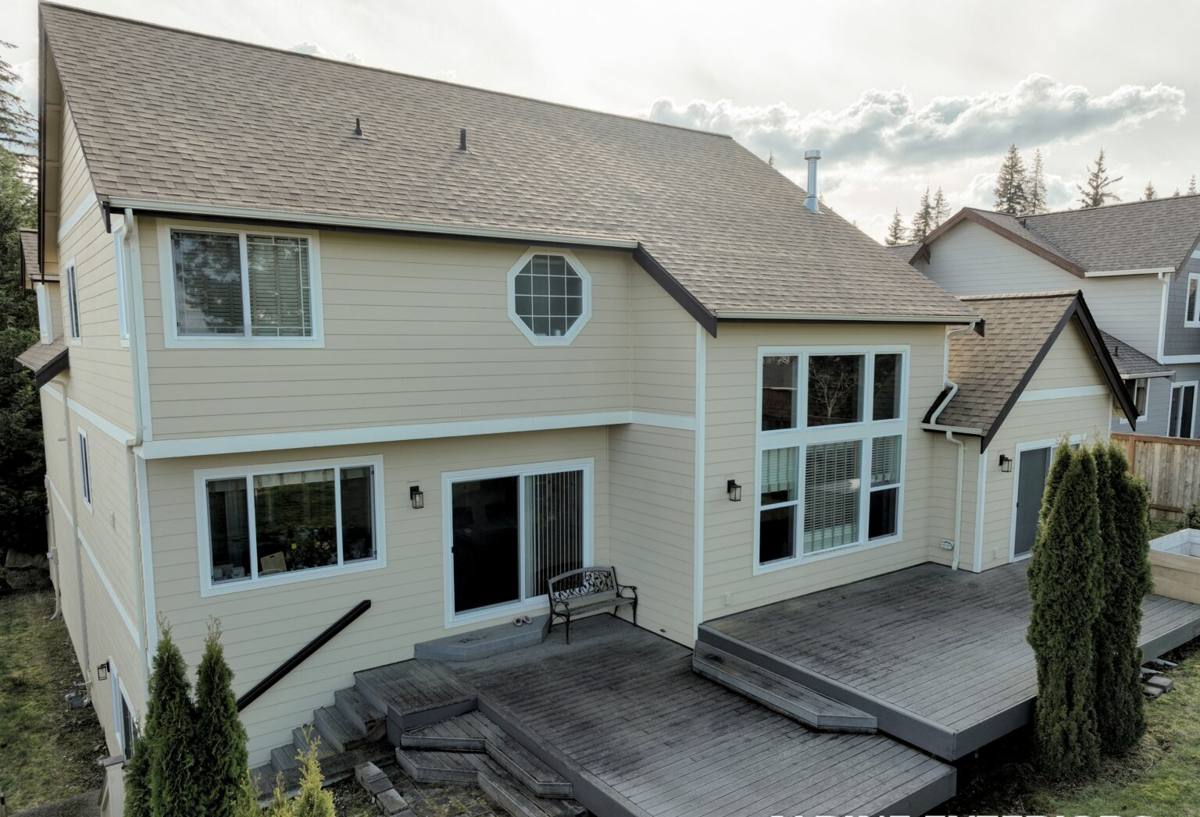
What Big Lake's Climate Actually Does to a Deck
Moisture that doesn't leave
Between lake humidity, tree canopy, and Skagit County's long wet season, decks around Big Lake often stay damp for days after a storm even when nearby open lots have dried. That extended dampness is what drives rot, not the rain itself — a board that gets wet and dries fast rarely fails, one that stays wet does.
Moss and algae, not just on the roof
Homeowners expect moss on their roof here, but it grows just as readily on shaded decking, especially on the north side of a house or under overhanging trees near the water. Moss holds moisture against the board surface and turns a dry deck into a wet one almost year-round. It also makes stairs and low platforms genuinely slick, which is a safety issue, not just a cosmetic one.
Ground and drainage near the water
Soil close to Big Lake tends to be softer and higher in water table than soil up on the surrounding slopes. Standard footings that work fine a half mile away can settle unevenly here if they're not sized and set correctly for the actual soil conditions on your lot.
Corrosion from the marine-influenced air
Skagit County's proximity to Puget Sound and the Samish Bay corridor means a steady marine influence runs through the whole region, Big Lake included — enough to accelerate corrosion in ungalvanized fasteners and cheap hardware over time. It's not the same salt exposure as a beachfront property, but over a decade it adds up, especially on hardware that's exposed and never gets wiped down.
What a Correctly Built Deck Involves
A deck that's actually built to last around Big Lake comes down to a handful of details done right, not a long list of upgrades. Here's what we consider non-negotiable:
- Ledger flashing: a properly integrated ledger flashing detail (not just caulk) where the deck attaches to the house — this is the single most common failure point we find on older decks in wet climates.
- Footings sized for the soil: footings set below frost depth and sized to the soil conditions on your specific lot, not a one-size-fits-all pour.
- Framing lumber rated for exposure: pressure-treated framing rated for ground contact where it's within a few inches of soil or standing water, not just standard treated stock.
- Corrosion-resistant fasteners: stainless steel or heavy hot-dip galvanized fasteners and structural hardware throughout, matched to the decking material so they don't react with it.
- Airflow underneath: enough clearance and ventilation under the deck that the framing can actually dry out between storms instead of sitting in trapped humidity.
- Drainage away from the house: grading and gutter tie-ins that move water away from the foundation and footings instead of pooling near them.
Choosing a Decking Material for Big Lake Conditions
There's no universally "right" decking material — there's the right material for your yard's shade, your maintenance appetite, and your budget. Here's how the common options actually perform in a shaded, damp, moss-prone setting like Big Lake:
| Material | How it handles moss & moisture | Maintenance | Typical lifespan here |
|---|---|---|---|
| Pressure-treated wood | Prone to moss and algae in shade; needs regular cleaning | Annual cleaning, periodic staining/sealing | 10–15 years with upkeep |
| Cedar | Naturally more rot-resistant, still grows moss in deep shade | Regular oiling/sealing to hold color and resist checking | 15–20 years with upkeep |
| Composite (wood-plastic blend) | Better moisture resistance than wood; can still get slick with algae film | Periodic washing, no sealing/staining needed | 20–25+ years |
| PVC / cellular composite | Best resistance to moisture absorption; least prone to rot | Occasional washing | 25+ years |
In heavily shaded yards close to the water, we generally steer clients away from bare pressure-treated wood as a primary surface unless they're genuinely committed to yearly cleaning and re-sealing. It's not that treated lumber is a bad product — it's that a shaded, damp deck punishes any material that depends on a maintained surface coating to stay dry. That's a maintenance-and-moisture trade-off we're upfront about, not a knock on the product itself.
Footings, Ledgers, and the Site-Specific Decisions
Every Big Lake lot we've worked on has had its own quirks — some have firm, well-drained soil twenty feet from the water and soft, spongy soil right at the shoreline edge. Before we finalize a footing plan, we look at:
- How close the deck footprint sits to the lake or to any low, wet part of the yard
- Whether the existing soil can support standard concrete footings or whether helical piers make more sense for softer ground
- How the deck ties into the house — where the ledger attaches, what's behind that wall, and whether existing flashing or siding needs to be opened up and redone correctly
- Where water naturally moves through the yard, so the new deck doesn't dam it up against the foundation
None of this is guesswork we do on-site with a shovel. It's a walk-through before we ever price the job, because guessing on a footing plan near water is how decks end up leaning within a few years.
Permits and Setbacks Near the Water
Properties near Big Lake can fall under Skagit County shoreline and critical area rules depending on how close the structure sits to the water, which is a different review path than a standard inland deck permit. We don't guess on this — we check the specific setback and permit requirements for your lot with the county before we finalize a design, so you're not stuck redesigning a deck after it's already framed. If your property doesn't trigger shoreline review, the permit process is the standard county deck permit, but we still pull it properly rather than skipping it, since an unpermitted deck can complicate a future home sale or insurance claim.
Our Process
1. Site visit and design
We walk the actual lot — sun exposure, tree cover, drainage patterns, distance to the water — and design the deck around what that specific yard is going to throw at it, not a generic template.
2. Honest material conversation
We'll tell you straight which materials make sense for your yard's shade and moisture level, and which ones will fight you every year if you go with the cheaper option in a heavily shaded spot.
3. Permitting
We handle the county permit application, including checking whether your lot's proximity to Big Lake triggers additional shoreline or critical-area review.
4. Build
Footings, framing, ledger flashing, decking, and railing, built to the details above — not a rushed weekend job with corners cut on what's underneath the boards.
5. Walkthrough
We go over the finished deck with you, including what maintenance it actually needs given where it sits on your property.
Cost Factors on a Big Lake Deck
Every deck is priced on its own specifics, but the things that most commonly move the number up or down on lots in this area are:
| Factor | Why it affects cost |
|---|---|
| Footing type (standard concrete vs. helical piers) | Soft or high-water-table soil near the lake sometimes requires piers, which cost more than standard poured footings |
| Height and grade change | Decks built on sloped lots down toward the water need more substructure and railing to meet code |
| Decking material | Composite and PVC cost more upfront than wood but need far less maintenance over time |
| Ledger and siding work | If old siding or flashing has to come off to tie the ledger in correctly, that's added labor most quotes skip |
| Permit/review path | Shoreline or critical-area review can add time (not usually major cost) if your lot is close enough to trigger it |
Simple maintenance checklist for a Big Lake deck
- Sweep off leaves and debris regularly, especially in shaded corners where moss gets a foothold first
- Wash the surface at least once a year to clear algae film before it becomes slick moss growth
- Check the ledger flashing and any caulked joints each spring for gaps or cracking
- Keep gutters and downspouts near the deck clear so runoff isn't dumping straight onto the structure
- Look underneath once a year for standing water, soft framing, or fastener corrosion
Why a Crew That Already Works Big Lake Matters
A deck built by someone unfamiliar with this specific stretch of Skagit County will often use the same footing plan, the same ledger detail, and the same decking recommendation they'd use on a dry, sunny lot across town. That's how decks around the lake end up with moss problems by year two and soft ledger connections by year five. We already know which yards around Big Lake stay damp longest, which lots have soft soil near the water, and which permit questions the county is going to ask before we even submit an application. That local knowledge doesn't show up as a line item on a quote, but it's the difference between a deck that needs real work in five years and one that's still solid in twenty.
If you're planning a new deck or replacing one that's failing near Big Lake, we're happy to come take a look, walk the site with you, and give you a straight assessment — no pressure, no upsell, just what your specific lot actually needs. Reach out for a free estimate using the form below.