 Mount Vernon
 Why Avon's Climate Is Hard on Windows
Avon sits low in the Skagit River delta, out on open farmland between Mount Vernon and the water. That location gives the community some of the most productive soil in the state — and some of the toughest conditions a window has to survive. There's less tree cover and fewer buildings to break up wind out here than in town, so weather hits homes with more force and less resistance. If your windows are original to the house, or even just fifteen to twenty years old, there's a good chance they're already losing the battle.
Salt Air and Metal Components
Avon's proximity to Puget Sound and the bay puts a steady trace of salt in the air, even a few miles inland. Salt-laden moisture is hard on window hardware — hinges, locks, balances, and screen frames — and it accelerates corrosion on anything that isn't built or coated to resist it. Over years, that shows up as stiff cranks, locks that won't seat, and pitting on aluminum trim.
Wind-Driven Rain and Water Intrusion
Open exposure means rain doesn't just fall on Avon homes, it gets driven sideways into window assemblies during storms. A window that's watertight in a light shower can still leak under wind-driven rain if the flashing, sealant, or fit isn't right. That's the failure mode we see most often on service calls out here — not a window that's simply old, but one that was never properly integrated with the wall behind it.
A Long, Wet Season
Skagit County's wet season runs long, and the humidity that comes with it doesn't let up quickly. Wood sashes and sills that stay damp for weeks at a stretch are prone to swelling, sticking, and eventually rot. Persistent moisture also feeds the moss and mildew that show up on north-facing glass, sills, and frames — more of a maintenance nuisance than a structural threat on its own, but a sign that moisture is sitting where it shouldn't.
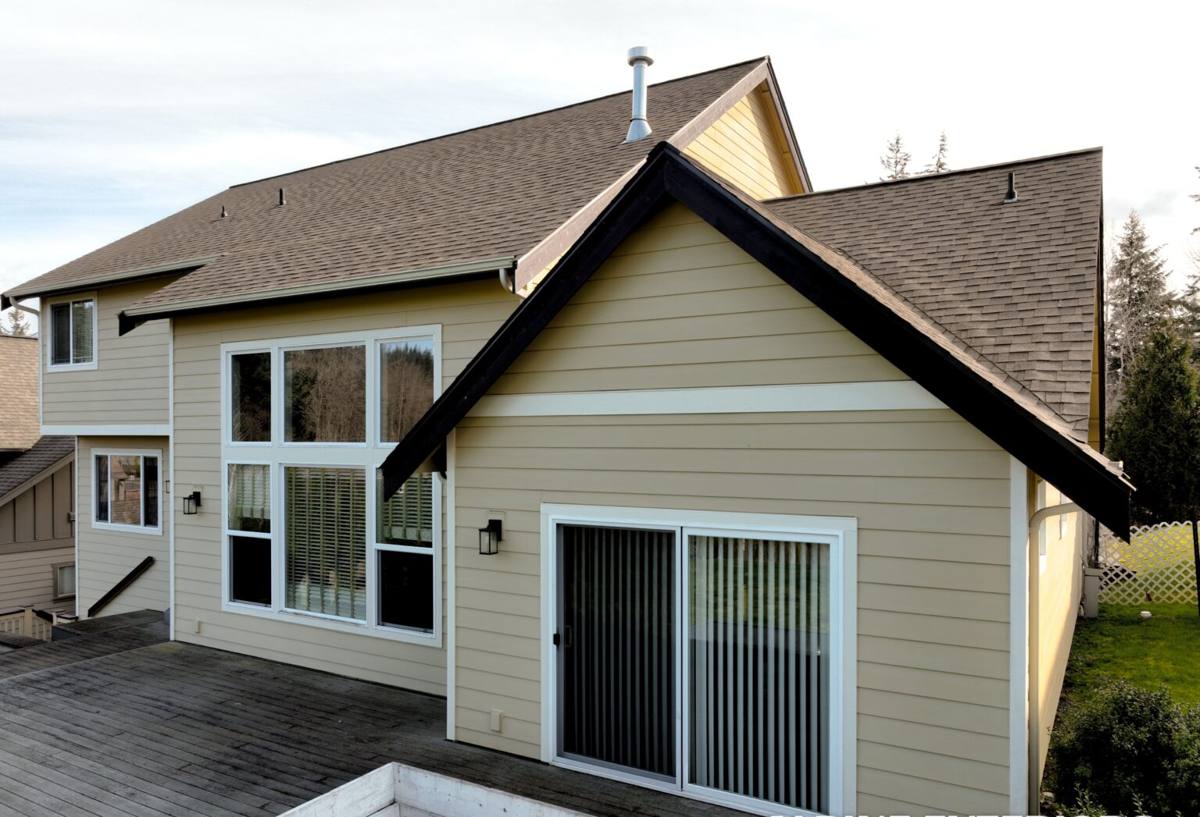
What "Energy-Efficient" Actually Means in a Window
It's a phrase that gets used loosely, so it's worth being specific. Every window sold today carries an NFRC label with real numbers behind it, and those numbers matter more than the marketing on the box.
The Numbers That Matter
- U-factor — how much heat escapes through the window. Lower is better; this is the main number for our climate, where keeping heat in matters more than keeping it out.
- SHGC (Solar Heat Gain Coefficient) — how much solar heat passes through the glass. Less critical here than in sunnier climates, but still relevant on south- and west-facing walls.
- Air leakage rating — how much air moves through the assembly itself, separate from the glass. This is often where an old, worn window is losing the most.
Glass Packages
Most energy-efficient replacement windows now use double-pane glass with a low-E coating and an inert gas fill (usually argon) between the panes. That combination cuts heat loss significantly compared to older single-pane or basic double-pane units. Triple-pane glass pushes performance further but adds cost and weight — worth discussing for specific rooms with unusual exposure, not something we push on every install by default.
Signs Your Current Windows Are Falling Behind
Homeowners usually notice a problem before they can name it. Here's what to look and listen for:
- Fogging or a permanent haze between the panes — the seal has failed and the gas fill is gone
- Noticeable draft near the window even with it fully latched
- Windows that are hard to open, close, or lock, especially after damp weather
- Visible gaps, cracked or missing caulk, or soft trim around the frame
- A cold wall or floor area near the window that the rest of the room doesn't share
- Condensation forming on the inside of the glass regularly during winter
- A heating bill that's crept up without any change in how the house is used
Any one of these on its own might just mean the window needs adjustment or new weatherstripping. Several together usually mean the unit has reached the end of its useful life.
What a Correct Installation Actually Involves
The window unit itself is only part of the job. In a climate like this, how it's installed determines whether it performs for twenty years or leaks within two.
Flashing and Water Management
Every opening needs to be flashed so that any water reaching the assembly is directed back out, not into the wall cavity. That means proper sill pan flashing, correctly lapped head and jamb flashing, and sealant placed to shed water rather than trap it. This is the step that gets rushed on cut-rate jobs, and it's exactly the step that matters most against Avon's wind-driven rain.
Fit, Shimming, and Insulation
A window needs to be square, plumb, and shimmed evenly so it operates smoothly and seals consistently around its full perimeter. The gap between the window frame and the rough opening should be insulated — not stuffed tight, which can bow the frame, and not left open, which creates an air path straight through the wall.
Interior and Exterior Sealant
Sealant is chosen and applied differently on the interior versus the exterior. The exterior seal keeps bulk water out; the interior seal manages air and vapor. Reversing that logic, or using one all-purpose caulk everywhere, is a common shortcut that causes moisture problems down the road.
Frame Material: What Holds Up in This Climate
Frame material affects how a window handles the combination of moisture, salt air, and temperature swings we get in this part of Skagit County.
| Frame Material | How It Handles Moisture & Salt Air | Maintenance |
|---|---|---|
| Vinyl | Won't rot or corrode; performs consistently in wet, salty conditions | Low — occasional cleaning |
| Fiberglass | Very stable dimensionally, strong resistance to moisture and corrosion | Low |
| Aluminum | Prone to corrosion and pitting in salt air over time; conducts cold | Moderate — hardware and finish need attention |
| Wood / wood-clad | Attractive but vulnerable to swelling and rot if the exterior seal ever fails | Higher — finish and joints need regular checking |
We don't refuse to install a given material — it's a legitimate choice for the right homeowner and the right application. But for a straight-up, low-maintenance, long-service-life window facing Avon's weather, vinyl and fiberglass are what we recommend first, and we'll explain the trade-offs honestly rather than just upselling.
Our Process for an Avon Window Project
- On-site assessment — we look at your existing windows, check for rot or hidden moisture damage around the openings, and measure accurately.
- Product selection — we go over frame material, glass package, and grille or hardware options based on your home and budget, without steering you toward the most expensive option by default.
- Scheduling around the weather — window replacement needs a dry work window. We plan installs to minimize how long any opening sits uncovered.
- Removal and inspection — old windows come out carefully so we can inspect the framing underneath before anything new goes in. If there's rot, we address it before installing, not after.
- Installation — proper flashing, shimming, insulation, and sealant, done in that order, every time.
- Walkthrough and cleanup — we test operation on every window, clean up the site, and go over care and warranty information with you.
What Affects the Cost
Every home is different, so we won't quote a number without seeing the job — but these are the main factors that move the price up or down:
| Factor | Why It Matters |
|---|---|
| Number and size of windows | More units and larger openings mean more material and labor |
| Frame material | Vinyl is typically the most budget-friendly; fiberglass and wood-clad cost more |
| Glass package | Triple-pane or specialty coatings add cost over a standard double-pane low-E unit |
| Condition of the existing opening | Rot or water damage found during removal means repair before the new window goes in |
| Access and site conditions | Second-story or hard-to-reach windows take more time and equipment |
| Full-frame vs. insert replacement | Full-frame replaces down to the rough opening; insert replacement reuses the existing frame where it's still sound |
Why It Matters to Hire a Crew That Already Works in Avon
Avon isn't a big town with a directory full of window specialists — it's a farming community where a lot of the housing stock shares a similar age and construction style. A crew that's already worked in the area knows what to expect before they pull the first old window: where moisture tends to collect on these homes, how the local wind patterns drive rain into certain wall orientations, and what permitting looks like through Skagit County for a straightforward window replacement versus a larger structural change.
That familiarity shows up in small but real ways — knowing to check a specific spot for hidden rot because it's a pattern we've seen on similar homes nearby, or timing a job around the weather realistically instead of optimistically. It also means we're not learning the area's quirks on your project. Mount Vernon and the surrounding Skagit Valley communities, Avon included, have their own weather personality, and experience here counts for something.
Keeping New Windows Performing
A well-installed, energy-efficient window is close to maintenance-free, but a little upkeep goes a long way in this climate:
- Clean tracks and weep holes periodically so water has a clear path out instead of pooling
- Rinse salt residue off exterior frames and hardware a few times a year, especially after storms
- Check and refresh interior and exterior caulk lines if you notice cracking or gaps developing
- Lubricate locks and cranks lightly if they start to feel stiff, rather than forcing them
- Keep an eye on moss buildup on sills and frames and clear it before it holds moisture against the surface
None of this takes much time, and doing it consistently is what keeps a good installation performing for decades instead of just years.
If your Avon home's windows are drafty, foggy, hard to operate, or just old enough that you're wondering, we're happy to take a look and give you an honest read on what's going on. Use the form below to request a free, no-pressure estimate — we'll walk the windows with you and lay out real options, not a sales script.