 Mount Vernon
 Why Anacortes Roofs Wear Differently Than Roofs Inland
Anacortes sits right where Skagit County meets the water, and that location changes how a roof ages. Salt-laden air corrodes exposed metal faster than it does even ten or fifteen miles inland — fasteners, flashing, and vent caps that would last decades in a dry climate can start rusting and staining within a few years if the wrong materials or installation details were used. Add in driving rain that comes sideways off the Sound during winter storms, and you've got wind-driven moisture finding its way under shingles, around chimneys, and into any flashing detail that wasn't sealed correctly the first time.
Then there's moss. Anacortes gets a long stretch of damp, shaded, mild-temperature weather every year — exactly the conditions moss needs to establish itself on north-facing slopes and anywhere tree cover blocks the sun. Moss isn't just cosmetic. Its root structure works into shingle granules and seams, holds moisture against the roof deck, and accelerates the same rot and granule loss that shortens a roof's usable life. A roof built and maintained without accounting for all three of these factors — salt air, wind-driven rain, and moss — tends to need replacement years earlier than the manufacturer's rated lifespan would suggest.
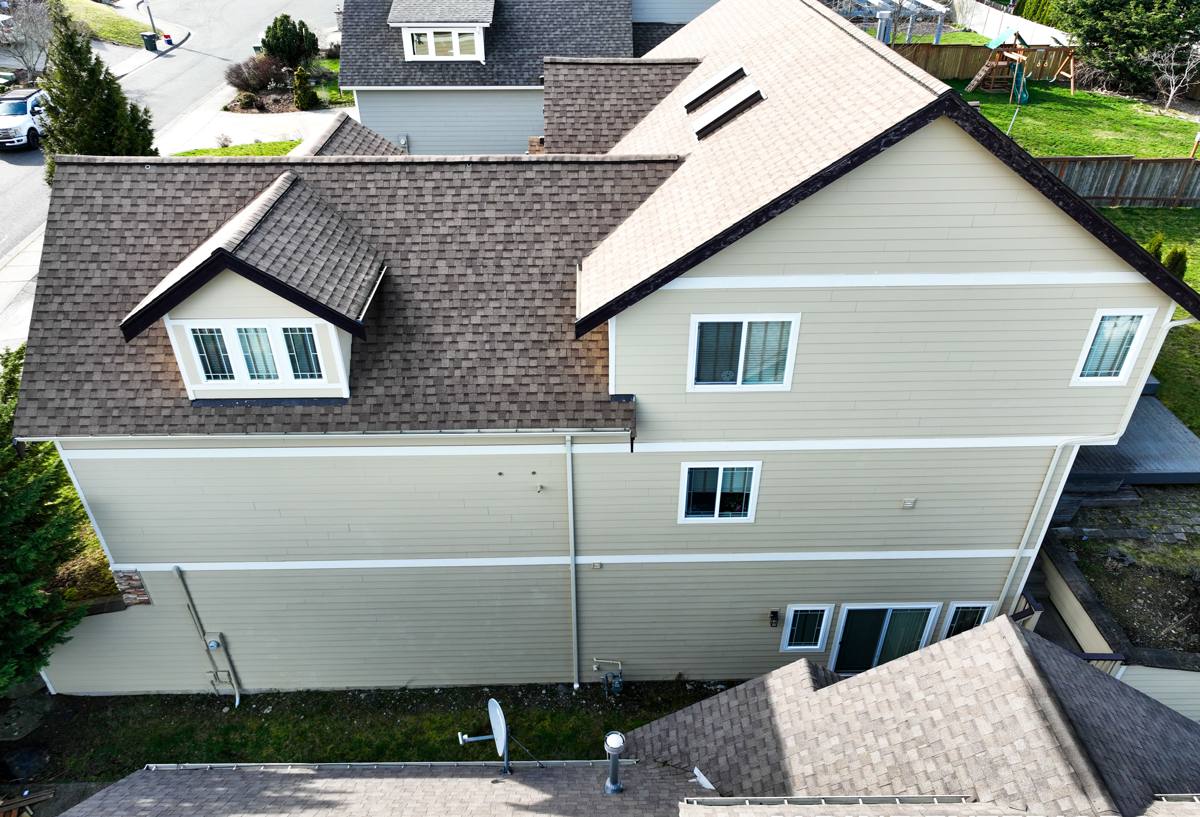
Signs a Roof Needs Replacement, Not Just Repair
Not every roof problem means a full replacement. But there's a point where patching individual leaks stops making financial sense and a full tear-off becomes the honest recommendation. Here's what we look for:
- Shingles that are cupping, curling, or losing granules across large sections rather than in one isolated spot
- Soft or spongy decking felt underfoot when walking the roof, indicating rot beneath the surface
- Daylight visible through the roof deck from inside the attic
- Repeated leaks in different locations after previous repairs
- Heavy, established moss growth that's lifted shingle edges rather than just sitting on the surface
- A roof original to a home built more than 20-25 years ago, especially one that's never had its ventilation upgraded
If a roof is showing one or two of these in a limited area, a targeted repair is often the right call and the honest one. When several of these show up together, or the roof is past its expected service life for this climate, replacement is usually the more cost-effective path — you stop paying for repeat repairs on a roof that's failing systemically.
What a Correct Roof Replacement Actually Involves
A roof replacement is more than stripping old shingles and nailing down new ones. Done correctly, it's a layered system, and skipping any layer is what leads to the early failures common on roofs built with the marine climate here as an afterthought.
Tear-Off and Deck Inspection
We remove the old roofing down to the deck rather than layering over existing material. This is the only way to actually see the condition of the plywood or plank decking underneath — soft spots, delamination, or rot from long-term moisture intrusion don't show up until the old layer is gone. Any damaged decking gets replaced before anything new goes down; installing new roofing over compromised decking just hides a problem that will resurface as a leak.
Underlayment
This is the waterproof layer between the decking and the visible roofing material, and given how much wind-driven rain this area sees, it's not a place to cut corners. Ice-and-water shield along eaves, valleys, and any roof penetration, paired with a quality synthetic underlayment across the rest of the field, gives the roof a real second line of defense if wind ever pushes water up under the shingles.
Flashing
Flashing around chimneys, skylights, vent stacks, and roof-to-wall transitions is where the majority of roof leaks actually originate — not in the open field of shingles. In a salt-air environment, the metal used for flashing matters: we use corrosion-resistant materials and proper step-and-counter-flashing techniques rather than relying on caulk or sealant alone, which breaks down faster here than it does inland.
Ventilation
Proper intake and exhaust ventilation keeps the attic space at a consistent temperature and moisture level. Without it, condensation builds up on the underside of the deck, which rots sheathing from the inside and also feeds the moss and algae growth on the outside. We check and correct ventilation as part of every replacement, not as an upsell.
Choosing a Roofing Material for This Climate
There isn't one universally "best" roofing material — the right choice depends on budget, the home's architecture, and how much ongoing maintenance a homeowner wants to take on. Here's an honest comparison of the options we most often discuss with Anacortes homeowners:
| Material | Moss & Moisture Resistance | Salt Air Durability | Typical Lifespan | Maintenance |
|---|---|---|---|---|
| Architectural asphalt shingle | Good, especially with zinc/copper strips at the ridge | Good with corrosion-resistant fasteners | 25-30 years | Periodic moss treatment on shaded slopes |
| Standing-seam metal | Excellent — sheds moss and debris well | Very good with the right coating and fastener spec | 40-50+ years | Low; occasional fastener/seam check |
| Cedar shake | Fair — needs active upkeep to resist moss and rot | Fair; can weather unevenly near salt air | 20-30 years with maintenance | Higher — regular treatment and inspection |
| Composite/synthetic shake | Good — resists moisture absorption better than wood | Good | 30-50 years | Low to moderate |
We don't push one material as universally superior — each has a legitimate place. Architectural shingles remain the most common choice because they balance upfront cost, appearance, and durability well for this climate. Metal roofing costs more initially but sheds moss and handles salt air with the least long-term maintenance, which matters to homeowners planning to stay put for decades. Cedar shake has real appeal architecturally, but it demands the most active maintenance to hold up against moss and moisture here — that's a trade-off worth being upfront about, not a knock on the product.
Our Roof Replacement Process
- On-site inspection and estimate — we walk the roof, check the attic, and assess decking and ventilation, not just the shingles.
- Written scope and material selection — you get a clear breakdown of what's being replaced, what materials are being used, and why.
- Protection of landscaping and property — tarps and ground protection go down before tear-off starts.
- Tear-off and deck inspection — old roofing removed, decking assessed and repaired as needed.
- Underlayment, flashing, and ventilation installed — the layers that actually determine how long the roof lasts.
- New roofing installed to manufacturer spec — including proper nailing pattern and exposure, which affects both wind resistance and warranty validity.
- Cleanup and magnetic sweep — site cleared of debris and stray fasteners.
- Final walkthrough — we go over the finished roof with you before calling the job done.
Cost Factors for an Anacortes Roof Replacement
Every roof is different, so we don't quote ballpark prices sight unseen — but these are the factors that most affect what a project costs:
| Factor | Why It Matters |
|---|---|
| Roof size and number of facets | More square footage and more valleys/hips mean more material and labor time |
| Roof pitch | Steeper roofs require more safety setup and slow down installation |
| Number of existing layers | Tear-off of multiple old layers adds labor and disposal cost |
| Decking condition | Rotted sheathing found during tear-off adds material and labor to replace |
| Material choice | Asphalt, metal, and shake carry different material costs and install labor |
| Access and site conditions | Tight lots, tall trees, or difficult staging affect equipment and time needed |
Why Hire a Crew That Already Works in Anacortes
A roofing crew that regularly works Anacortes and greater Skagit County has already seen how the local conditions play out over time — which slopes tend to hold moss, which flashing details fail first in wind-driven rain, and which fastener and coating choices actually hold up against salt air rather than just looking good on a spec sheet. That's not something you can fully learn from a manual; it comes from repeatedly seeing how roofs in this specific climate perform five, ten, and twenty years after installation.
There's also a practical side: a local crew understands Skagit County permitting requirements, is familiar with the area's typical roof and truss framing, and can respond quickly if a storm exposes a problem that needs immediate attention rather than a multi-week wait for an out-of-area company to schedule a return trip.
After the Job: Keeping a New Roof Performing
A correctly installed roof still benefits from basic upkeep, especially in this climate. A simple annual routine goes a long way:
- Clear debris and needles from valleys and around vent penetrations each fall
- Check gutters are flowing freely so water isn't backing up under the roof edge
- Watch shaded, north-facing slopes for early moss growth and address it before it establishes
- Have flashing and sealant points visually checked every year or two, particularly around chimneys and skylights
- Confirm attic ventilation isn't blocked by insulation or debris
If you're weighing a repair against a full replacement, or just want an honest read on where your roof currently stands, we're glad to take a look. Reach out for a free, no-pressure estimate using the form below.